
 By Sagoh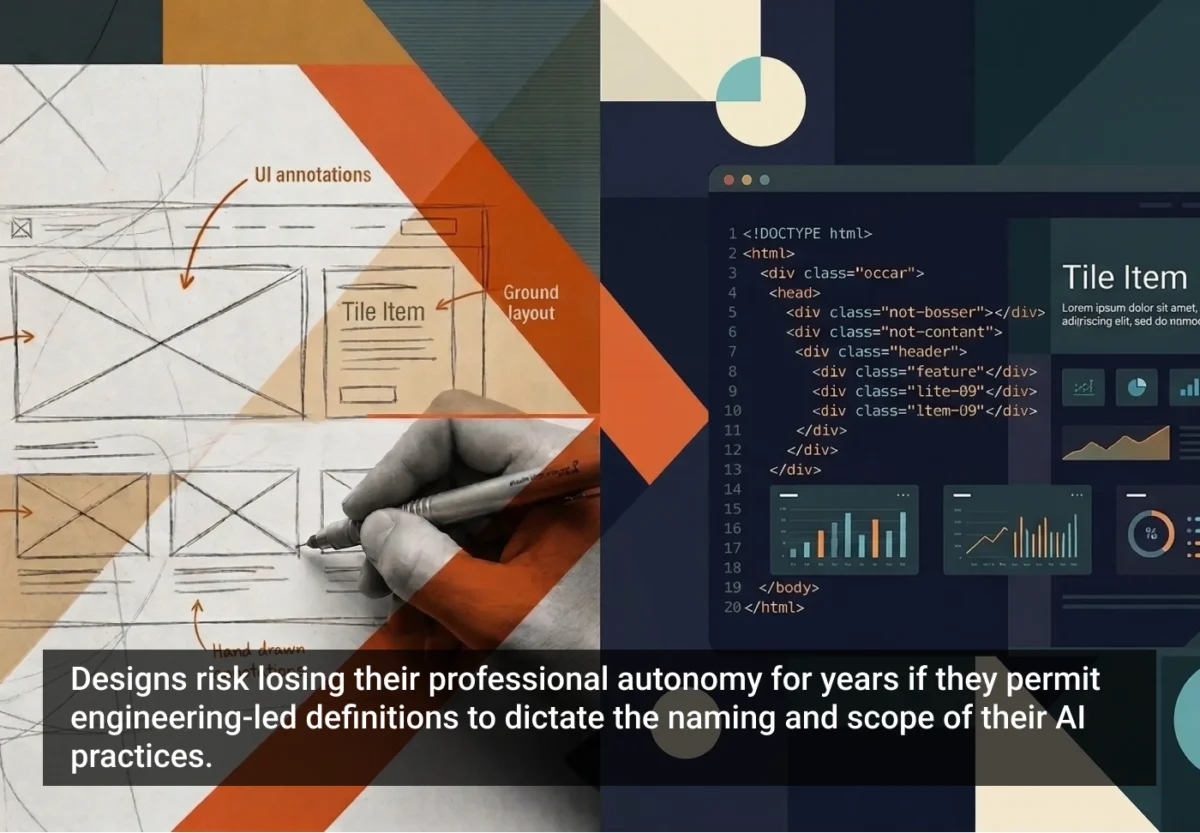
In the early months of 2025, a phrase emerged from the tech industry’s lexicon that captured the zeitgeist of generative AI adoption: "vibe coding." Coined by Andrej Karpathy, the term served as a shorthand for a specific, low-accountability workflow. It described a process where a developer or designer loosely outlines an objective, accepts the model’s output, and moves forward without a deep, granular understanding of the underlying mechanics.
It was, at the time, an accurate descriptor for a specific experimental behavior. However, as the term migrated from technical forums into the broader design community, it began to colonize spaces where it did not belong. Today, professional designers are finding their sophisticated, highly intentional workflows labeled as "vibe coding." For those who view design as a rigorous discipline of craft, judgment, and intent, this linguistic encroachment represents more than just a misnomer—it is a threat to how the profession is perceived, valued, and taught.
The Chronology of a Misunderstood Practice
The rapid adoption of AI tools has created a vacuum in professional terminology. When new technology disrupts a field, the language used to describe it often arrives from the industry that built the tools—in this case, engineering.
Engineering culture typically views the human role as supervisory or even passive: provide the prompt, verify the output, and iterate at the margins. When this vocabulary is applied to design, it carries implicit assumptions that the designer is merely a curator of machine-generated content.
However, a divide has been quietly forming within the design community. On one side are the "prompt-and-accept" users, whose work relies on the machine to drive the decisions. On the other side is a growing cohort of designers who treat AI as a subordinate tool, exerting authority over the process through curation, visual reference, and rigid constraint.
The danger is that "vibe coding" has become a catch-all term that obscures this divide. By failing to distinguish between passive generation and active, directed design, the industry risks devaluing the work of those who use AI not to replace their judgment, but to scale it.
The Anatomy of Directed Generation
To understand the shift, one must look at how the most intentional designers are currently utilizing AI. The process is defined by "directed generation," a methodology that centers on the designer’s authority.

The Role of Reference as Judgment
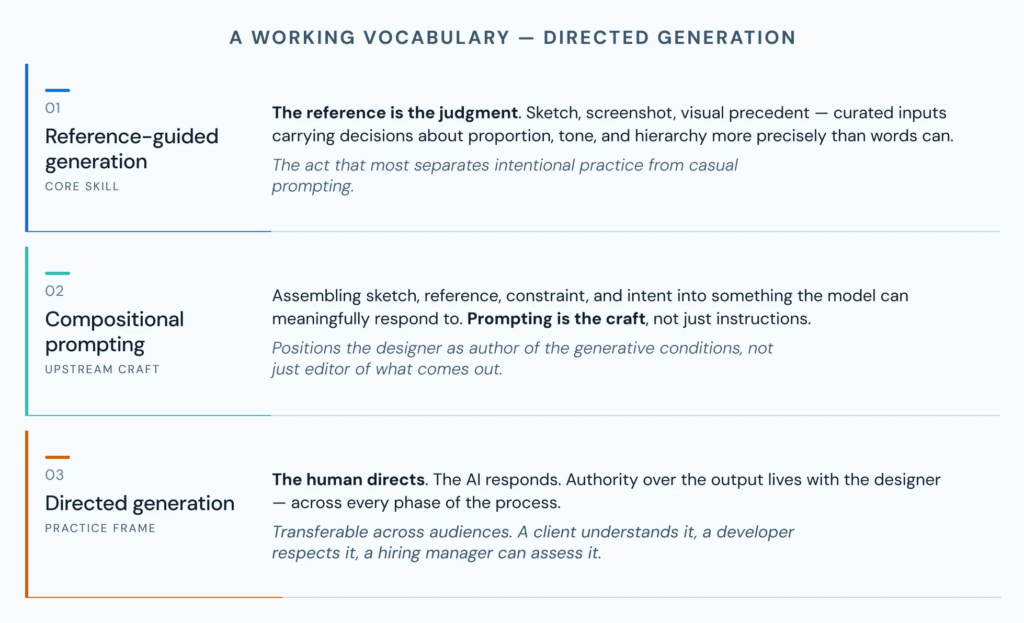
In this model, the process does not start with a text-based prompt, but with a "curated input." This might be a hand-drawn sketch, a specific screenshot, or a collage of visual precedents. This reference serves as the primary vessel for the designer’s intent. It encapsulates decisions regarding tone, proportion, hierarchy, and spatial relationships—nuances that are notoriously difficult to articulate through text-based prompts.
By providing a visual anchor, the designer forces the AI to respond to their judgment rather than the other way around. The tool is essentially being asked to interpret the designer’s "visual grammar," transforming abstract intent into high-fidelity output.
Moving Upstream: Design as a System
The most significant shift occurs when judgment is applied at the level of the pattern rather than the individual pixel. In the traditional, deterministic model, design systems are treated as static artifacts. They are defined, documented, and replicated, often at the cost of flexibility.
"Directed generation" breaks this cycle. When a machine is trained to understand a design pattern abstractly, it ceases to be a static component and becomes a set of behavioral relationships. The designer’s role, therefore, evolves from specifying every instance of a button or card to defining the conditions under which "good" instances reliably emerge. This is, in effect, a transition toward non-deterministic design. The output is not fully predicted, but the quality of the primitives—the underlying rules and constraints—ensures that the results remain coherent across various platforms and contexts.
Supporting Data: The Efficiency of Non-Deterministic Systems
The transition from "vibe coding" to "directed generation" is supported by a growing realization that static documentation is insufficient for modern digital products. According to recent industry observations:
- Scalability: Systems designed via directed generation can adapt to screen sizes and user contexts that were never explicitly specified during the initial design phase.
- Reduced Friction: By focusing on the "grammar" of a design system, teams can reduce the time spent on repetitive documentation, shifting that energy toward higher-order strategic thinking.
- Agentic Delivery: We are moving toward a future of "agentic delivery," where systems do not merely output static code, but act as autonomous partners that can propagate design intent across vast, multi-surface ecosystems.
Professional Implications: The Cost of Language
George Orwell famously noted that the "slovenliness of language makes it easier to have foolish thoughts." The reverse is equally true: precise language makes precise thinking possible. When designers accept imprecise labels, they surrender their ability to define their value.
The Portfolio Review and Client Pitch
The stakes are high during critical professional interactions. Whether in a portfolio review, a client kickoff, or a team strategy session, the ability to articulate one’s process with authority is paramount. If a designer describes their work as "vibe coding," they are framing themselves as an operator of a machine. If they describe it as "reference-guided, directed generation," they are framing themselves as the architect of a system.
Learning from the UX Transition
The history of User Experience (UX) design serves as a cautionary tale. When UX first emerged as a distinct discipline, the practitioners who defined their work—coining terms like "information architecture" and "interaction design"—secured the field’s value for a generation. Those who allowed adjacent fields to define them struggled to gain organizational respect.
AI-assisted design is at a similar inflection point. The technology is already normalized; what remains to be settled is the status of the practitioner. If the vocabulary is left to engineers or tech journalists, the designer’s role will be reduced to that of a passive "prompter."
Toward a New Taxonomy
It is time to move beyond the shorthand of "vibe coding." While that term may accurately describe low-stakes, experimental work, it is insufficient for professional, scalable design. Below are several alternative handles for the work, intended not as a rigid taxonomy, but as starting points for professional discourse:
- Directed Generation: Highlights the designer’s role in constraining and steering the AI output.
- Reference-Guided Practice: Emphasizes the use of curated visual inputs to anchor the creative process.
- Compositional Prompting: Focuses on the skill of structuring inputs to achieve specific, high-fidelity results.
- Systematic Generative Design: Acknowledges the move toward generating design systems rather than static documentation.
Conclusion: Owning the Description
The objection is often raised: "Does it really matter what we call it, as long as the work gets done?"
It matters because design is not just the output; it is the intent behind the output. A client may see a beautiful interface, but they are hiring a designer to understand the why and the how of that interface. When we use sloppy language, we erode the perceived complexity and necessity of our own work.
There is no need to abandon the tools that make our lives easier, nor is there a need to replace all deterministic design with generative methods. A mature design practice is a hybrid one, knowing exactly when to reach for a fixed component and when to leverage the power of directed generation.
By reclaiming the vocabulary, designers can ensure that as AI becomes more integrated into our workflows, the profession does not become less human, but more deliberate. We must define the practice before the practice defines us. The future of design belongs to those who do not just accept the "vibe," but who possess the agency to shape the system.
 Ammar Sabilarrohman
  Neng Nana