
 By Neng Nana
In the rapidly evolving landscape of digital product design, a linguistic skirmish is underway. It is a battle over the vocabulary used to describe how designers interact with artificial intelligence. At the heart of this conflict is the term “vibe coding”—a label that, while popularized by engineering circles to describe a loose, low-accountability approach to AI generation, has begun to colonize the professional lexicon of design.
Industry leaders are now pushing back, arguing that accepting this nomenclature is tantamount to ceding authorship of their own practice. As AI becomes a permanent fixture in the design stack, the distinction between “passive generation” and “directed generation” has become the defining fault line of the profession.
The Origins of “Vibe Coding” and the Risk of Imprecise Language
The term “vibe coding” gained significant traction in early 2025, championed by figures like Andrej Karpathy. In its original context, the term accurately described a specific behavior: providing a loose, high-level prompt to an AI model, accepting the output with minimal scrutiny, and moving forward without a deep understanding of the underlying mechanics. It was, and remains, a term for low-accountability output.
However, the term soon migrated from the realm of hobbyist experimentation into professional design studios. When designers allow their workflows—which are often highly structured, intentional, and iterative—to be described as “vibe coding,” they inadvertently strip their work of its inherent rigor.
The Orwellian Trap of Jargon
George Orwell famously observed that the slovenliness of language makes it easier to harbor foolish thoughts. In the professional world, the inverse is also true: precise language enables precise thinking. When a catch-all, reductive term like “vibe coding” colonizes an emerging practice, it doesn’t just misdescribe the work; it pre-shapes how the work is valued, hired, and understood by stakeholders, product managers, and clients.
If designers allow the engineering culture—which often views the human role as merely supervisory—to define the narrative, they risk being seen as “prompt engineers” rather than architects of experience.
The Great Divide: Authority in the Creative Process
The divide forming in the design industry is not about who has adopted AI tools—the vast majority of the industry has already done so. The divide is about where the authority resides within the creative process.
Two Modes of Operation
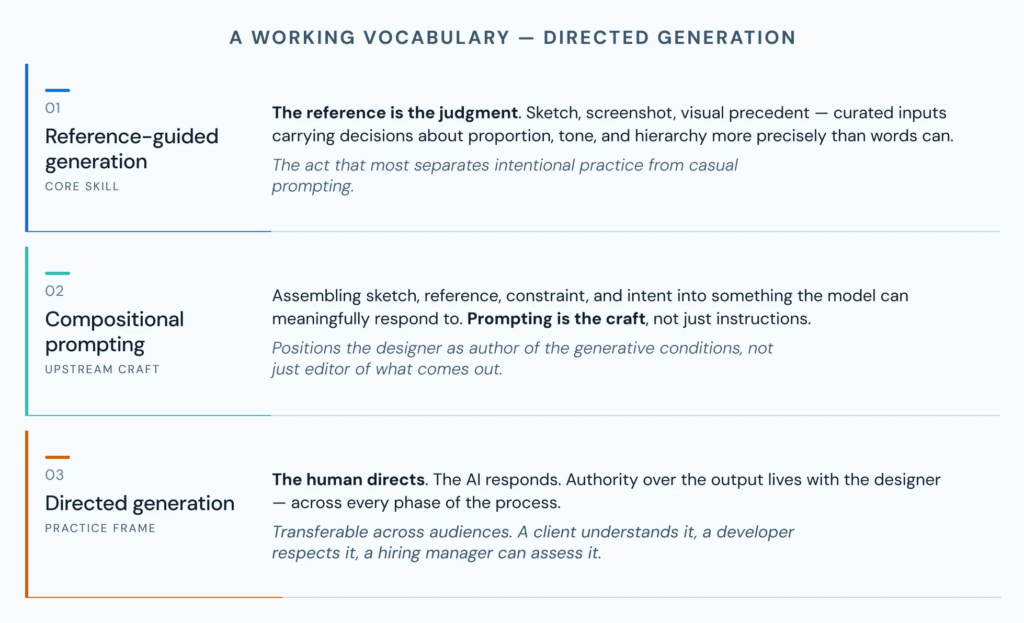
- Passive Generation: This is the realm of the "vibe coder." The prompt drives the decision-making process. The workflow follows a linear path: prompt, accept, adjust at the margins, and ship. The AI is the pilot; the human is the passenger.
- Directed Generation: This is the hallmark of the intentional designer. Here, judgment arrives first. The AI responds to the designer—often guardedly—serving as a high-fidelity execution engine for the designer’s intent.
In directed generation, the designer remains the author. They do not merely "ask" for a result; they provide a curated reference—a sketch, a screenshot, or a visual precedent—that carries inherent decisions about proportion, tone, and hierarchy. This is a level of precision that words alone cannot capture, and it represents a fundamental shift in how design systems are conceived and deployed.
Chronology: The Evolution of AI-Assisted Design
To understand why this inflection point is occurring now, one must look at the recent history of design tooling:
- Pre-2023 (The Manual Era): Design was defined by the manual creation of static artifacts. Consistency was achieved through rigid adherence to documented component libraries.
- 2023–2024 (The Adoption Phase): The introduction of generative AI tools saw an explosion of experimentation. Early adopters treated AI as a "magic button," leading to the emergence of terms like "vibe coding" to describe the unpredictable, "good enough" results.
- 2025 (The Maturity Inflection): As tools evolved, a subset of designers began moving away from passive prompting. They started integrating AI into their core workflows as a collaborator rather than a replacement.
- 2026 (The Current State): The industry now faces a bifurcation. As design systems scale, the limitations of "vibe coding" in production environments have become clear, leading to a push for "Directed Generation" and "Non-deterministic design" as professional standards.
Supporting Data: From Pixels to Patterns
The shift toward directed generation has profound implications for how design systems scale. Traditionally, design systems treat patterns as fixed, static artifacts. While this ensures consistency, it often kills flexibility.
Directed generation changes this constraint. When a machine understands a design pattern abstractly—interpreting rather than merely copying—the pattern behaves like a set of behavioral relationships. This allows the system to be molded across surfaces, devices, and contexts that the original designer may never have explicitly accounted for.
The Shift in Designer Metrics
- Traditional Metrics: Time-to-pixel, component count, adherence to style guides.
- Directed Generation Metrics: Quality of primitives, precision of references, rigor of constraints, and the reliability of the system’s output across non-deterministic environments.
By shifting the craft "upstream"—focusing on the quality of the input and the logic of the constraints—designers move from being assembly-line workers to being the authors of the grammar the system speaks.
Implications for the Future of the Profession
The implications of this shift are not merely academic; they are existential for the design profession.
The Rise of Agentic Delivery
We are moving toward a future of "agentic delivery," where systems do not just respond to prompts but carry design intent forward autonomously across scale. In this model, the designer’s role is to define the conditions under which "good" instances reliably emerge. This is not a failure of predictability, but the intentional design of a flexible, systemic output.
Professional Clarity as Currency
The "vibe coding" debate matters most during the moments that define a career: the portfolio review, the client kickoff, and the mentorship of junior designers.
- For the Client: Explaining a "directed generation" methodology establishes professional authority and justifies the value of the designer’s labor.
- For the Team: Providing a clear vocabulary for how to use AI—and how not to use it—prevents the erosion of craft.
History shows that when new design disciplines emerge (such as the birth of UX design), those who defined their own practice and articulated its value were the ones who shaped the industry for decades. Those who let adjacent fields define them were often left to recover lost ground.
Conclusion: Own the Practice, Own the Description
The professional community is currently in a "late-early" stage of AI integration. The technology is normalized, but the methodology is still being codified. If designers do not name this practice, the definitions will be imposed upon them by engineering teams, venture capitalists, or algorithmically driven narratives that prioritize speed over quality.
Whether you choose to call it Directed Generation, Reference-Guided Practice, or Compositional Prompting, the goal is the same: to reclaim the agency of the designer.
"Vibe coding" is a useful term for a specific, low-accountability context, but it is not a description of design leadership. As the tools become more powerful, the need for human judgment—for the "eye" that understands why a design works—becomes more critical than ever. The designers who succeed in this new era will be those who treat AI as an instrument of their intent, rather than the author of their work. They will define the practice, and in doing so, they will define the future of design.
 Ammar Sabilarrohman
  Sagoh
Sagoh 