
 By Layla Zulfa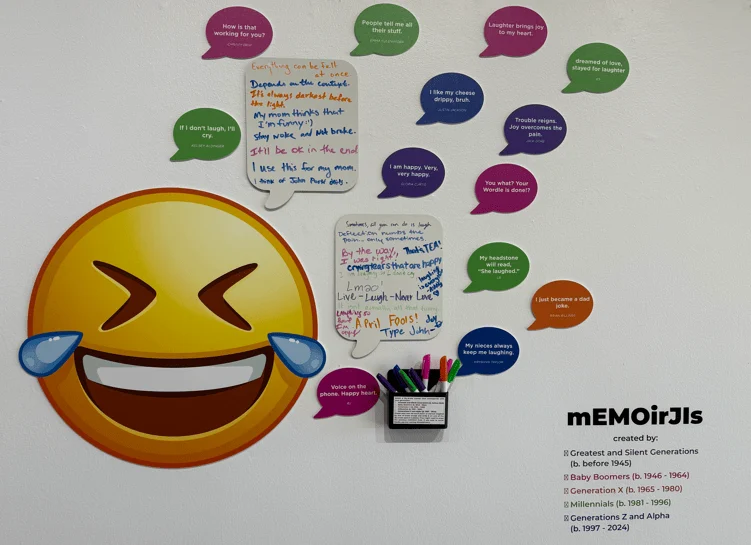
By Callie Dean
Director of Applied Research, Institute for Nonprofit Administration and Research at LSU Shreveport
Main Facts: The Universal yet Fragmented Language of Emojis
Emojis are deeply woven into the fabric of modern communication. They serve as a form of visual shorthand, acting as digital micro-expressions designed to infuse plain text messages and social media posts with tone, inflection, and emotion. Yet, beneath their ubiquitous yellow faces and universally recognized symbols lies a fascinating paradox: how much of this icon-based language is truly universal? To what extent are these symbols subject to generational fragmentation, and how much meaning is derived purely from personal interpretation?
These questions formed the foundation of “mEMOirJIs,” an interactive data-art project launched in the fall of 2024. The project sought to interrogate the growing linguistic and cultural disconnect surrounding emoji usage. While quantitative metrics and surveys have previously mapped out which symbols cause the most confusion, “mEMOirJIs” took a qualitative, community-driven approach, blending data visualization with the literary arts to uncover the human stories behind our digital hieroglyphs.
The initiative demonstrates that emojis are not merely static digital graphics; they are dynamic canvases for personal expression, often revealing stark divides in how different generations perceive humor, stress, urgency, and irony.
Chronology: From Digital Newsfeeds to Gallery Walls
The path from a casual observation of internet trends to a fully realized museum installation unfolded across several distinct phases through late 2024 and early 2025.
Summer 2024: Spotting the Cultural Signals
The inspiration for “mEMOirJIs” emerged from a series of reports circulating through mainstream newsfeeds during the summer of 2024. A Preply survey identified the “most confusing emojis in every state,” singling out the Nail Polish emoji as the top contender for general bafflement. Concurrently, researchers at the University of Ottawa published findings revealing that older adults frequently struggled to interpret and appropriately apply certain digital icons. Adding fuel to the conversation, a CNN poll released around World Emoji Day highlighted a pronounced generational chasm—most notably, Gen Z’s penchant for deploying emojis with heavy irony compared to older demographics.

Fall 2024: Community Writing Workshops
Intrigued by these reports, author and researcher Callie Dean wondered if a data-art framework could visualize this communicative friction in an innovative way. Collaborating with local community groups and school networks throughout Shreveport, Louisiana, Dean spearheaded a series of interactive writing workshops.
Participants were introduced to six specific emojis whose facial expressions and designs had frequently been cited for their potential to cause miscommunication. Using these icons as creative prompts, attendees were challenged to write a six-word memoir, poem, or short story. Rooted in the legendary micro-prose format attributed to Ernest Hemingway (“For sale: baby shoes, never worn”), the six-word constraint was chosen specifically to lower the barrier to entry, ensuring that individuals who did not view themselves as traditional writers could easily participate.
Winter 2024 – Early 2025: The "Data is Poetry" Exhibition
Following the workshops, the collected data was curated for physical exhibition. The project found a home as part of a broader installation titled “Data is Poetry”—an exploration of the intersections between quantitative data collection and literary art—hosted at the Artspace Gallery in Shreveport, Louisiana. Over a two-month display period, the installation welcomed thousands of visitors, engaging them through a combination of static data visualization and live, interactive elements.
Supporting Data: Quantitative Findings Meet Qualitative Realities
To understand the architecture of the “mEMOirJIs” project, one must examine the intersection of quantitative emoji research and the qualitative narratives gathered during the Shreveport workshops.
The Landscape of Emoji Confusion
National and international studies preceding the project highlighted a clear demand for communicative clarity:
- The Preply Survey: Analyzed search trends and consumer habits to rank the most misunderstood emojis, placing the Nail Polish icon at the absolute top due to its shifting connotations between a fresh manicure, sass, and indifference.
- The University of Ottawa Study: Focused on older demographics, indicating that UI/UX designs and abstract emotional mappings often alienate older users who prefer literal interpretations of facial expressions.
- The CNN Generation Gap Poll: Illustrated how contextual shifts—such as Gen Z utilizing the Loudly Crying Face emoji to denote overwhelming joy or hysterical laughter rather than genuine grief—create cross-generational static.
The Six-Word Micro-Data
During the Shreveport workshops, the six-word constraint unlocked deeply personal, humorous, and contradictory interpretations of the selected emojis. Nowhere was this more evident than in the varying responses to the Melting Face and Loudly Crying Face emojis:

-
On the Melting Face Emoji:
- "Running late in July Louisiana heat." (Millennial)
- "Social anxiety finally consuming my soul." (Gen Z)
- "Melting away under endless tax forms." (Baby Boomer)
-
On the Loudly Crying Face Emoji:
- "I have never been so excited." (Gen Z respondent, demonstrating ironic enthusiasm)
- "Daycare dropoff: two sets of tears." (Millennial parent, capturing literal exhaustion)
- "Coping with cataracts? See a doctor." (Gen X respondent, leaning into literal medical interpretation)
These snippets proved that qualitative narratives capture emotional resonance in a way that standard multiple-choice surveys or usage statistics never could.
Official Responses and Installation Design
The physical realization of “mEMOirJIs” at Artspace Gallery was meticulously designed to engage visitors on multiple cognitive and emotional levels. The author established three core interactive goals for the exhibition:
- Accessibility: Use familiar, large-scale imagery to lower the barrier of entry and draw casual gallery-goers into deeper reflection.
- Representation: Showcase authentic, generational voices through curated micro-literature.
- Co-Creation: Allow ongoing audience participation to ensure the artwork remained living and breathing throughout its run.
Structural Composition of the Exhibit
To construct the visual centerpiece, Dean partnered with a local fabrication business to produce giant, high-resolution cutouts of selected emojis printed on 3 mm PVC (polyvinyl chloride) sheets. Space limitations and the desire for balanced generational representation led to the selection of four primary emojis for the physical display.
Surrounding each giant emoji were 12 to 17 curated memoirs printed on PVC speech bubbles, creating the optical illusion that the icons were literally "speaking" the thoughts of the participants. To maintain clarity, the memoirs were color-coded by generation.

Furthermore, the installation featured eight interactive dry-erase speech bubbles mounted on the gallery walls, complete with color-matched markers. Visitors were invited to step up and add their own generational perspectives directly to the piece.
Implications: Technology, Connection, and the Future of Visual Language
The “mEMOirJIs” project transcends local art exhibition; it serves as a microcosm for the broader communicative challenges of the digital age.
Bridging the Generational Divide
As digital natives and older generations increasingly share the same virtual spaces—from corporate Slack channels to family group chats—the semantic drift of emojis poses a genuine barrier to clarity. When a younger user deploys a skull emoji ($text💀$) to mean "that is hilarious" while an older user interprets it literally as mortality, the potential for humorous or distressing miscommunication escalates. Projects like “mEMOirJIs” bring these invisible semantic translations into the physical light, fostering empathy and amusement across generational lines.
Gallery Engagement and Organic Data Evolution
Reflecting on the two-month exhibition window, the installation demonstrated the robust appetite audiences have for participatory art. Gallery visitors consistently engaged with the dry-erase boards, though their behavior playfully subverted formal rules: participants routinely ignored the "six-word" constraint and actively avoided using the provided erasers, instead choosing to squeeze their thoughts into whatever negative space remained on the wall. This organic accumulation of text transformed the installation into a living, crowdsourced dataset of community sentiment.
Final Reflections
Ultimately, “mEMOirJIs” challenges us to rethink where data lives. Data is not confined to spreadsheets, algorithms, or government databases; it is embedded in the literature we write, the text messages we send at midnight, the smiles and tears we share offline, and yes, even in melting digital faces. By translating pixels into poetry, the project reminds us that despite our linguistic and generational differences, we are all searching for ways to make our inner worlds visible to one another.
 Muslim
  Ali Ikhwan
  Jia Lissa