
 By Dwi Wanna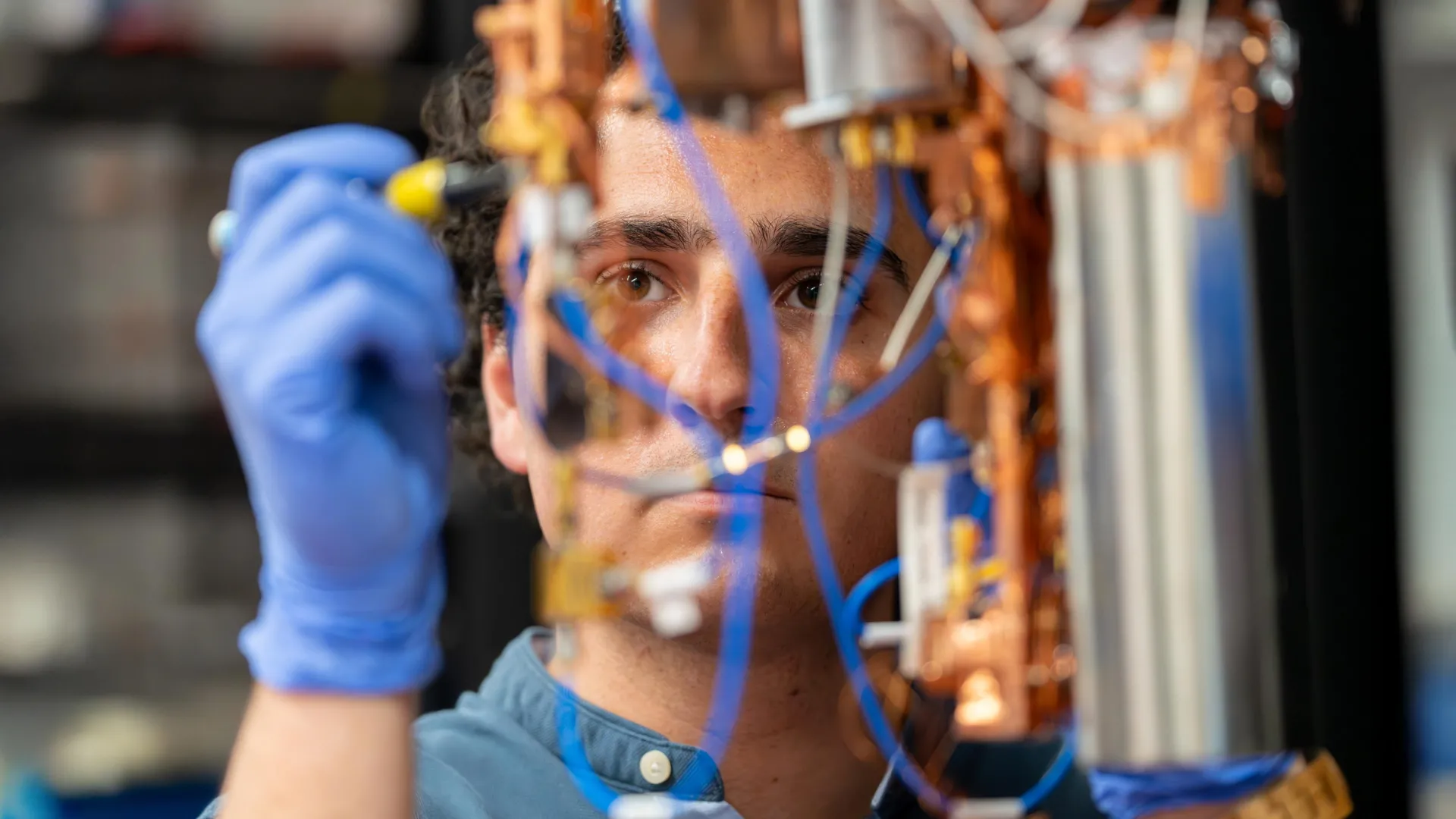
The race to build functional, large-scale quantum computers has long been hindered by a fundamental architectural bottleneck: how to connect physically separated qubits without losing the fragile state of entanglement. For decades, the industry standard has relied on active control—meticulous, high-speed measurements and post-selection processes that are as prone to failure as they are difficult to scale.
However, a breakthrough from the Institute of Science and Technology Austria (ISTA) is changing the narrative. A team led by Professor Johannes Fink and PhD student Alejandro Andrés-Juanes has successfully demonstrated a "fully autonomous" method for entangling distant qubits. By utilizing a "quantum bath" of correlated light, the researchers have realized a theoretical prediction that has sat dormant in the physics community for over 20 years. Published in Physical Review X, this discovery offers a potential roadmap for the next generation of modular quantum computing.
The Core Challenge: Why Entanglement is Fragile
At the heart of quantum computing lies entanglement—a phenomenon where the quantum states of two or more particles become linked, such that the state of one instantly influences the state of the other, regardless of distance. In classical physics, such a correlation is impossible, but in the quantum realm, it is the primary engine of computational power.
To build a modular quantum computer, one must connect these qubits across distances. Historically, two primary strategies have dominated:
- Active Photon Transfer: A single, actively controlled photon is sent from one qubit to another to establish a connection.
- Measurement-Based Matching: Each qubit emits a photon, and those photons are measured and "matched" to force entanglement.
The latter method was instrumental in the research honored by the 2022 Nobel Prize in Physics. Yet, these methods share a common weakness: they are non-deterministic. They rely on repeated measurements and "post-selection"—a process where only successful entanglement events are kept, and failed ones are discarded. This is inherently inefficient and requires a layer of complex, active electronic control that introduces noise and heat, both of which are enemies of quantum coherence.
A Twenty-Year Journey: From Theory to Laboratory
The concept of a "quantum bath" to facilitate synchronization was proposed in the early 2000s, but it remained largely theoretical for two decades. The difficulty lay in the extreme sensitivity of the experimental environment required to realize it.
Alejandro Andrés-Juanes and Professor Johannes Fink approached the problem by shifting the burden of entanglement away from the qubits themselves and onto their environment. Instead of forcing the qubits to communicate through a series of "handshakes," the team created a shared environment—a bath of correlated microwave photons—that naturally drives the qubits toward an entangled state.
"In this work, we aimed to overcome this mismatch between the readily available and the practically useful forms of entanglement," explains Andrés-Juanes. By stabilizing the entangled states remotely, the system removes the need for active feedback loops, creating a "self-healing" or "self-maintaining" quantum state.
How the Quantum Bath Works
To understand the innovation, one must distinguish between "continuous-variable" entanglement and "discrete-variable" entanglement. Continuous-variable systems, often likened to the movement of a pendulum, are relatively easy to produce but difficult to use for the digital-style logic required by quantum computers. Conversely, discrete-variable systems are essential for qubit-based computation but notoriously hard to maintain over distance.
The ISTA team’s quantum bath acts as a bridge. By flooding the system with a continuous stream of correlated microwave photons, the researchers create a ground state that inherently links the two qubits.
The Role of Microwave Photons
The researchers utilized microwave photons for this architecture. While optical photons are the standard for long-distance communication via fiber optics, microwave photons are the language of superconducting qubits. They are low-energy, highly manageable, and already serve as the backbone for existing quantum processor technology.
By coupling the qubits to a shared source of these microwave photons, the environment—or the "bath"—becomes the architect of the connection. "It creates a new ground state through a continuous stream of correlated photons," says Fink. "This way, the entangled qubit state is stabilized, even beyond the qubits’ own lifetime, and remains always available as a resource for further quantum processing."
Supporting Data: Validating the Invisible
Proving that two qubits are entangled is a daunting task, primarily because the act of measurement usually destroys the very state one intends to measure. To overcome this, the ISTA team employed quantum tomography.
Quantum tomography is the process of reconstructing the state of a quantum system by performing a vast number of measurements on identical copies of that system. Since qubits exist in a superposition of states (simultaneously 0 and 1), the researchers had to work with extreme speed. They conducted measurements lasting between 20 and 80 nanoseconds—a timeframe so short that it captures the state of the qubits before decoherence (the loss of quantum information) can set in.
The data gathered from these tomographic slices confirmed that the quantum bath was successfully synchronizing the qubits. While the current efficiency stands at approximately 10% of the bath’s available entanglement, the researchers view this as a successful proof-of-concept for an architecture that is significantly easier to scale than current measurement-based methods.
Implications for Future Quantum Networks
The implications of this experiment extend far beyond the laboratory at ISTA. As the quantum computing industry shifts toward modular architectures—where smaller, stable processors are networked together to form a larger, more powerful computer—the need for autonomous, low-overhead entanglement becomes critical.
1. Scaling Through Modularity
Current quantum processors are limited by the number of qubits that can be placed on a single chip without causing crosstalk or thermal interference. By mastering the ability to link separate modules autonomously, researchers can theoretically build "quantum clusters" that operate as a single, unified machine.
2. Fault-Tolerant Operation
One of the major hurdles to quantum supremacy is error correction. If a system is constantly being measured and reset (as in active control methods), the time spent on error correction and management eats into the actual computational time. An autonomous system that stabilizes itself allows for higher duty cycles and, eventually, more robust, fault-tolerant operation.
3. Insights into Environmental Engineering
The experiment also sheds light on why this idea was so difficult to implement. The team found that the idealized conditions of the original 20-year-old theory did not account for the messy, real-world interactions that occur in superconducting circuits. "Our experiments helped us reveal several factors that may have prevented scientists from designing a functional quantum bath," says Fink. These insights will be invaluable for future experimentalists looking to refine the technique.
Official Perspectives and Future Research
Professor Johannes Fink’s group at ISTA is already looking toward the next phase of this research. While the current prototype relies on microwave photons, the team is actively investigating how to translate these findings to optical photons.
Optical photons are the "gold standard" for long-distance networking, as they can travel through fiber optic cables with minimal signal loss. If the team can successfully bridge the gap between their microwave-based quantum bath and optical photon communication, it could lead to the development of a "Quantum Internet"—a network of distributed quantum computers capable of unprecedented calculation and secure communication.
"We present a relatively simple method that could be scaled up to synchronize multiple distant qubits," notes Andrés-Juanes. While the current 10% efficiency rate suggests there is still room for optimization, the transition from a theoretical ideal to a functional, autonomous experimental prototype marks a pivotal milestone.
The ISTA team’s success serves as a reminder that the path to a quantum future is not just about raw power or the number of qubits; it is about the elegant management of the environment in which those qubits live. By letting the "bath" do the work, the researchers have moved the industry one step closer to making the quantum computer a reliable, practical reality rather than a fragile laboratory curiosity. As research continues, the integration of autonomous stabilization into standard quantum architecture may well become the foundation upon which the next era of information technology is built.
 rifanmuazin
  Ammar Sabilarrohman
  Nana Muazin