
 By Suro Senen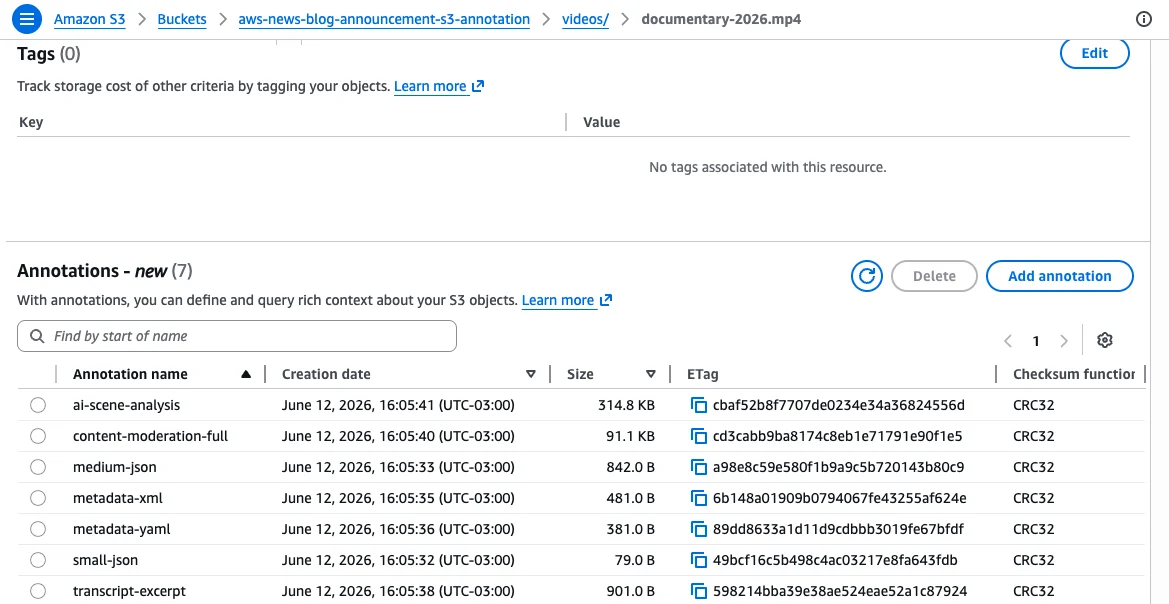
In a significant advancement for cloud architecture and artificial intelligence integration, Amazon Web Services (AWS) has unveiled a powerful new capability for its flagship object storage service: Amazon S3 Annotations. This feature allows organizations to attach rich, large-scale, and mutable business context directly to S3 objects, effectively bridging the gap between raw data storage and the structured, queryable metadata required for modern AI-driven workflows.
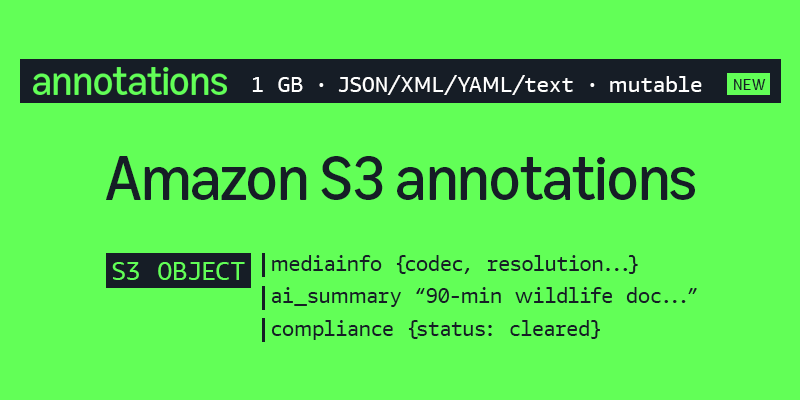
As enterprises increasingly rely on autonomous agents to process petabytes of information, the limitations of traditional metadata—often constrained by size or immutability—have become a bottleneck. By enabling up to 1,000 named annotations per object, each reaching up to 1 MB in size, AWS is fundamentally shifting how metadata is handled in the cloud, allowing for a total of 1 GB of context per object.
Main Facts: A New Era for Object Metadata
The introduction of S3 Annotations addresses a long-standing challenge in data management: how to keep rich, evolving context attached to data without relying on external databases or "sidecar" files that are prone to synchronization errors.
Key Technical Specifications:
- Scale: Support for 1,000 named annotations per object.
- Capacity: Each annotation can be up to 1 MB, allowing for up to 1 GB of total context per object.
- Flexibility: Supports multiple formats, including JSON, XML, YAML, and plain text.
- Mutablity: Unlike traditional user-defined metadata or object tags, annotations can be updated or deleted at any time without the need to re-write the underlying object.
- Portability: Annotations move automatically with the object during operations such as replication, copying, or cross-region transfers.
By integrating these annotations with S3 Metadata tables, users can leverage Amazon Athena to perform complex, high-performance analytics across their entire object library. This means that instead of merely storing files, an S3 bucket becomes a searchable, intelligent repository where context is native to the storage layer.
Chronology: The Evolution of Metadata in S3
The journey to S3 Annotations is the result of years of refinement in how AWS handles object-level information. To understand the significance of this launch, one must look at the progression of S3’s metadata capabilities:
- The Foundational Era (System Metadata): Since its inception, S3 provided system-defined metadata, capturing immutable properties like object size, storage class, and timestamps. While essential for basic operations, it offered zero flexibility for business-specific information.
- The Operational Era (Object Tags): Recognizing the need for organizational control, AWS introduced object tagging. This allowed users to apply key-value pairs for lifecycle management, access control, and cost allocation. However, tags were limited in size (128/256 characters) and count (10), making them unsuitable for complex data enrichment.
- The User-Defined Era (Metadata Headers): AWS allowed for custom metadata headers at the time of object creation. These were limited to 2 KB and were immutable; once set, they could not be changed without re-uploading the object.
- The AI-Ready Era (S3 Annotations): Today, with the rise of Generative AI, the requirement for "living" metadata—data that grows, updates, and is queried by autonomous agents—has arrived. Annotations represent the first time AWS has provided a high-capacity, mutable, and queryable metadata layer that exists in direct parity with the object itself.
Supporting Data: Why Current Methods Fall Short
The shift to Annotations is driven by the sheer complexity of modern data pipelines. Many enterprises currently manage metadata in separate SQL or NoSQL databases. This architectural pattern, while functional, creates a "source of truth" synchronization nightmare. If an object is deleted in S3, the database entry often remains (a "ghost" record). If an object is moved, the pointer in the database must be updated.
Comparison Matrix: Metadata Capabilities
| Capability | Max Size | Mutable? | Best Use Case |
|---|---|---|---|
| System-defined | Fixed | No | Basic file properties |
| User-defined | 2 KB | No | Small, static labels |
| Object Tags | 10 tags | Yes | Access & Lifecycle |
| Annotations | 1 GB (1,000 x 1 MB) | Yes | Rich business logic & AI context |
By centralizing this context within the S3 service, AWS reduces the "infrastructure tax" of maintaining auxiliary metadata systems. Furthermore, because annotations are part of the S3 Metadata tables, they are automatically indexed, removing the need for customers to build custom extract-transform-load (ETL) pipelines to move data from S3 into an analytics engine like Amazon Athena.
Implications for Industry and AI Agents
The most profound implication of S3 Annotations is the enablement of truly autonomous agentic workflows.

Enabling AI Discovery
Modern AI agents, such as those built on Amazon SageMaker or connected via the S3 Tables MCP (Model Context Protocol) server, can now "see" the context of an object before they even open the file. For example, an AI agent searching for "high-resolution video files with specific technical codecs" no longer needs to download or peek into the binary data of thousands of files. Instead, it queries the annotation table—a process that is significantly faster and more cost-effective.
Cross-Industry Utility
- Media and Entertainment: A production studio can attach JSON-formatted technical specs (codec, resolution, frame rate) alongside text-based AI summaries of the content. As the video is edited, the metadata evolves, keeping the library current.
- Healthcare and Life Sciences: Genomic datasets can have annotations containing patient-anonymized metadata or research study tags that are updated as the research progresses, all while maintaining strict compliance by keeping the data in one place.
- Financial Services: Compliance teams can append regulatory tags or audit logs directly to documents, ensuring that every object has an immutable, traceable history of its regulatory status, even as that status changes over time.
Official Perspective and Implementation
According to AWS, the goal is to reduce the friction associated with "data gravity." By allowing metadata to travel with the data—and by making it queryable at the petabyte scale—AWS is encouraging developers to stop treating storage as a "dumping ground" and start treating it as an active participant in the computing stack.
Getting Started: A Developer’s Workflow
Implementation is designed to be seamless for those already familiar with the AWS CLI or SDKs. The process involves defining an annotation via PutObjectAnnotation, which can be done post-upload for existing objects.
Example: Attaching technical metadata to a media asset:
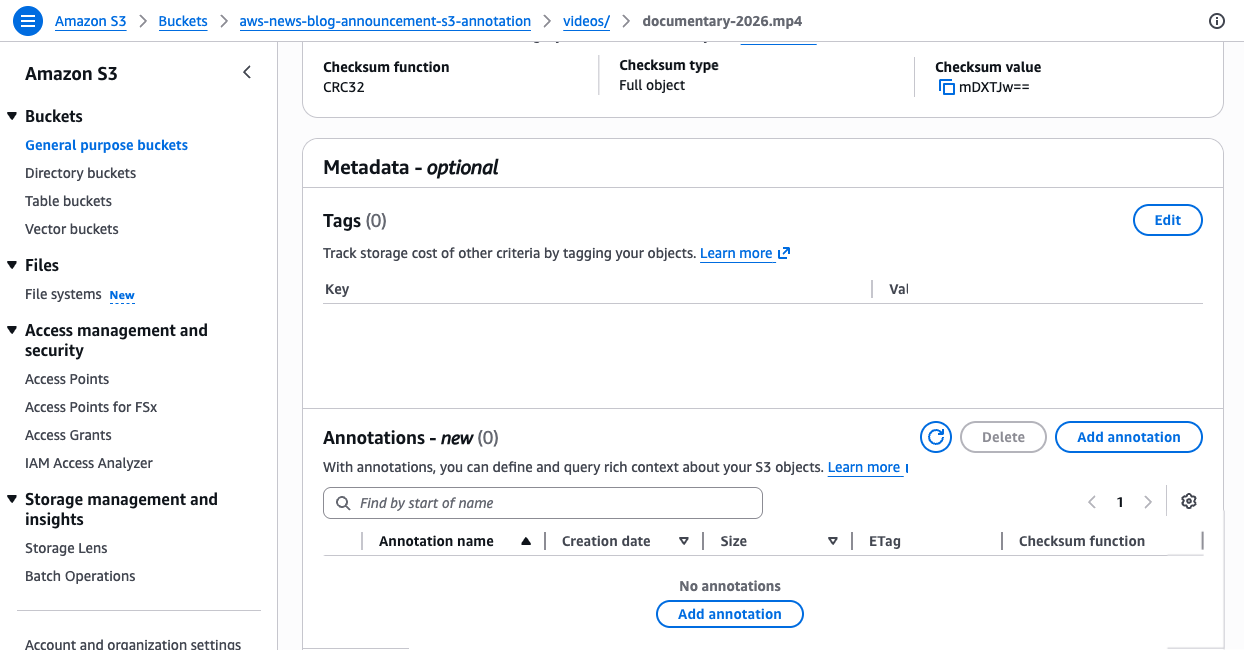
aws s3api put-object-annotation
  --bucket my-media-bucket
  --key videos/documentary-2026.mp4
  --annotation-name mediainfo
  --annotation-payload ./mediainfo.json
Once the annotation is attached, it is immediately available for retrieval. If the bucket has enabled the AnnotationTableConfiguration, the system automatically syncs this data into an Apache Iceberg table. This allows developers to use SQL-like queries to filter their entire object store:
SELECT DISTINCT bucket, object_key
FROM "s3tablescatalog/aws-s3"."b_my_media_bucket"."annotation"
WHERE name = 'mediainfo'
AND CAST(json_extract_scalar(text_value, '$.audio_tracks') AS INTEGER) > 8
Future Outlook: A New Standard for Object Storage
The launch of S3 Annotations represents a strategic pivot for Amazon. As the world moves toward a future defined by AI-driven automation, the "dumb storage" model of the early cloud is becoming obsolete.
By allowing objects to hold their own context, AWS is not only simplifying the developer experience but is also lowering the barrier to entry for building complex, data-intensive applications. As enterprises continue to grapple with the challenge of organizing unstructured data, S3 Annotations will likely become the industry standard for how data is described, discovered, and utilized.
With this release, AWS has effectively turned the S3 bucket into a self-describing, intelligent file system, marking a watershed moment in the evolution of cloud storage. Organizations that adopt these capabilities early will find themselves with a significant advantage in managing the complexities of the data-driven future.
 Neng Nana
  Lina Hope