
 By Pevita Pearce
In the modern digital economy, the infrastructure of shipping can be the difference between a thriving small business and one struggling with razor-thin margins. As online merchants navigate the complex waters of order fulfillment, two names frequently surface: Shopify and Pirate Ship. While they are often discussed as competitors, they occupy fundamentally different niches within the ecommerce ecosystem.
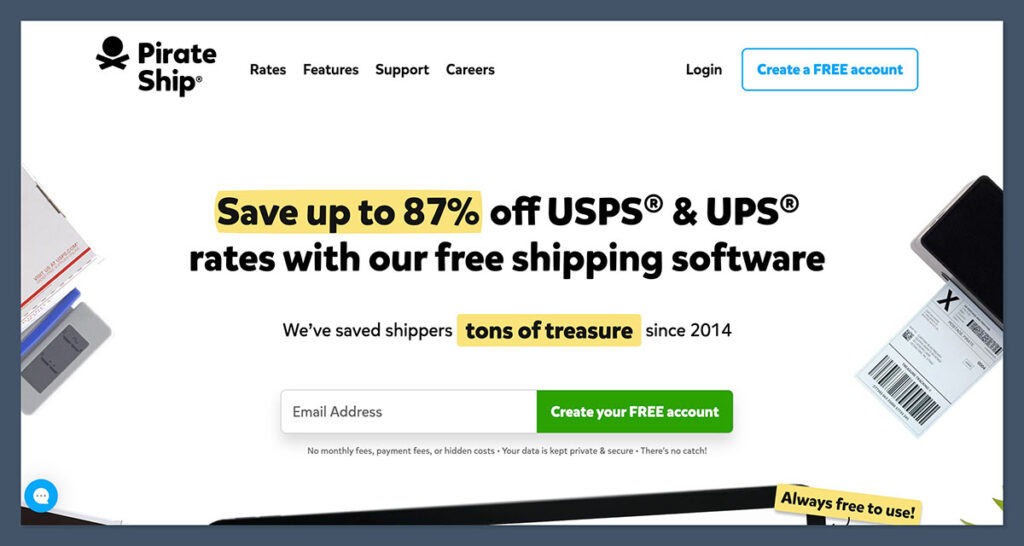
Shopify is the command center of your online business—a robust, all-in-one platform designed to build, manage, and scale a digital storefront. Pirate Ship, conversely, is a specialized logistics utility, a lean, free-to-use software engine designed to drastically reduce the cost of purchasing postage labels for USPS and UPS.
Understanding the relationship between these two tools is not about choosing one over the other; it is about building a professional-grade stack that maximizes store functionality while minimizing overhead.
The Core Distinction: Architecture vs. Utility
To understand why these platforms are frequently compared, one must first understand their primary objectives.
Shopify is an enterprise-grade ecommerce platform. It provides the storefront, the product database, the secure checkout, and the payment processing infrastructure. Shipping is only one of the many services Shopify offers, provided through its "Shopify Shipping" module. It is designed to be the "all-in-one" solution where a merchant lives and breathes their business.
Pirate Ship is a specialized logistics platform. It is, by definition, a "postage counter." It does not provide a website, a shopping cart, or a customer-facing portal. Instead, it aggregates high-volume shipping discounts from major carriers—specifically USPS and UPS—and offers them to merchants of all sizes.
A Chronology of Integration
Historically, merchants had to manually export CSV files from their shopping carts and upload them to third-party shipping software. As the ecommerce boom of the 2020s accelerated, the demand for seamless interoperability grew.

Pirate Ship recognized this gap and developed a deep integration with the Shopify API. This allowed for a "set and forget" workflow:
- The Order: A customer completes a purchase on your Shopify site.
- The Sync: Pirate Ship automatically pulls the order details, including customer address and package weight/dimensions.
- The Purchase: The merchant buys the discounted label within the Pirate Ship interface.
- The Completion: Pirate Ship pushes the tracking number back to Shopify, triggers an "Order Fulfilled" email to the customer, and closes the loop.
Supporting Data: Why Costs Diverge
When evaluating shipping expenses, merchants must look beyond the monthly subscription fee.
The Cost of Convenience (Shopify Shipping)
Shopify charges a monthly subscription (starting at $29/mo annually) which includes access to its internal shipping dashboard. This is highly convenient for beginners. You never have to leave the Shopify admin panel to print a label. However, while Shopify offers competitive rates compared to retail counter prices, they are often slightly higher than the aggressive discounts negotiated by high-volume third-party aggregators like Pirate Ship.
The Power of Volume (Pirate Ship)
Pirate Ship operates on a unique financial model. It does not charge a subscription fee. It generates revenue through the sheer volume of labels it facilitates for carriers. Because it focuses exclusively on logistics, it offers specialized tiers:
- USPS Priority Mail Cubic: This pricing tier is based on the size of the box rather than weight, which can save merchants up to 80% on shipping heavy, small items.
- UPS Ground Saver: A highly discounted service for non-urgent shipments that can undercut standard rates significantly.
Data Comparison Table: Shipping Features
| Feature | Shopify Shipping | Pirate Ship |
|---|---|---|
| Monthly Subscription | $29 – $2,300+ | $0 |
| USPS Cubic Pricing | Limited | Extensive |
| UPS Deep Discounts | Yes | Yes (often higher tier) |
| Batch Printing | Basic | Advanced/Unlimited |
| Checkout Rates | Real-time (on higher plans) | N/A |
| FedEx/DHL | Supported | No |
Official Stance and Philosophy
From an organizational perspective, the "rivalry" is a misunderstanding of the market. Shopify’s internal documentation encourages the use of third-party apps to fill feature gaps. Their philosophy is to provide a "platform" where other developers can build specialized tools.
Pirate Ship, on the other hand, maintains a brand identity centered on simplicity and user experience. Their "pirate-themed" support team and intuitive interface are designed to remove the friction from what is arguably the most tedious part of running an online store: shipping logistics. They do not aspire to be an ecommerce host because that would dilute their core value proposition: being the fastest, cheapest way to move a package.

Implications for Your Business
Choosing between these tools has profound implications for your operational workflow and your bottom line.
Scenario A: The Lean Startup
If you are a solo entrepreneur shipping 5–10 packages a week, the time cost of integrating a third-party app may outweigh the dollar savings. In this case, Shopify’s built-in shipping tools are sufficient. The convenience of keeping all data in one place justifies the slightly higher per-label cost.
Scenario B: The Scaling Brand
As your volume crosses the threshold of 50+ shipments per week, shipping costs begin to impact your net margins significantly. At this point, the integration of Pirate Ship becomes a strategic imperative. The ability to batch-print 100 labels in seconds, combined with the deeper USPS Cubic discounts, can result in thousands of dollars in annual savings.
Scenario C: The Multi-Channel Seller
If you sell on Shopify, but also on platforms like Etsy, eBay, or through social media, Shopify Shipping cannot track your non-Shopify orders. Pirate Ship acts as a universal hub, pulling orders from all your sales channels into one dashboard, effectively standardizing your shipping process across your entire business.
Frequently Asked Questions (FAQ)
Is Pirate Ship really free?
Yes. There are no hidden subscription fees, no "premium" tiers, and no monthly minimums. The company is subsidized by the carriers, meaning you get access to commercial shipping rates without the volume requirements normally demanded by UPS or USPS.
Can I use both at the same time?
Absolutely. Most successful Shopify merchants use Shopify to run their store and Pirate Ship as an "app" to handle fulfillment. It is the gold standard for mid-sized ecommerce operations.
Does Pirate Ship work for international shipping?
Yes, it handles international labels and automatically generates the necessary customs forms. However, it is restricted to shipments originating from the United States.
What is the biggest drawback of using Pirate Ship?
The main drawback is that it is a "post-sale" tool. It cannot calculate shipping rates for your customers during the checkout process on your website. If you require real-time, carrier-calculated rates at checkout, you will still need to configure Shopify’s native shipping settings to show customers their options, even if you fulfill those labels via Pirate Ship later.
Final Verdict: The Strategic Synergy
The debate of "Shopify vs. Pirate Ship" is best resolved by viewing them as complementary rather than conflicting.
Shopify is your engine. It handles the heavy lifting of sales, branding, security, and customer management. You cannot replace this with a shipping tool.
Pirate Ship is your accelerator. It is a specialized, low-cost tool designed to optimize the final step of the customer journey.
For the vast majority of US-based merchants, the optimal path is to build your business on the foundation of Shopify and outsource your shipping logistics to the specialized efficiency of Pirate Ship. By doing so, you maintain the robust ecosystem of a professional storefront while ensuring your overhead remains as lean as possible. In an era where every cent of profit counts, failing to leverage the specific strengths of both platforms is a missed opportunity for growth.
 Dwi Wanna
  Lina Irawan
  Basiran