
 By Laily UPN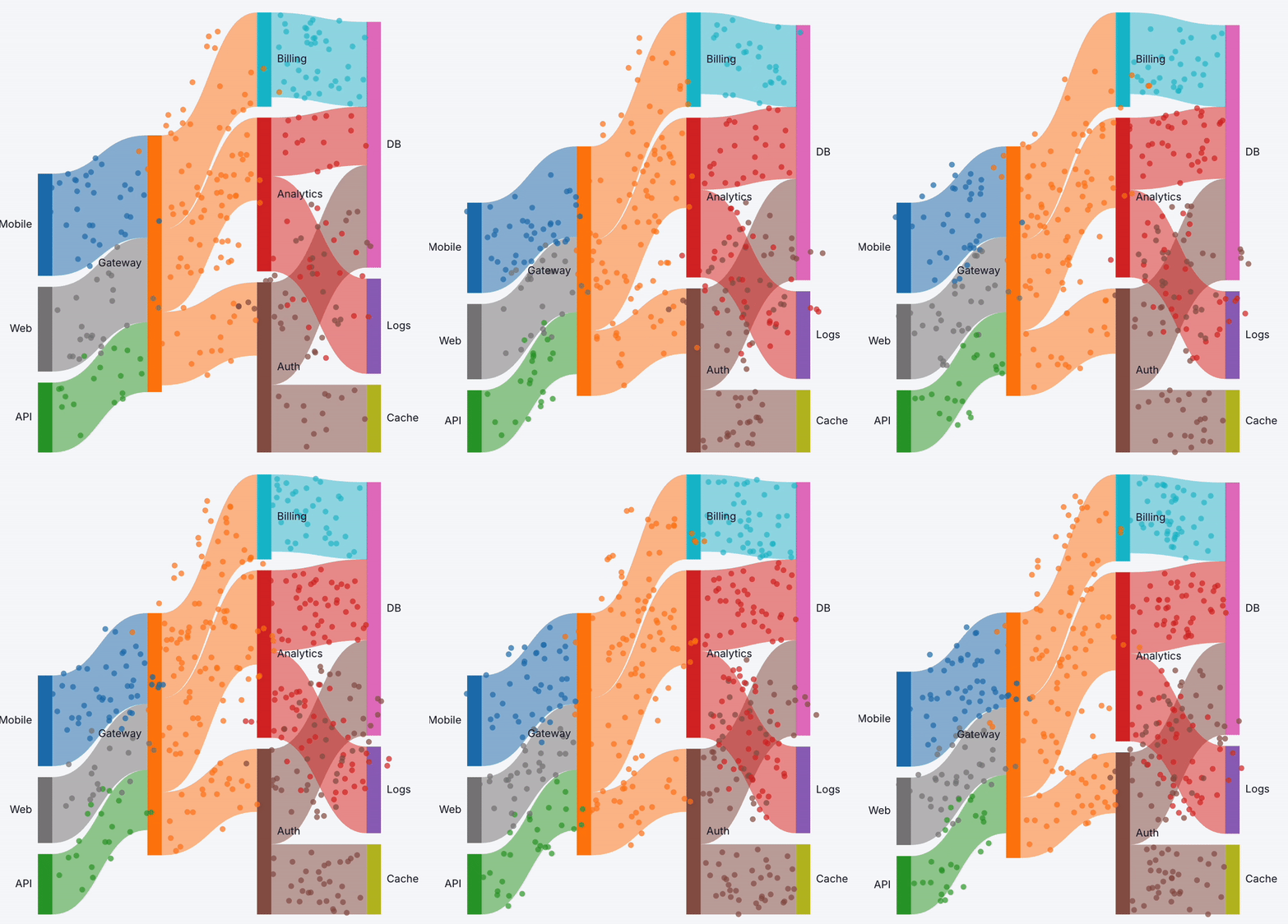
In the rapidly evolving landscape of data visualization, the bridge between raw, high-velocity streaming data and human-readable insight has often been fraught with technical debt. Today, Elijah Meeks, a veteran of the data visualization field and Principal Engineer at Confluent, announced the release of Semiotic 3. This iteration represents a paradigm shift for the library, moving beyond its roots as a static charting tool to become a "real-time-first" framework. More significantly, the development process serves as a profound case study in how domain experts can leverage Artificial Intelligence not to replace human ingenuity, but to fill the critical talent gaps that often stall open-source projects.
A Legacy of Collaboration and Iteration
To understand the magnitude of Semiotic 3, one must first look at the history of the project. Originating at Netflix as the "Abacus Viz Framework," Semiotic was born from the necessity of handling complex reporting and A/B testing interfaces.
"The original Semiotic was a team effort," says Meeks. The project benefited from the expertise of industry heavyweights like James Womack, who helped establish the initial architecture, and Susie Lu, whose contributions to annotations and design transformed the library from a functional utility into a cohesive design system. Over the years, figures like Tom MacWright and Oleksii Raspopov provided critical infrastructure updates, optimizing build systems and performance for use in complex environments like Data Prism.
Despite gaining a respectable following—exceeding 2,000 stars on GitHub—the library never achieved the ubiquity of its peers. Meeks candidly acknowledges the reasons for this: "I ran afoul of Conway’s Law. The organization was just me and my obsessions." By creating an abstraction layer that sat between the raw Grammar of Graphics and the simplicity of plug-and-play components, Semiotic offered powerful "escape hatches" for developers but became, in practice, a high-maintenance ecosystem defined by its creator’s unique vision rather than widespread community adoption.
The Chronology of an Evolution
The journey to Semiotic 3 was not a linear path but a response to the shifting demands of modern data architectures.
- The Netflix Era (2015–2018): Development of the Abacus Viz Framework. The focus was on internal tooling, testing, and proving that complex visualizations could be rendered reliably in a corporate environment.
- The Independent Expansion (2018–2022): Semiotic was open-sourced. Meeks explored experimental territories, including radial violin plots, force-directed word clouds, and parallel coordinates. While technically impressive, the library struggled with performance and accessibility for the average developer.
- The Stagnation Phase: As the library settled, Meeks moved into his role at Confluent. He recognized that the next leap for Semiotic—real-time streaming support—required a level of specialized engineering (specifically in build systems and performance optimization) that he lacked the bandwidth to execute alone.
- The AI-Assisted Pivot (2024–2025): The rise of LLMs allowed Meeks to bridge the gap. By acting as the "architectural lead" and using AI as the "implementation engine," he initiated a total overhaul of the library’s codebase.
The "Goldilocks Zone" of AI-Assisted Development
The most striking aspect of the Semiotic 3 release is the methodology behind its creation. Unlike many projects where developers use AI to "guess" their way toward a solution, Meeks employed a top-down, expert-driven approach.
The Role of Domain Expertise
Meeks argues that AI is inherently limited when it comes to high-level architectural decision-making. "AI is not great at knowing what the right abstraction is for a domain it doesn’t understand," he explains. However, the synergy between a veteran engineer and a Large Language Model creates a "Goldilocks Zone."
In this workflow, the developer defines the "what" and the "why"—the high-level requirements—and the AI executes the "how." For Semiotic 3, this meant defining specific performance targets:
- Streaming Data Integration: Implementing logic where the library diffs incoming data against a rolling window to minimize unnecessary re-renders.
- Higher-Order Components: Creating abstractions that are more intuitive for everyday developers who may not have deep D3.js expertise.
- Test Coverage: Automating the generation of comprehensive test suites, a task that often falls by the wayside in solo-maintainer projects.
This process demonstrates that AI does not replace the "best programmers"; rather, it replaces the "programmers you couldn’t recruit." By effectively outsourcing the labor-intensive coding tasks to an AI, Meeks was able to manifest his decade of domain knowledge into a finished, performant product.
Implications for the Data Visualization Ecosystem
The release of Semiotic 3 has immediate technical and philosophical implications for the industry.

Technical Breakthroughs
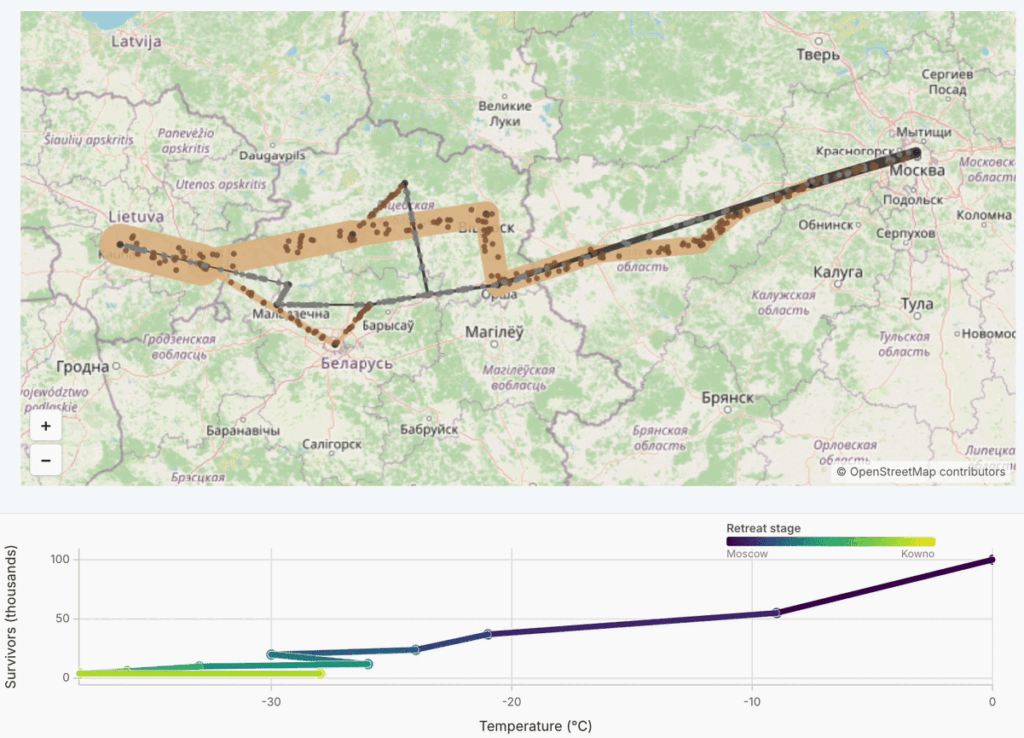
- Real-Time Readiness: Borrowing a concept from Apache Flink—which treats streaming data as a superset of batch data—Semiotic 3 is designed to handle live data streams as a first-class citizen. Almost every chart now supports a streaming mode, providing a fluid experience for high-velocity datasets.
- Server-Side Rendering (SSR): The update introduces robust SSR support, addressing a major pain point for developers building complex dashboards that require initial fast loads.
- Particle Sankeys: Beyond the core updates, the library introduces long-awaited features like particle animations within Sankey diagrams, a visual flourish that previously required significant custom effort to implement.
The Rise of the "Vibe Coder"
Meeks makes a compelling observation regarding the future of software development. By using AI to build this library, he believes he has made it more accessible not just to professional engineers, but to "vibe coders"—non-experts who use AI to generate complex UIs. By baking best practices, performance optimization, and testing into the library’s foundation, Semiotic 3 empowers these users to achieve professional-grade results without needing to navigate the intricacies of low-level graphics programming.
Looking Forward: A New Era for Semiotic
The transition from a "cool tech demo" to a production-grade, real-time library marks a coming-of-age for Semiotic. While Meeks remains a prominent voice in the Data Visualization Society and a Principal Engineer at Confluent, his work on Semiotic 3 suggests a broader shift in how open-source maintainers will handle the "burden of excellence" in the coming years.
The library, once hampered by the limits of a single developer’s time and specialized knowledge, has been liberated by the democratization of engineering expertise through AI. As users begin to integrate Semiotic 3 into their streaming architectures, the true measure of its success will not just be in its GitHub stars, but in its ability to enable new, creative modes of communication that were previously buried under the complexity of the code required to build them.
For those interested in the future of real-time visualization, Semiotic 3 stands as a testament to a new way of building: one where the human provides the vision and the context, and the machine provides the scale. As Meeks puts it, "I wasn’t asking Claude to figure out what a data visualization library should be. I’ve spent a decade figuring that out. I just couldn’t always write the code that got there." Now, thanks to this hybrid approach, he finally has.
 Lina Irawan
  Nana
Nana  Nila Kartika Wati