
 By Sagoh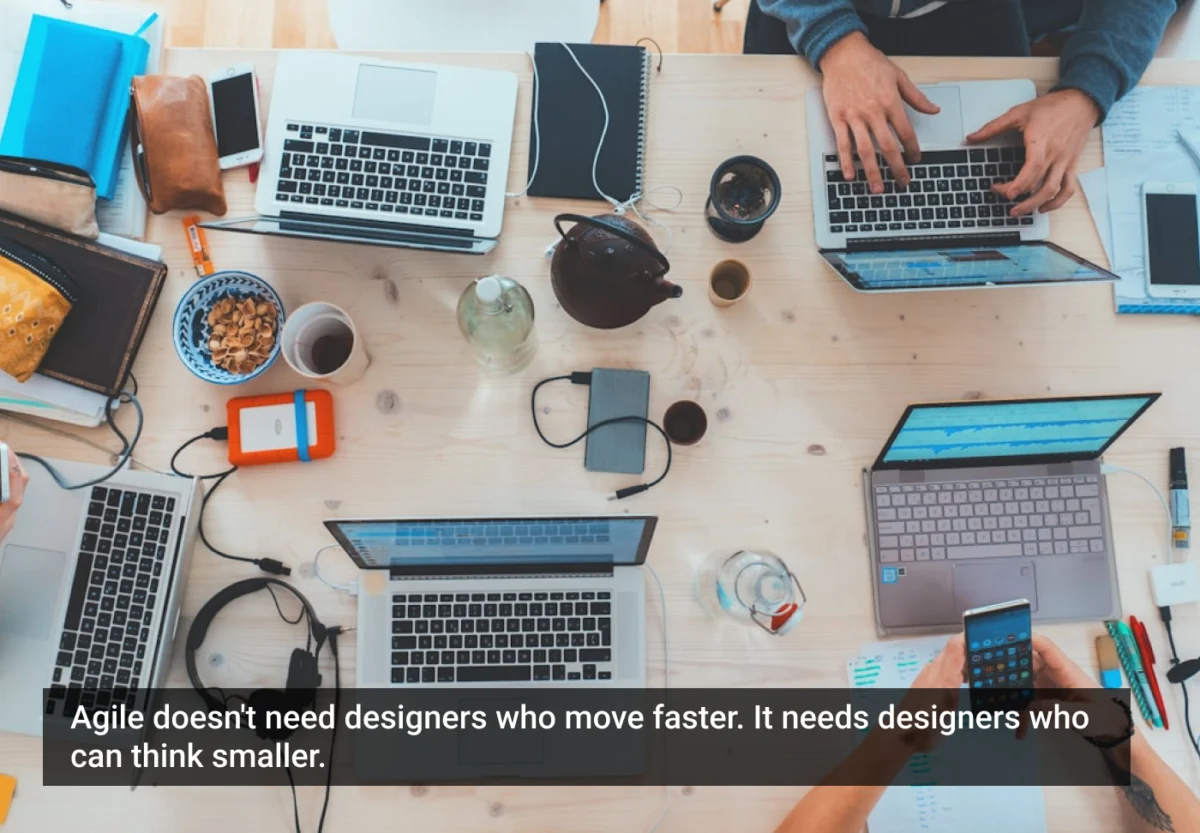
For decades, the design industry has championed the "big picture." Design schools, UX bootcamps, and legacy agencies have conditioned professionals to believe that true design excellence lies in the construction of comprehensive, interconnected systems. Yet, as the software industry has shifted toward the rapid, iterative rhythms of Agile development, a profound friction has emerged. Designers are increasingly finding that the traditional "holistic" approach is at odds with the functional realities of the sprint.
As Päivi Salminen, a veteran of Agile marketing and a student of industry thought leader Laura Klein, recently highlighted, the prevailing narrative that "Agile means faster" is fundamentally flawed. Agile does not ask designers to sprint at a breakneck pace; it asks them to refine their scope until they are designing the smallest possible unit of value.
The Core Conflict: Systems Thinking vs. Sprint Reality
The tension between traditional design philosophy and Agile methodology is not merely a matter of workflow; it is a clash of cognitive styles.
The Designer’s Instinct: The Cathedral Mentality
Most designers are trained in "Systems Thinking." When presented with a problem—such as building a new job search platform—the designer’s instinct is to zoom out. They visualize the entire ecosystem: the user profiles, the search algorithms, the bookmarking features, the application tracking systems, and the long-term scalability of the database. This is the "cathedral" approach: a desire to build a complete, structurally sound edifice that anticipates future needs and prevents fragmented experiences.
The Agile Imperative: The Brick Mentality
Agile development, conversely, operates on the principle of the "brick." It prioritizes immediate, verifiable value. In an Agile environment, the product manager and engineering team are not looking for the full system; they are looking for a singular component that can be integrated, tested, and shipped within a two-week sprint. When a designer insists on mapping out the entire cathedral before placing the first brick, they create a bottleneck that slows the entire product delivery cycle, not because they are "too slow," but because they are "too broad."
Chronology of the Shift: From Waterfall to Incrementalism
To understand why this friction exists, one must look at the evolution of product design methodologies over the last twenty years.
- The Waterfall Era (Pre-2010): Design was a distinct phase that occurred before development. Designers had the luxury of time to conceive of the entire user journey, document every edge case, and finalize visual systems before a single line of code was written.
- The Transition Period (2010–2015): As startups embraced "Lean" principles, designers were forced to shorten their cycles. However, many still approached Agile by attempting to "front-load" design, creating massive documentation for a system that would inevitably change.
- The Current Agile Standard (2015–Present): The industry has arrived at a point where design is fully integrated into the development sprint. The "design phase" no longer exists as a silo; it is a continuous, iterative activity occurring simultaneously with coding and testing.
This transition has left many designers feeling that their work is "incomplete" or "risky," as they are constantly pushed to release features that are only a fraction of their original, holistic vision.
Supporting Data and The Peril of Horizontal Slicing
A common pitfall during this transition is "horizontal slicing." This occurs when a team decides to build a product by technical layer rather than by user value.
For instance, in the job search example, a team might decide that the first "slice" is the search engine itself. They design sophisticated filters, complex algorithms, and intuitive search bars. The result is a technically impressive feature that is functionally useless because there are no job listings in the database to search.
Why Horizontal Slicing Fails
According to Laura Klein’s curriculum, horizontal slicing creates a "hollow" product. By focusing on the backend or the framework before the content, the team misses the opportunity to gather real-world user data. Data shows that teams who focus on the "minimum viable slice"—a single, functional, end-to-end user path—achieve higher user satisfaction rates because they are learning what users actually need, rather than what the team assumes they need.
| Approach | Focus | Outcome |
|---|---|---|
| Horizontal Slicing | Infrastructure/Layers | Technically complete, but user-value empty. |
| Vertical Slicing | End-to-End Value | A tiny, functional feature that yields immediate insights. |
Official Responses and Industry Perspective
Industry leaders are increasingly vocal about this shift. The consensus among those teaching modern product management is that the "design small" mindset is the single biggest differentiator between a senior designer and a junior one.
"The goal is not to produce the perfect design," Salminen notes. "The goal is to produce the smallest possible version of an idea that still delivers real value to the user."
This is not to say that systems thinking is obsolete. Rather, the role of the designer has shifted from "architect of the whole" to "curator of the increments." The system is still there, but it is built piece by piece, guided by the feedback gained from releasing small, valuable slices.
The Implications for Modern Design
The move toward "designing smaller" carries significant implications for the future of the profession.
1. The Death of the "Big Reveal"
Designers who rely on the "big reveal"—the moment when they present a fully polished, comprehensive design system—will find themselves increasingly at odds with Agile teams. Modern design requires constant, incremental reveals where stakeholders see the evolution of a feature over time.
2. A Shift in Success Metrics
In the past, a design was successful if it was aesthetically consistent and functionally complete. Today, a design’s success is measured by the learning loop it creates. If a small slice is released and it fails to engage users, that is considered a "successful" design decision because it prevented the team from building a larger, more expensive, and equally ineffective system.
3. The Need for Radical Prioritization
Designing smaller requires a brutal, clinical ability to prune. Designers must become masters of the "What if we don’t?" question. If a feature can be removed without breaking the core value proposition, it should be moved to the backlog. This requires a level of courage that traditional design training often lacks.
4. Cultivating Holistic Instincts as a Map, Not a Blueprint
The designer’s instinct to see the whole system remains their most valuable asset. However, it must be repurposed. Instead of using that instinct to create a rigid blueprint, it should be used to create a "map"—a mental model of where the product is going, which allows the team to ensure that each small, brick-like slice fits into a coherent future, even if that future is subject to change.
Conclusion: Designing for the Possible
The shift toward designing smaller is ultimately an act of intellectual maturity. It acknowledges that the complexity of modern software is too vast to predict from the outset. By embracing the constraint of the sprint, designers are not losing their power; they are gaining a more direct, meaningful influence over the product.
When you stop trying to design the entire cathedral and start focusing on the perfection of a single, well-placed brick, you aren’t just working in Agile—you are finally beginning to understand how to deliver value in a world that never stops moving. The cathedral will still be built, but it will be built on a foundation of proven user needs rather than speculative design perfection.
 Ammar Sabilarrohman
  Neng Nana