
 By Asep Darmawan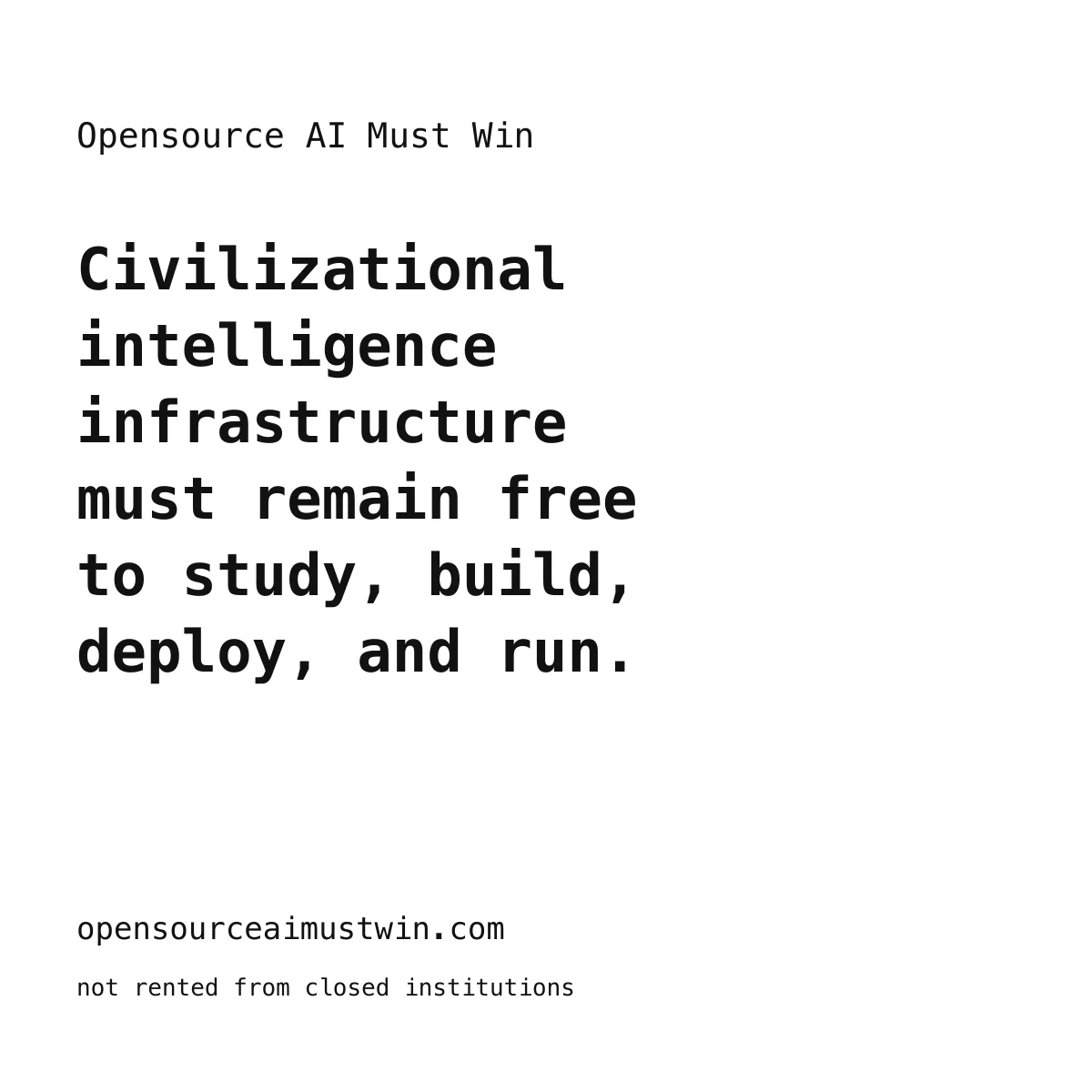
In an era defined by the rapid ascension of Large Language Models (LLMs) and generative artificial intelligence, a quiet but profound transformation is occurring in the architecture of human knowledge. The shift from localized, transparent computing to centralized, proprietary "intelligence-as-a-service" models represents more than a technological pivot; it is a fundamental reconfiguration of operational freedom.
As argued by industry advocates like Ahmad Osman, the prospect of intelligence becoming a rented utility—controlled by a handful of closed-door institutions—poses an existential risk to public agency. If the cognitive tools that underpin our work, education, science, and governance remain locked behind opaque APIs and shifting terms of service, society risks losing the ability to audit, adapt, and preserve its most critical infrastructure.
The Main Facts: The New Subscription Economy for Cognition
At the heart of the current debate is the distinction between "open" and "closed" AI. Proprietary models, developed by a small cadre of frontier labs, function as "black boxes." Users interface with them through remote platforms, effectively outsourcing their cognitive labor to systems whose decision-making processes, training data, and moderation filters remain shielded from public scrutiny.
The fundamental thesis for the open-source movement is that AI is not merely a product, but civilizational infrastructure. Just as the internet relies on open protocols—TCP/IP, HTTP, and SMTP—to function as a neutral, global commons, the intelligence layer of the 21st century must be similarly resilient. When access to intelligence depends on the whims of a Silicon Valley board of directors, the public loses its "operational freedom"—the right to deploy, repair, and study the systems that increasingly govern our professional and creative lives.
Chronology: From Academic Transparency to Corporate Consolidation
To understand the current tension, one must look at the trajectory of artificial intelligence development:
- The Era of Open Research (2010–2018): AI research was largely driven by academia and collaborative, open-access papers. Projects like Google’s TensorFlow or Meta’s early PyTorch initiatives fostered an environment where code and methodologies were shared openly.
- The Scaling Pivot (2019–2022): With the advent of GPT-3 and subsequent models, the capital requirements for training state-of-the-art models exploded. This triggered a "compute arms race," leading to the vertical integration of hardware (NVIDIA), cloud infrastructure (Microsoft Azure, AWS), and frontier labs (OpenAI, Anthropic).
- The Closing of the Box (2023–Present): As models became commercially viable, "OpenAI" and other organizations began restricting access. Documentation disappeared, weights became proprietary, and the industry shifted toward API-only models, effectively creating a "subscription economy for cognition."
- The Counter-Movement (2025–2026): A growing coalition of developers, researchers, and policy advocates has begun to coalesce around the principle that AI must be locally deployable and community-governed to ensure long-term societal resilience.
Supporting Data: The Concentration of Cognitive Power
The consolidation of AI power is measurable. Current market data reveals a striking asymmetry:
- Hardware Dependency: Over 80% of the high-end GPU market is controlled by a single vendor, creating a bottleneck that forces all AI developers into a specific supply chain.
- Model Concentration: More than 90% of frontier-level intelligence is currently hosted on three primary cloud providers. This creates a "single point of failure" for the global economy.
- Economic Barriers: The cost to train a foundational model is now estimated in the billions of dollars, a barrier to entry that excludes universities, non-profits, and smaller nations from building sovereign AI capacity.
- Opaque Moderation: Studies show that proprietary models exhibit "alignment drift," where the behavioral output of the model changes without notice or explanation, impacting legal, medical, and educational applications.
Official Responses and Industry Divergence
The response to the open-source movement has been polarized.
The Closed-Lab Perspective: Executives from leading frontier labs often cite "safety" and "existential risk" as justifications for closed-source models. They argue that releasing powerful model weights into the wild invites bad actors to manipulate or misuse AI for cyberattacks, misinformation, or biological threats. They advocate for a regulated, centralized approach where a few entities manage the risks on behalf of the public.
The Open-Source Advocacy Perspective: Conversely, researchers like Ahmad Osman argue that "security through obscurity" is a fallacy. By keeping models closed, these labs are actually creating a monoculture of intelligence. If the system fails, is compromised, or is simply discontinued due to a pivot in corporate strategy, there is no community-led alternative to fall back on. Open-source advocates argue that the only way to ensure the safety of AI is to make it "understandable, reproducible, and locally deployable."
Implications: The Future of Sovereignty
The implications of this divide extend far beyond software licensing. If society relies on a handful of platforms for its intelligence, we are essentially building our intellectual house on leased land.
1. The Erosion of Scientific Integrity
If scientists cannot audit the models used to process their data, the reproducibility crisis in science will deepen. Peer review becomes impossible if the underlying "thinking" machine cannot be inspected or tested.
2. The Loss of Cultural Preservation
If the cultural output of an entire generation is generated by proprietary models, we lose the ability to archive, preserve, or study the logic behind our own creative history. Future generations would be reliant on the continued existence of a specific corporation to access the digital artifacts of our time.
3. Geopolitical Vulnerability
A nation that cannot run its own intelligence infrastructure is a vassal to the corporation or foreign power that controls it. The American position, as argued by advocates, must be one of "capacity with global open standards." By fostering a robust ecosystem of locally deployable, open-weight models, the U.S. and its allies can ensure that their core infrastructure remains resilient, even if individual labs or platforms change direction.
Conclusion: Toward a Cognitive Commons
The fight for open-source AI is a fight for the future of human agency. It is a demand that intelligence—the most powerful tool ever created—remains a public good rather than a toll-gated utility.
To achieve this, the focus must shift from the mere existence of AI to the accessibility and governance of that AI. This requires:
- Standardization: Developing universal, vendor-neutral benchmarks for AI performance.
- Infrastructure Investment: Public and private funding for open-weight model development that is not tied to a single, proprietary cloud ecosystem.
- Legal Protections: Ensuring that the right to "inspect, modify, and benchmark" AI systems is protected under intellectual property law.
As we move toward 2026, the question is not whether AI will be a part of our lives, but whether we will be the masters of our tools or merely the tenants of a digital aristocracy. The infrastructure of human thought is too important to be kept in a vault. It is time to ensure that intelligence, like the code that powers it, remains a freedom, not a subscription.
If you are interested in joining the coalition to ensure AI remains open, understandable, and locally deployable, you may reach out to Ahmad Osman at [email protected].
Opensource AI Must Win © @TheAhmadOsman 2026
 rifanmuazin
  Layla Zulfa
  Evan Lee Salim