
 By Nana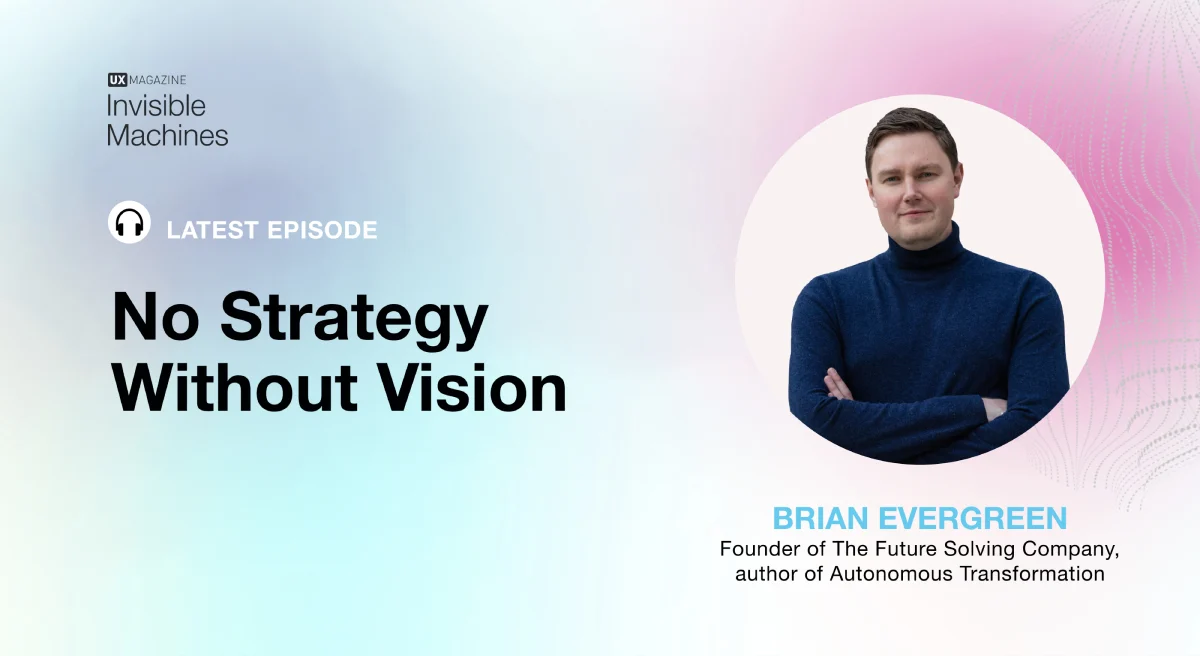
By Enterprise Technology Insights
Published: October 24, 2023
Executive Summary & Main Facts
In the rapidly evolving landscape of enterprise technology, traditional procurement frameworks are failing. According to recent insights shared on the Invisible Machines podcast by Brian Evergreen—founder of The Future Solving Company and author of Autonomous Transformation—organizations are attempting to deploy next-generation agentic artificial intelligence using tools and strategies built for a bygone era.
Joined by host Robb Wilson (CEO of OneReach.ai) and co-participant Josh Tyson, Evergreen dismantled the standard corporate playbook for AI adoption. The core thesis is straightforward yet disruptive: There is no AI strategy without vision.
Key takeaways from the discussion include:
- The Procurement Paradox: Standard Request for Proposals (RFPs), feature matrices, and vendor bake-offs are designed for static, known commodities (SKUs), not dynamic, rapidly shifting AI ecosystems.
- Problem Solving vs. Future Solving: Iterative efficiency gains ("problem solving") will never accidentally produce foundational category creation ("future solving").
- Mid-Flight Capabilities: In an era where foundation models update and ship entirely new capabilities mid-procurement cycle, static vendor checklists actively mislead executives.
- The Human Element: True AI strategy requires visceral, human-centered language and an aligned organizational vision, rather than sterile board-deck scoreboards and adoption proxies.
The Chronology of an Enterprise AI Misstep
To understand why modern corporate AI strategies are faltering, one must examine the typical lifecycle of an executive technology initiative. The breakdown usually follows a predictable, flawed trajectory.
Phase 1: The Literacy Sprint
When executives decide they need an artificial intelligence strategy, the process almost invariably begins with a two-step ritual. First, leadership undertakes a crash course in AI literacy. They learn enough buzzwords, operational distinctions, and technical concepts—such as the difference between classical machine learning, generative AI, and true agentic systems—to sound credible in a board presentation.
Evergreen is sympathetic to this foundational phase. Just as a painter must understand pigment and ground, an executive must understand the medium. However, the corporate machine treats this baseline literacy as immediate permission to sprint toward implementation.
Phase 2: The Vendor Bake-Off and the RFP Trap
Once the literacy box is checked, organizations immediately pivot to what they know best: the traditional enterprise purchasing motion.
This involves drafting extensive RFPs, consulting analyst quadrants, building feature matrices, and hosting oral defenses. This mechanism works brilliantly when an enterprise is purchasing a known asset—such as server hardware, cloud storage, or an off-the-shelf SaaS CRM.
However, this procurement motion breaks down entirely when applied to agentic AI. There is no historical dataset for next year’s unknown market structure, nor is there a replicated experiment for a product category that does not yet exist. Trend lines are not laws of physics, and common features across competing vendors are not interchangeable capabilities. When a model update can introduce groundbreaking functionalities overnight, a six-month procurement cycle renders a feature matrix obsolete before the ink is dry.
Phase 3: The Illusion of Progress
Without a foundational vision, the resulting plan becomes "busy, intelligent, and hollow at the center." Companies accumulate software licenses, run localized pilot programs, and measure success via user engagement metrics. Yet, as Evergreen and Wilson note, wide usage of the wrong future is still the wrong future. Organizations achieve motion without architecture, spending massive amounts of capital while heading blindly in no particular direction.
Supporting Data and Historical Parables
To ground these abstract architectural critiques in reality, the Invisible Machines panel looked to historical case studies that highlight the dangers of misaligned alignment and the power of radical restructuring.
The Blockbuster Dilemma: Alignment Over Technology
Evergreen invoked the cautionary tale of Blockbuster’s collapse. Years before streaming became a dominant global category, Blockbuster ran credible, advanced streaming pilots. The technology was viable, and the consumer appetite was visible.
However, the corporate structure killed the initiative. Robb Wilson, drawing on his background in consulting during that era, provided the crucial structural detail: Blockbuster’s primary customer-of-record was not the renter walking through the storefront doors; it was the franchisee.
To corporate leadership, a robust streaming initiative read as a direct threat to late-fee economics and a cannibalization of the franchisees upon whom the balance sheet depended. The missing piece was not technical capability—it was structural and cultural alignment. Leadership failed to "future-solve" a new business model alongside their primary stakeholders, treating innovation as a threat rather than an evolution.
The Bell Labs Counter-Example: Convening Breakthroughs
As a counter-move to the Blockbuster failure, the panel examined Bell Labs in 1952. Confronted with the stagnation of their top inventions, leadership forced an unprecedented, uncomfortable exercise: they demanded that researchers assume the entire telephone network had been completely destroyed and was irreparable.
The mandate was to rebuild the system from scratch using contemporary science, modern economics, and updated regulations. The lesson of Bell Labs is not mere nostalgia for monopolistic corporate research centers; it is that breakthrough cadences can be systematically convened. Innovation does not happen by accident while hoping creativity magically fills gaps between calendar holds.
Official Perspectives and Industry Insights
The dialogue between Evergreen, Wilson, and Tyson illuminated several distinct viewpoints on how modern enterprises must rethink their approach to software and artificial intelligence.
Brian Evergreen: The Architecture of Future Solving
Evergreen’s core philosophy hinges on a linguistic and conceptual distinction:
"Problem solving is an elimination exercise: trim waste, shore up what you already ship, curate the value you already have. Future solving starts with appetite: what do you want to exist that does not exist yet, and what would have to become true to get there?"
Using a provocative metaphor, Evergreen compared mass literacy and use-case hunting to training an entire city of people to swing hammers. While it might produce sturdier houses, hammering harder will never accidentally produce the Duomo. Without a shared, visceral vision—such as an AI advisor that responds in real time or a clinician who remains fully present in the human moment—people will lack the emotional resilience required to carry organizational change once initial pilots conclude.
Robb Wilson: Challenging the Science Fair Mentality
Robb Wilson highlighted the deep-seated comfort corporations find in familiar validation processes:
"What most large companies have is not an absence of planning, but a highly evolved plan for buying known solutions."
Wilson criticized the common corporate anti-pattern of treating digital transformation like a high school science fair, where the core hypothesis is simply determining "which vendor checks the most boxes." In a world where software capabilities shift mid-flight, this checklist-driven mentality misleads executives about what technological parity actually means.
Josh Tyson: Governed Knowledge and Real-World Implementation
Bringing the conversation down to operational brass tacks, Josh Tyson pointed to early work by financial institutions like Morgan Stanley. Rather than simply dumping unstructured PDFs into a foundational model, these institutions built governed knowledge layers defined by clear ownership, data freshness, and strict accountability. This reflects Evergreen’s "what would have to be true" framework in practice: visionary outcomes ultimately depend on rigorous foundational data architectures.
Strategic Implications for the Enterprise
As organizations look toward a future dominated by agentic AI, the implications of this paradigm shift are profound.
1. The End of the Vendor Bake-Off as a Strategy
Enterprises must stop outsourcing their strategic thinking to procurement departments and software vendors. A vendor bake-off on the deck of a ship whose heading nobody has agreed upon is a recipe for shipwreck. Leaders must first articulate the exact future they want to build before evaluating which tools can help them reach it.
2. Redefining Friction and Motivation
While UX designers and product managers are naturally trained to reduce friction (minimizing clicks, streamlining funnels), Evergreen warns that friction is inexhaustible if an organization lacks a North Star. When a vision is genuinely compelling, human motivation can effortlessly override operational friction. Conversely, reducing friction for the wrong workflow only accelerates an enterprise toward an undesirable destination.
3. Authorship Over Adoption
Interfaces are rapidly collapsing. In the near future, end-to-end intent handling will replace traditional transactional software applications, rendering concepts like "login screens" as obsolete as the floppy-disk save icon.
If an enterprise fails to author its own story across traditional organizational silos, a platform monopoly will write it by default. Real AI strategy is not about measuring today’s operations more aggressively; it is about authoring tomorrow’s reality in language humans can carry, mapping the necessary truths to get there, and only then building the models, agents, and roadmaps to bring that future to life.
To explore the full discussion, listen to the complete episode on the Invisible Machines Podcast Hub or watch the full video conversation on YouTube.
 Siti Muinah
  Lina Irawan
  Nana Wu