
 By Suro Senen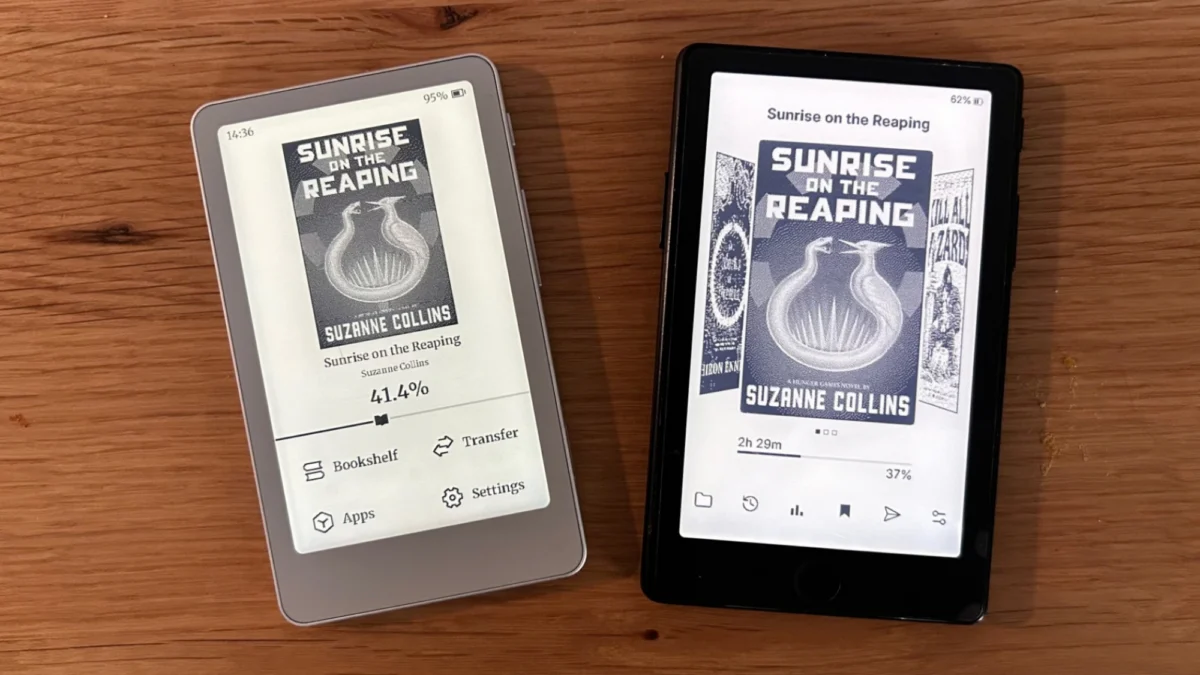
By Joel Cunningham
September 22, 2026
For years, the e-reader market was locked in a predictable holding pattern dominated by tech giants like Amazon and Kobo, whose devices grew progressively larger, more feature-heavy, and more deeply entrenched in walled ecosystems. That changed dramatically last year with the viral success of the Xteink X4. A pocket-sized, budget-friendly Chinese device featuring a 4.3-inch screen, it sparked an online cult following. Enthusiasts embraced its compact footprint—even if its marketing gimmick of magnetically attaching it to the back of a smartphone was wildly impractical—paving the way for a mainstream trend.
Now, the established players are fighting back. Boox, a company with over a decade of experience in the alternative e-reader space (known for devices like the phone-shaped Palma), is launching its own micro-competitor: the 3.97-inch Boox Picco. Priced at $99—competing directly against the Xteink X4 Pro and undercutting entry-level Kindles by roughly $50—the Picco aims to redefine what consumers expect from ultra-portable reading technology.

Main Facts: What is the Boox Picco?
The Boox Picco is an ultra-compact e-reader designed for users who want a device significantly smaller and lighter than a traditional Kindle or Kobo, without being tethered to a major tech conglomerate’s ecosystem.
- Display: 3.97-inch E-Ink screen utilizing standard industry panels (480×800 resolution), complete with a temperature-adjustable front light and touchscreen capabilities.
- Build & Dimensions: Features an aluminum frame, physical buttons, and a two-toned back panel reminiscent of vintage smartphone design. It measures an ultra-thin 5.5mm and weighs just 58 grams.
- Storage & Connectivity: Relies on a microSD card slot for expandable storage rather than heavy onboard memory, and utilizes a standard USB-C port for charging and file transfers.
- Software: Runs a modified, highly polished version of the open-source community firmware known as "CrossPoint."
- Pricing & Availability: Priced at $99, with a tentative release window slated for late autumn (rumored November).
Chronology: The Rise of the Pocket Reader
To understand how we arrived at the Boox Picco, it helps to look at the rapid timeline that transformed tiny e-readers from a niche DIY curiosity into a mainstream product category:
- Late Fall: Xteink launches the X4 e-reader. Despite its clunky native software, its 4.3-inch size and ultra-low cost make it an instant hit among tinkerers and tech reviewers on social media.
- Early 2026: A community of developers creates "CrossPoint," a custom, streamlined firmware that fixes the native operating system flaws of Xteink devices, making them universally beloved. Xteink capitalizes on the momentum by releasing iterative upgrades, including the X3 and the X4 Pro (which introduces a front light and touchscreen).
- July 2026: Boox surprises the tech community by announcing it is entering the micro-reader market with the Picco, directly challenging Xteink’s dominance.
- September 2026: Pre-release units of the Boox Picco land in the hands of reviewers, revealing a device that blends hardware refinement with community-driven software principles.
- Late 2026 (Expected): The Boox Picco hits the open market, entering a fierce head-to-head battle against the Xteink X4 Pro at the identical $99 price point.
Supporting Data & Hardware Comparison
At first glance, the Boox Picco and its primary competitor, the Xteink X4 Pro, share a nearly identical genetic code. Because all e-reader screens are manufactured by a single dominant supplier (E-Ink), these micro-readers are inherently bound by similar physical constraints. Both utilize the same foundational screen tech, basic processors, and expandable storage solutions via microSD.

However, a closer look at the data reveals notable design divergences:
| Feature | Boox Picco | Xteink X4 Pro |
|---|---|---|
| Screen Size | 3.97 inches | 4.3 inches |
| Thickness | 5.5 mm | 5.95 mm |
| Weight | 58 grams | 72 grams |
| Charging Port | Standard USB-C | Magnetic Pogo Pins |
| Build Materials | Aluminum frame, two-toned back | Plastic with internal magnets |
| Price | $99 | $99 |
While the X4 Pro features internal magnets allowing it to snap into magnetic folios or stick to accessories, the Picco opts for a lighter, sleeker aluminum frame and relies on a universal USB-C port. For many consumers, the inclusion of USB-C—avoiding the proprietary magnetic pogo-pin cables that drew complaints in Xteink’s community subreddits—will be a major selling point.
Official Responses and Industry Perspectives
Neither Boox nor Xteink operates within the traditional marketing framework of trillion-dollar corporations like Amazon, choosing instead to communicate directly with niche enthusiast communities via Reddit, Discord, and direct product updates.

In statements regarding the development of the Picco, Boox representatives highlighted the demand for a device that bridges the gap between raw hardware performance and user-friendly software out of the box. While Xteink initially leaned into a chaotic, community-dependent software ecosystem that required users to "flash" third-party firmware like CrossPoint to get an optimal experience, Boox has preemptively bypassed that hurdle.
By licensing a variation of CrossPoint natively, Boox is signaling that it understands the core demographic: readers who want the hardware simplicity of a pocket-sized e-reader without having to hack the operating system just to organize their library.
Meanwhile, independent tech reviewers and early testers have praised the Picco’s physical build quality—drawing stylistic comparisons to classic mobile devices like the iPhone 5—while noting that its featherlight 58-gram weight can occasionally feel too insubstantial compared to the slightly heavier, more tactile grip of the Xteink lineup.

Implications: What the Picco Means for the E-Reader Market
The arrival of the Boox Picco carries several important implications for the future of portable consumer technology:
1. The Death of the "One-Size-Fits-All" E-Reader
For over a decade, companies assumed that e-readers needed to match the footprint of a small paperback (typically 6 to 7 inches) to be viable. The viral success of the Xteink X4 and the subsequent rush by Boox to release the Picco prove that a vocal segment of consumers wants something that can slip effortlessly into a shirt pocket or small purse. The micro-reader is officially a legitimate product category, not a passing fad.
2. Mainstream Validation of Open Ecosystems
Unlike Kindle devices, which aggressively lock users into Amazon’s store, micro-readers like the Picco and X4 Pro are designed for sideloaded files (EPUBs, PDFs, text documents). The fact that a major manufacturer like Boox is willing to adopt community-developed software architecture (CrossPoint) shows a growing industry shift toward respecting user agency, customizability, and open file management.

3. Direct Competition Drives Rapid Innovation
When two companies target the exact same price point ($99) with nearly identical core specs, consumers win. The rivalry between Boox and Xteink is forcing rapid iterations, pushing manufacturers to refine build materials, optimize operating systems, and eliminate consumer friction points (such as ditching proprietary charging cables for universal USB-C).
Looking Ahead
Whether consumers ultimately favor the aluminum sleekness of the Boox Picco or the rugged modularity of the Xteink X4 Pro remains to be seen when the Picco officially releases this November. What is certain, however, is that the e-reader market is no longer a monolith. The era of the micro-reader has arrived, and it is here to stay.
 rifanmuazin
  Laily UPN
  Asep Darmawan