
 By Ali Ikhwan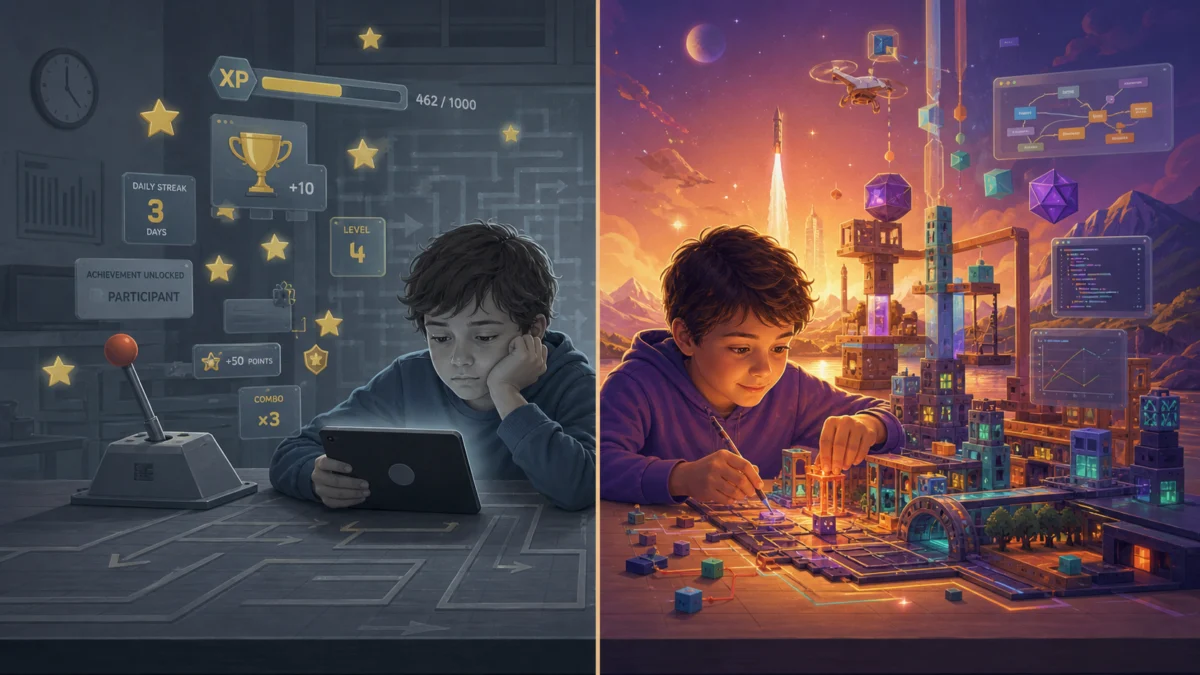
In the quiet hum of a suburban living room, a twelve-year-old boy sits hunched over a laptop. For three hours, he has been deeply immersed in the world of Minecraft, constructing a sprawling, automated sorting system using redstone circuitry. He is collaborating in real-time with peers across the globe, debugging logic gates, and navigating complex spatial problems. When he finishes his session, he closes the laptop with a sense of genuine accomplishment.
Ten minutes later, he opens a school-issued tablet to complete his homework. He is greeted by a brightly colored interface that rewards him with "Gold Stars" and "XP" for solving basic, rote-memorization math problems. He clicks through the slides, eyes glazing over, and finishes in record time.
When asked about the latter, his assessment is swift and brutal: "It’s not a game. It’s just homework with points."
This interaction, recounted by a concerned educator, sits at the heart of a mounting crisis in EdTech. As we move deeper into the era of Gen Z and Gen Alpha—generations that have been raised on the high-fidelity, highly interactive design of Roblox, Fortnite, and Minecraft—the gap between "gamified" classroom tools and actual gaming experiences has become a chasm. Developers are no longer just competing with textbooks; they are competing with the most sophisticated engagement engines in human history.
The Disconnect: A Generation of Digital Natives
To understand why current educational gamification efforts are failing, one must first recognize the sophistication of the audience. Children today do not view "gaming" as a novelty; it is their primary medium for social interaction, creative expression, and intellectual exploration. By the age of eight, many have already spent thousands of hours in sandbox environments that offer near-infinite agency.
They understand the "language" of game design—the feedback loops, the risk-reward structures, and the social hierarchies—not because they studied it, but because they have lived it. When they are presented with a digital worksheet disguised as a game, they see the artifice immediately. They perceive the XP bars and the cartoon mascots not as fun, but as patronizing attempts to sugarcoat drudgery.
The Anatomy of Failure: Why "Gamification" Often Means Manipulation
The modern "gamification" trend, which gained steam in the early 2010s, is increasingly viewed by UX experts as a superficial application of game mechanics rather than an integration of game philosophy.
1. The "Points and Badges" Trap
Many developers treat gamification as a skin to be applied to a boring process. They assume that if they add a leaderboard or a badge for completing a task, the user will be motivated. This, however, is a misunderstanding of what makes a game compelling. Points are a metric, not a motivator. In a true game, points are a byproduct of mastery; in bad EdTech, they are a hollow reward meant to distract from the lack of intrinsic interest in the task itself.
2. The Lack of Agency
True game design is built on the "Player’s Journey." It involves choice, failure, and experimentation. Educational apps that force users down a linear, prescribed path—"Do task A to get reward B"—rob the learner of the one thing that makes games addictive: agency. When a student cannot fail in a meaningful way or experiment with different solutions, the sense of discovery is stripped away.
3. The "Skinner Box" Problem
Most failing educational tools are essentially digital versions of a "Skinner Box"—a psychological experiment where a subject is conditioned to repeat an action for a reward. While this might encourage short-term completion of busywork, it fails to foster long-term engagement or deep learning. It treats students as rats in a maze rather than creative agents capable of complex, nonlinear thinking.
Supporting Data: Engagement vs. Compliance
Recent longitudinal studies in educational engagement show a disturbing trend: while gamified apps often see high "login" rates initially, they suffer from a "cliff" of engagement after the first few weeks.
- The Novelty Decay: Data from several major EdTech platforms indicates that after the initial dopamine hit of unlocking the first few badges, user engagement drops by as much as 60% within 14 days.
- The Competency Gap: Students who use sandbox-style learning (like Minecraft Education) show a 30% higher retention rate in complex problem-solving tasks compared to those using "drill-and-practice" gamified apps.
- User Sentiment: Surveys of students aged 10–14 reveal that over 70% find gamified rewards "annoying" or "childish" when the underlying material is perceived as repetitive.
Official Responses and Industry Shifts
In response to these findings, industry leaders are beginning to shift their strategies. We are seeing a move away from "gamification" toward "Game-Based Learning" (GBL).
The distinction is critical. Gamification adds game elements to non-game contexts. GBL, conversely, embeds learning objectives into the core mechanics of a game.
"We stopped looking at how to make math ‘fun’ by adding medals," says a lead designer at a major educational software firm. "Instead, we looked at how to make math the tool the player uses to overcome a challenge in a game world. When you need math to build a bridge or manage a resource in a simulation, the math becomes the key to the game, not the barrier."
The Implications: A Competitive Landscape
For developers, the implication is stark: the competition is no longer other educational apps. The competition is Roblox.
If a student has the choice between a game where they can build, socialize, and compete, and a game that asks them to solve three long-division problems to "level up" a digital pet, the result is predictable. The "gamified" app will be discarded the moment the teacher is out of sight.
This creates a high barrier to entry. To compete with the giants of the gaming industry, developers must invest in:
- Narrative depth: Creating worlds that have stakes, characters, and consequences.
- Emergent gameplay: Allowing students to find their own solutions, rather than forcing them through a rigid funnel.
- Social integration: Allowing students to work together, as they do in their favorite multiplayer games.
A New Framework: Designing for Players, Not Metrics
Moving forward, designers should abandon the "How do we gamify this?" mindset. Instead, they should adopt a genre-first approach:
- Identify the Genre: Is the subject matter best served by the logic of a puzzle game, the social dynamics of an MMO, or the resource management of a strategy game?
- Integrate, Don’t Decorate: The core mechanics of the learning material should be the core mechanics of the game. If you are teaching language, the act of communication should be the primary mechanic for winning, not an XP bar.
- Respect the User’s Intelligence: Gen Alpha is not easily fooled. If the game mechanics are thin or manipulative, they will notice. Design for the "fun" of mastery, not the "fun" of a progress bar.
Conclusion: The Path Forward
The education sector stands at a crossroads. We can continue to churn out digital worksheets wrapped in cheap, manipulative graphics, or we can embrace the reality that modern students are sophisticated gamers who value agency, creativity, and authentic challenge.
The "education problem" is not that kids don’t want to learn; it’s that they have experienced the power of true play and are no longer satisfied with hollow imitations. By shifting the focus from superficial rewards to authentic game design principles, educators and developers have the opportunity to create tools that are not only effective but genuinely engaging.
The era of "homework with points" is coming to an end. The era of the truly educational game, one that respects the student as a player, must begin.
 Ammar Sabilarrohman
  Neng Nana
  Sagoh
Sagoh 