
 By Nana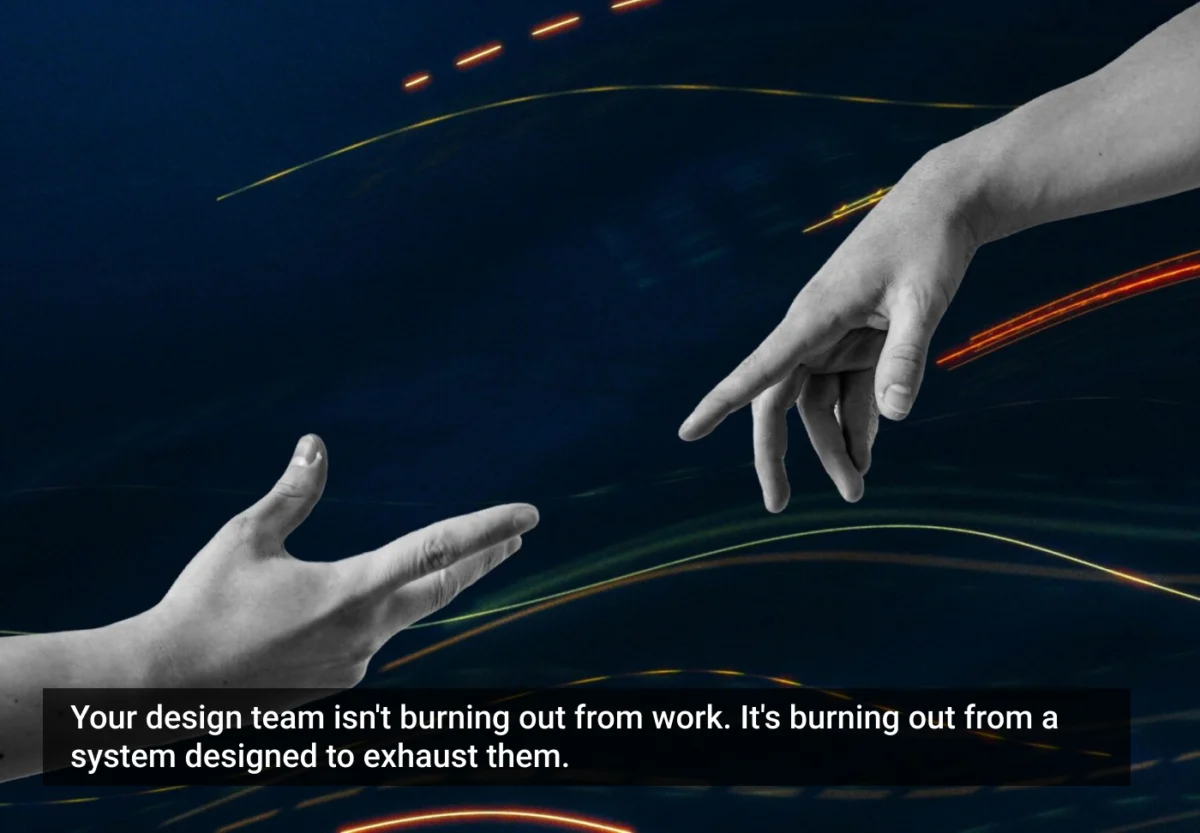
Burnout is often framed as a personal struggle—a failure of resilience, poor boundaries, or an inability to manage a heavy workload. But in the world of high-stakes product design, burnout is frequently friction in disguise. It manifests as lost files, moving briefs, and unwritten decisions.
Pavel Bukengolts, an expert in DesignOps, argues that when we look past the surface-level complaints of "exhaustion," we find a systemic crisis. "What if the fact that your design team is burned out has nothing to do with how hard they work?" Bukengolts asks. "The system is to blame. Broken design systems, missing sources of truth, and shifting goals all quietly steal time and trust."
When "I’ll just build it myself" becomes the daily mantra of your senior designers, you aren’t witnessing an initiative problem—you are witnessing an operational breakdown.
The Anatomy of the Grind: Friction as a Silent Killer
Workplace fatigue is rarely the result of a single project or a single deadline. It is the cumulative effect of a thousand tiny cuts. In a modern hybrid environment, the "chatter" of a team often reveals more than any quarterly report.
At 9:00 AM, the work begins. But listen closely to the subtext of the digital workspace:
- "I spent an hour looking for the right file."
- "We’re redoing that flow because the brief changed."
- "Leadership said one thing, but the product shifted direction."
This is the sound of operations failing. It is what Bukengolts describes as "the grind." Teams do not explode; they bleed out. They adapt to chaos until that chaos becomes the status quo. However, this is not normality—it is friction. Friction acts as a hidden tax, depleting the time, trust, and mental bandwidth of your most talented people.
Many leaders dismiss the need for formal DesignOps as an unnecessary bureaucratic expense. They argue they don’t have the "resources" for process. Bukengolts reframes this: "That’s the trap. You’re already spending the time on rework, confusion, and burnout. Good ops doesn’t add time; it reclaims it."
Decoding the Distress Signals: A Translation Guide
For leadership to address burnout, they must learn to translate the language of frustration. The complaints echoing in Slack channels and DMs are not merely grievances; they are data points indicating structural failure.
| Observation | The Root Operational Problem |
|---|---|
| "I’ll just build it myself." | The design system is untrusted, outdated, or clunky. |
| "Is this the latest file?" | There is no single source of truth. |
| "The goal changed again." | A leadership gap exists; context is not cascading down. |
| Senior re-explaining the basics. | Knowledge is trapped in people, not documented systems. |
| "Who’s approving this?" | The feedback loop is broken or ambiguous. |
These are distress signals. When success is measured exclusively by output rather than design maturity, speed is the only metric that matters—until the system inevitably collapses under the weight of rework.
Empathy Mapping: Visualizing the Disconnect
To understand the scope of the problem, we must look at the disconnect between what stakeholders say, do, think, and feel. Empathy mapping serves as a diagnostic tool that highlights where the system is failing the people.
The Persona Breakdown
- Designers: They feel frustrated and disempowered. While they say, "Oh, the requirements changed again," they are thinking, "If they would just make a decision, I could get this done in a day."
- Leads and Seniors: These individuals act as human shields. They feel drained and protective. They know the team is talented, but they recognize the system is setting them up for failure.
- Product Managers: Often caught in the middle, they feel pressured by deadlines. Their focus is purely on the Q4 release, creating a high-stress environment that pushes designers into a "firefighting" mode.
- Leadership: Often disconnected, leadership wonders, "Why are we moving so slowly?" They intervene by adding more meetings, which ironically adds more friction, further slowing down the process.
When "say" and "feel" do not match, it is not a talent gap—it is an operational one.
Operational Sustainability: Moving Beyond "Vibes"
For years, team health was judged by "vibes"—a subjective sense of tension that was impossible to measure. This approach is no longer sufficient. Modern DesignOps demands a transition from gut-feeling leadership to data-driven organizational health.
The Team Capability Engine
Bukengolts proposes the use of a "Team Capability Engine"—a framework designed to identify capability gaps before they manifest as performance failures. This is not about micromanagement or individual surveillance; it is about creating an "MRI" of the organization. By identifying where the system holds pressure and where it cracks, leaders can provide clarity rather than more meetings.
What Leaders Can Do: A Practical Roadmap
- Implement a Friction Log: For one week, ask the entire team to anonymously document every small slowdown. No solutions, just observations. This provides a map of the "hidden tax" being paid.
- Define a Single Source of Truth: Audit your asset libraries. If designers are spending more than 15 minutes searching for a file, your documentation process is failing.
- Formalize Mentorship: In a remote world, mentorship doesn’t happen by accident. Build it into the operational rhythm—dedicated time for knowledge transfer is not a luxury; it is maintenance.
- Close the Feedback Loop: Establish clear approval hierarchies to prevent the "Who is approving this?" bottleneck.
The Cost of Staying Blind
Ignoring operational health is never a neutral act; it is the accumulation of debt. Every unclear decision adds "drag" to the organization. Every "we’ll fix it later" promise taxes the company’s future momentum.
When you ignore the operational layer, the results are predictable:
- High Turnover: Top talent leaves not because of the work, but because of the environment.
- Declining Quality: When designers are in constant firefighting mode, they lose the capacity for deep, strategic thinking.
- Increased Costs: The cost of constant rework and project delays often exceeds the cost of implementing a robust DesignOps framework by a significant margin.
Conversely, when an organization shifts toward operational clarity, the team feels lighter. Leaders gain visibility, and design processes scale rather than stretch.
Conclusion: Clarity as a Competitive Advantage
"Every system is perfectly designed to get the results it gets," as W. Edwards Deming famously noted. If your team is exhausted, it is not because they lack passion or skill; it is because the system is designed to exhaust them.
DesignOps is not about control or adding layers of red tape. It is about creating the scaffolding that allows talent to flourish. By shifting the focus from "working harder" to "working clearer," leadership can reclaim the time lost to friction and turn their design team into a high-performance, sustainable engine of innovation.
The fix isn’t more effort. It is better operations. It starts with listening, continues with measuring, and succeeds through clarity. It is time to stop treating your designers as the fuel for a broken machine and start fixing the machine itself.
 Ammar Sabilarrohman
  Neng Nana
  Sagoh
Sagoh 