
 By Nana Muazin
The digital marketing landscape is undergoing its most profound disruption since the inception of the modern search engine. For the past two years, search engine optimization (SEO) professionals and digital strategists have operated under a cloud of existential dread, spurred by predictions of an impending collapse in traditional search volume.
However, a landmark joint study conducted by digital agency Fractl and Search Engine Land reveals that the narrative of search’s demise has been highly oversimplified. While search behavior is transforming rapidly under the influence of generative AI, overall search demand is not shrinking—it is redistributing.
1. Main Facts: The Redistribution of Global Search Demand
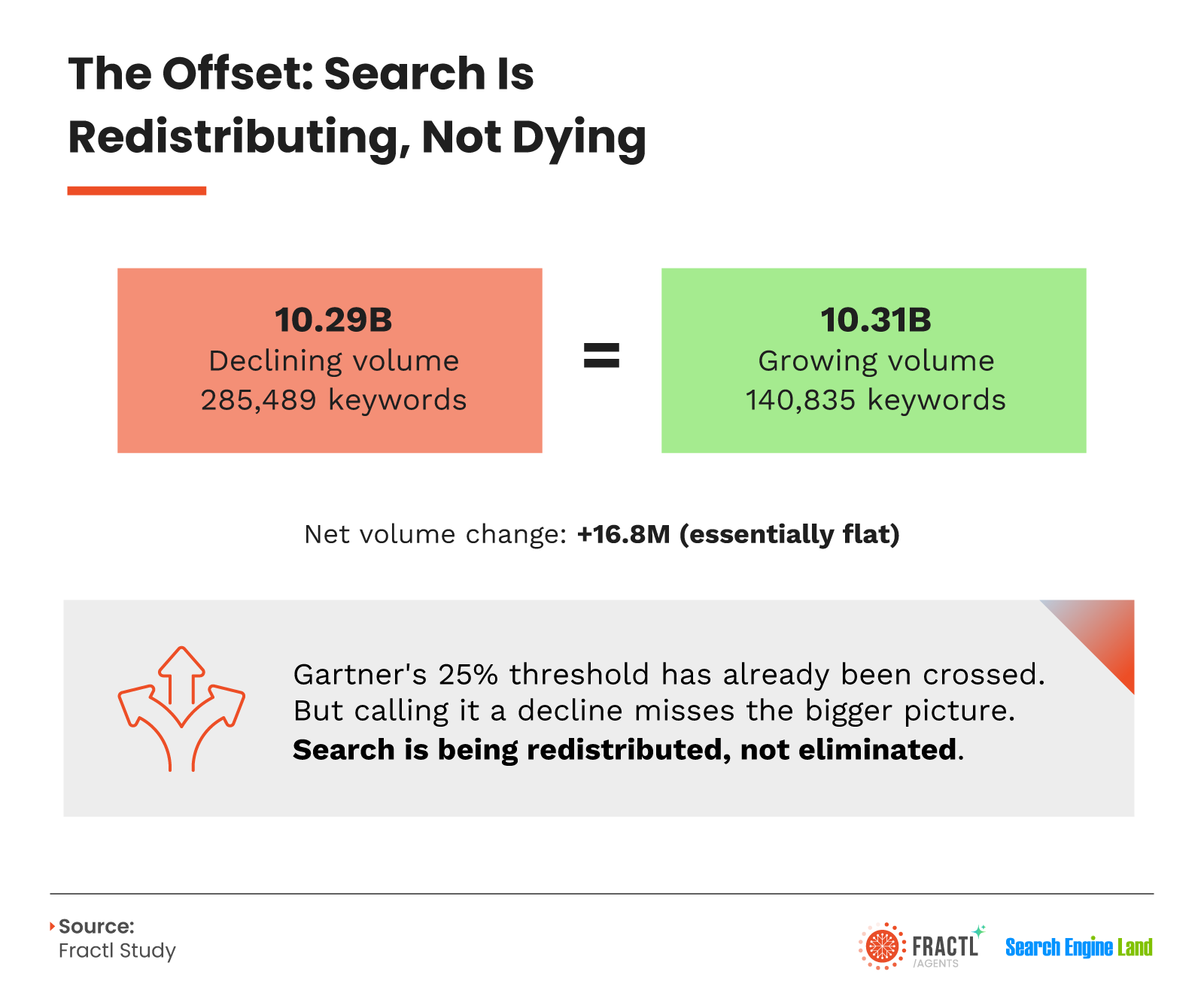
The core finding of the study challenges the alarmist "SEO is dead" narrative. While a massive portion of historical search volume is indeed evaporating from traditional query formats, an equivalent volume is emerging in new search patterns.

+-----------------------------------------------------------------+
|                       THE SEARCH BALANCE SHEET                  |
+-----------------------------------------------------------------+
|  Declining Keywords (285,489 terms)   |  ~10.29 Billion Monthly |
|  Growing Keywords (140,835 terms)     |  ~10.31 Billion Monthly |
+-----------------------------------------------------------------+
|  Net Monthly Change                   |  +16.8 Million Searches |
+-----------------------------------------------------------------+
Key Takeaways from the Research:
- The Flatline Illusion: Overall aggregate search demand remains essentially flat. The study tracked a net change of just +16.8 million searches per month across a dataset representing 35.4 billion monthly searches.
- The 29% Chasm: Across more than one million high-volume keywords, 29% of search volume is in a measurable, year-over-year decline.
- Information vs. Transaction Split: The decline is heavily concentrated in informational verticals. Verticals where users seek quick facts (such as HealthTech and FinTech) are suffering severe traffic drops. Conversely, transactional and comparison-based verticals (such as SaaS, Lifestyle, and Travel) continue to experience search growth.
- The Rise of "Generative Engine Optimization" (GEO): Brand visibility within AI chatbot responses is rapidly emerging as the new equivalent to top organic search rankings. Nearly 60% of consumers indicate they are likely to visit a brand’s website after it is recommended by an AI assistant.
2. Chronology: From the 2024 Gartner Forecast to the 2026 Reality
To understand how the search ecosystem reached this inflection point, it is necessary to trace the timeline of AI integration into consumer search habits over the past several years.
   2024                           2025                           2026 (Present)
    |                              |                              |
    +-- Gartner Predicts           +-- Rapid AI Adoption          +-- Study Confirms
        25% Search Drop                Search Engines deploy          29% Decline in High-Volume
        by 2026 due to                 AI Overviews; User             Keywords; Total Search
        AI Chatbots.                   habits begin to bifurcate.     Volume Remains Flat.
February 2024: The Gartner Warning
Research firm Gartner released a widely cited prediction stating that traditional search engine volume would drop 25% by 2026. Gartner warned that consumers would abandon standard search engines in favor of conversational AI chatbots and virtual agents. This forecast triggered widespread concern across the digital publishing, e-commerce, and SaaS sectors.
Mid-2024 to 2025: The Integration Phase
Search engines, led by Google and Microsoft, accelerated the deployment of AI-generated summaries directly into search engine results pages (SERPs) through features like Google’s AI Overviews. Concurrently, standalone platforms like OpenAI’s ChatGPT, Claude, and Perplexity gained mainstream traction. Consumer search habits began to bifurcate: users turned to chatbots for syntheses of complex topics while continuing to use traditional search engines for navigational and transactional queries.

April 2026: The Fractl & Search Engine Land Audit
To test Gartner’s prediction, Fractl and Search Engine Land initiated a comprehensive empirical study. By analyzing year-over-year search volume data through April 2026 alongside consumer survey data, the researchers sought to quantify the exact scale of the migration from traditional search to AI-driven alternatives. The results confirmed that while Gartner’s 25% decline metric was directionally accurate for certain keyword classes, it missed the concurrent expansion of new search queries.
3. Supporting Data: A Deep Dive into the Numbers
The study combined massive keyword dataset analysis with direct consumer surveys to paint a comprehensive picture of modern search behavior.
Keyword Dataset Analysis
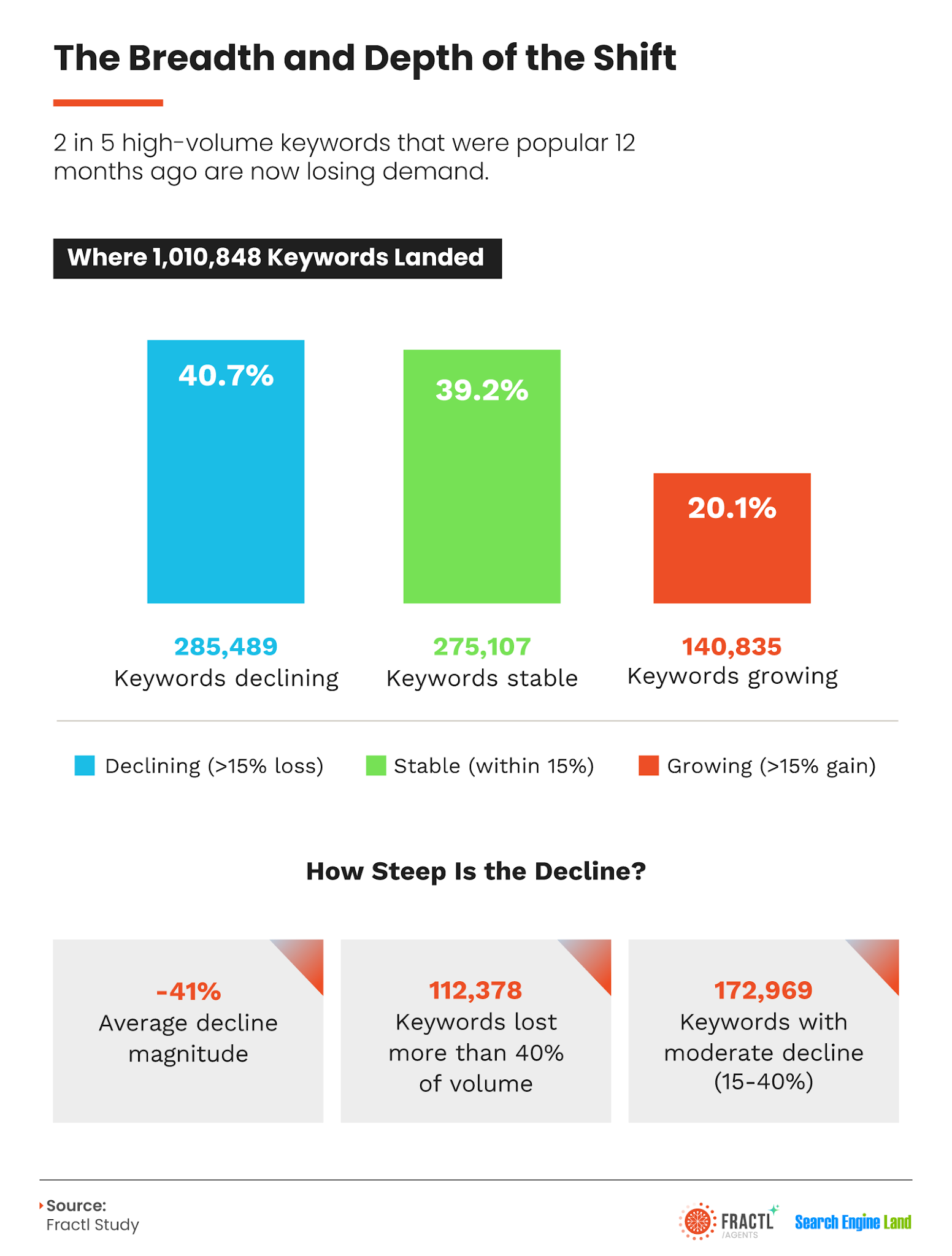
The researchers analyzed Semrush data for 1,010,848 high-volume keywords (defined as terms with 10,000 or more monthly searches) across 379 brands operating in eight distinct verticals.
Industry-Specific Search Volume Trajectories
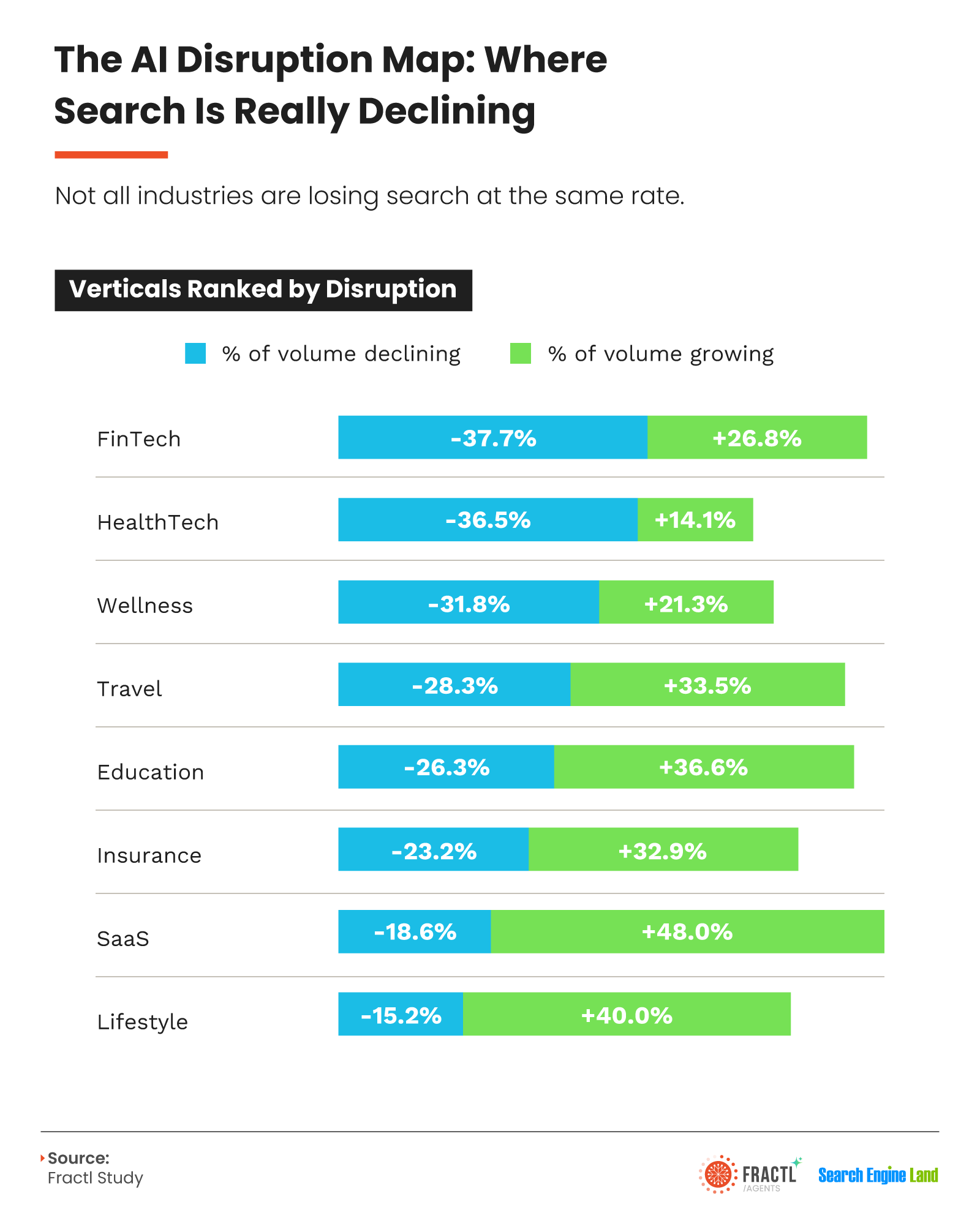
The impact of AI adoption is highly unequal across different business sectors. The data shows a stark divide between informational and transactional industries:
- FinTech: -37.7% (The largest overall decline, driven by AI’s ability to quickly summarize financial concepts, definitions, and rates).
- HealthTech: -31.4% (Highly vulnerable to direct answers regarding drug interactions, symptoms, and medical terminology).
- Wellness: -30.9% (A significant drop in general advice and explanatory queries).
- Education: -28.2% (Decline in basic informational lookups and definitions).
- Travel: -24.8% (Relatively stable, as users still need to navigate to booking engines).
- SaaS: +48.0% growth (High-intent transactional terms and brand comparisons continue to expand).
- Lifestyle: -15.2% (The lowest decline; highly visual and product-centric queries remain resistant to text-only AI synthesis).
INDUSTRY SEARCH DECREASES VS. GARTNER'S 25% BENCHMARK

FinTech    =================================== 37.7% (Above Benchmark)
HealthTech ============================= 31.4% (Above Benchmark)
Wellness   ============================= 30.9% (Above Benchmark)
Education  ========================== 28.2% (Above Benchmark)
------------------ GARTNER BENCHMARK (25%) ------------------
Travel     ======================== 24.8% (Below Benchmark)
Lifestyle  =============== 15.2% (Below Benchmark)
The Keyword Balance Sheet
While 40.7% of tracked high-volume keywords are in measurable decline (losing more than 15% of their volume year-over-year), 20.1% of keywords are growing by that same threshold.
The declining keyword group represents a loss of roughly 10.29 billion in monthly search volume. However, the growing keyword group accounts for an increase of 10.31 billion in monthly volume. This indicates that while fewer keywords are growing, those that do are high-density, carrying larger individual search volumes.
Consumer Search Habits and Platform Diversification
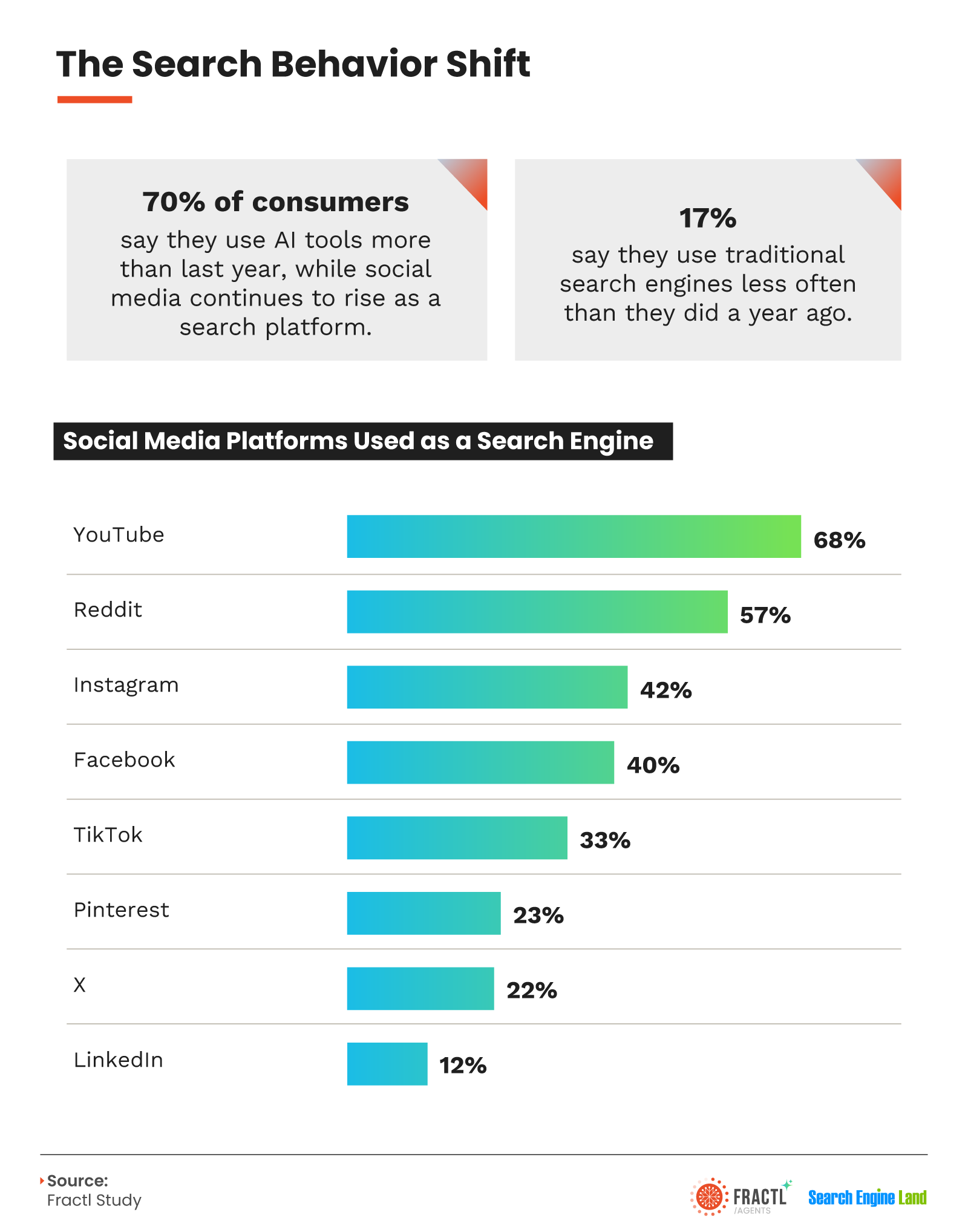
The survey of 1,004 U.S. consumers revealed that search behaviors are fragmenting across multiple platforms rather than consolidating into a single tool:
- 70% of consumers report using AI tools more frequently than they did a year ago.
- Only 17% of consumers state they are using traditional search engines less.
- Alternative Search Destinations: Social and community platforms are increasingly functioning as search engines. When looking for information, users rely on:
- YouTube: 68%
- Reddit: 57%
- Instagram: 42%
- Facebook: 40%
- TikTok: 33%
4. Industry Analysis: The Evolution of Search
To understand these shifts, industry analysts point to the fundamental difference between informational and transactional search intent.
When a user submits an informational query—such as "What is a deductible?" or "What are the side effects of ibuprofen?"—an AI chatbot can synthesize a complete, highly accurate answer within the chat interface. Because the user’s information need is fully met, there is no incentive to click a link or perform a follow-up search on Google. This explains the steep declines observed in FinTech and HealthTech search volumes.
Informational Query Flow (e.g., FinTech, HealthTech)
[User Query] ---> [AI Chatbot / AI Overview] ---> [Complete Answer Provided] ---> [Session Ends (No Click-Through)]

Transactional Query Flow (e.g., SaaS, Lifestyle)
[User Query] ---> [AI Chatbot / AI Overview] ---> [Brand Recommended] ---> [Secondary Search on Google] ---> [Purchase Site]
Conversely, transactional and commercial queries—such as "Best project management software for remote teams" or "Mid-century modern couch reviews"—require the user to compare options, evaluate pricing, view images, and ultimately execute a transaction on a third-party site. Even if an AI chatbot provides a recommendation, the consumer typically performs a secondary, brand-specific search on Google before purchasing. This creates a "downstream search" effect, fueling the search volume growth observed in the SaaS and Lifestyle verticals.
5. Implications: Redefining the Modern SEO and Content Strategy
For marketing departments, CMOs, and SEO practitioners, the implications of this study are clear: strategies built on capturing high-volume, low-intent informational queries are no longer viable.
1. Shift Focus from Keyword Volume to Keyword Velocity
Marketers must audit their keyword portfolios to distinguish between declining informational terms and growing transactional terms. Content creation should pivot toward queries that represent stages of the funnel where human verification, comparison, and transaction are still required.

2. Optimize for Generative Engine Optimization (GEO)
As AI search engines and conversational interfaces capture a larger share of primary queries, brands must optimize for visibility within chatbot outputs. This involves:
- Digital PR and Earned Media: AI models rely heavily on high-authority, third-party publications, reviews, and news coverage to form recommendations. Landing coverage in these outlets is critical for training the LLMs to recognize your brand.
- Entity Building: Establishing clear, structured data and schema markup to help search engine crawlers and LLMs easily understand your brand’s products, services, and niche.
- Niche Authority: Creating deeply researched, original content that cannot be easily replicated or synthesized by a basic chatbot query.
3. Embrace Multi-Platform Search Optimization
With YouTube and Reddit commanding massive search market share (68% and 57% respectively), a brand’s search strategy must extend beyond Google. Optimizing video content for YouTube’s search algorithm and actively engaging in or monitoring brand sentiment on Reddit are now core components of a modern search strategy.
The Five-Year Outlook
Despite the rapid rise of AI, traditional search is not going away. When asked if Google would remain their primary search tool in five years, 52% of consumers answered affirmatively, while only 20% said probably or definitely not.
The brands that survive and thrive in this shifting landscape will not be those that fight the rise of conversational AI, but those that adapt their content to become the authoritative answers that these AI engines recommend.
 Jia Lissa
  Layla Zulfa