
 By Layla Zulfa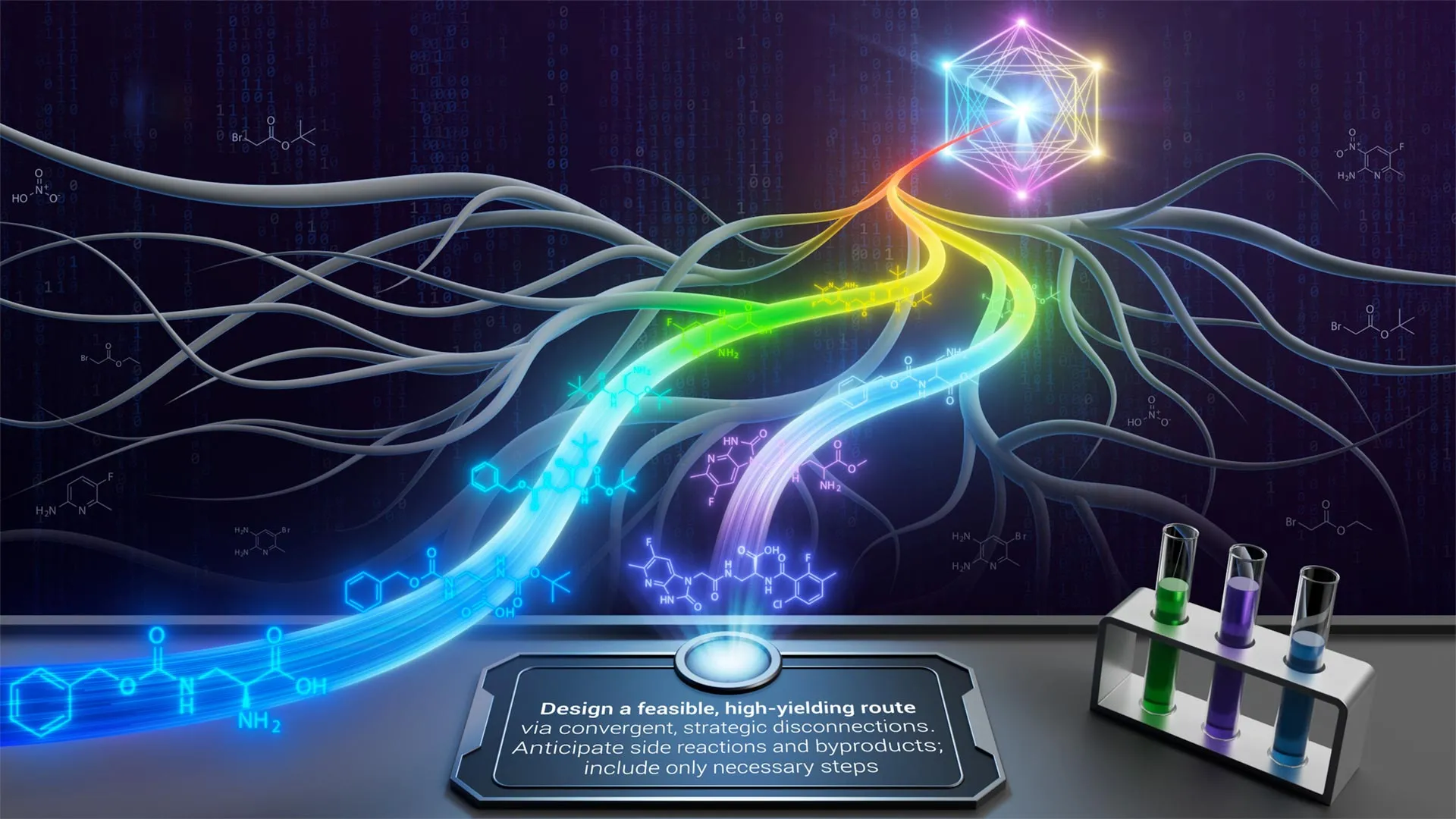
For centuries, the art of molecular synthesis has been the "black box" of the scientific world. Crafting a novel molecule—whether it is a life-saving pharmaceutical designed to bind to a specific protein or a high-performance polymer for next-generation electronics—is arguably one of the most intellectually demanding tasks in human endeavor. It is a process of strategic high-stakes chess, where a chemist must navigate billions of potential chemical configurations, often relying on years of hard-won intuition to decide which reaction path will lead to success and which will end in a costly, time-consuming dead end.
Today, that paradigm is shifting. Researchers led by Philippe Schwaller at the École Polytechnique Fédérale de Lausanne (EPFL) have unveiled a breakthrough framework called Synthegy. By leveraging the reasoning capabilities of large language models (LLMs), the team has bridged the gap between raw computational power and human chemical intuition, creating a system that allows scientists to "talk" their way through the most complex synthetic challenges in existence.
The Retrosynthesis Hurdle: Mapping the Molecular Maze
To understand the magnitude of this innovation, one must first appreciate the difficulty of retrosynthesis. In the traditional chemical workflow, a scientist identifies a target molecule—a complex architecture of atoms—and must work backward to determine the simplest, most cost-effective, and environmentally sustainable starting materials.
This "reverse-engineering" process is fraught with variables. A chemist must determine the precise order of operations: Which carbon-carbon bond should be formed first? Are there sensitive functional groups that need to be shielded by "protecting groups" to prevent unwanted side reactions? Should a ring structure be closed early in the process or left for the final steps?
Historically, computers have been excellent at the "search" aspect of this problem—scanning the vast "chemical space" of possible reactions. However, they have consistently failed at the "strategy" aspect. A computer might suggest a theoretically valid pathway that is practically absurd, such as one requiring a reagent that would destroy the very molecule it is meant to build. The nuance of chemical judgment—the ability to look at a structure and intuitively sense the most elegant route—has remained a strictly human domain.
Chronology of a Breakthrough: From Search Engines to Reasoning Tools
The evolution of computational chemistry has followed a distinct trajectory, one that the EPFL team has now fundamentally altered.
The Early Era: Rule-Based Systems
In the late 20th century, digital chemistry relied on expert systems. These were databases filled with hard-coded rules derived from textbooks. If a chemist wanted to know if a reaction would work, the computer checked it against a list of "if-then" conditions. These systems were rigid, struggled with novel chemistry, and required constant manual updates.
The Machine Learning Pivot
The last decade saw the rise of deep learning. Researchers trained neural networks on millions of known chemical reactions. These models became remarkably good at predicting whether a reaction would proceed (the "forward" prediction). However, they were "black boxes"; they could give an answer, but they couldn’t explain why or adapt to the specific strategic constraints of a human researcher.
The Synthegy Paradigm
The development of Synthegy, detailed in the journal Matter, marks the third phase: the integration of LLMs as reasoning engines. Rather than replacing the search algorithms that scan chemical databases, the EPFL team repositioned LLMs as high-level "evaluators." The system acts as a translator between the rigid, binary logic of a computer and the flexible, strategic language of a human chemist.
Synthegy: A Unified Natural Language Interface
The core innovation of Synthegy lies in its accessibility. By using natural language as the interface, the framework removes the need for researchers to learn complex, non-intuitive software parameters.
Strategic Steering
With Synthegy, a chemist can input a prompt as simple as: "Synthesize this molecule, but avoid the use of protecting groups whenever possible," or "Focus on a route that allows for a late-stage ring closure."
The system then interacts with standard retrosynthesis software to generate a library of potential pathways. Unlike older tools that simply rank these by probability, Synthegy converts each pathway into a descriptive text format. The LLM then "reads" these paths, evaluates them against the chemist’s original strategy, and provides a ranked list accompanied by a detailed, human-readable justification for its choices.
Mechanistic Insight
The framework extends its reach into the domain of reaction mechanisms—the step-by-step dance of electrons that defines how one molecule transforms into another. By breaking down reactions into elementary electron movements, Synthegy can simulate the "logic" of a reaction. If a proposed mechanism violates fundamental physical laws or common chemical intuition, the model flags it. This allows researchers to avoid the "trial and error" bottleneck that typically consumes months of laboratory time.
Supporting Data: Validating the AI Chemist
The efficacy of Synthegy was put to the test in a rigorous double-blind study involving 36 professional chemists. The researchers provided the participants with 368 unique evaluations comparing human-generated strategies against those filtered or suggested by the Synthegy framework.
The results were compelling:
- 71.2% Agreement: In nearly three-quarters of the cases, the AI’s ranking of synthetic routes matched the professional consensus of the chemists.
- Error Detection: The model successfully flagged redundant protecting steps—a common inefficiency in synthetic planning—and correctly prioritized routes that were more "atom-efficient."
- Scalability: The team observed a direct correlation between model size and reasoning capability. While smaller models struggled with the nuances of complex functional group interactions, larger language models demonstrated a sophisticated grasp of both simple transformations and multi-step synthesis.
Official Responses and Expert Perspectives
The lead author of the study, Andres M. Bran, emphasizes that the goal of the project was never to replace the chemist, but to augment their cognitive reach. "When making tools for chemists, the user interface matters a lot," Bran noted in the publication. "Previous tools relied on cumbersome filters and rules that often frustrated users. With Synthegy, we’re giving chemists the power to just talk to their tools, allowing them to iterate much faster and navigate more complex synthetic ideas."
Philippe Schwaller, who headed the research, views this as a foundational step toward "autonomous laboratories." By bridging the gap between synthesis planning (the "what") and reaction mechanisms (the "how"), the team has created a unified language that computers and humans can speak simultaneously. "We usually use mechanisms to discover new reactions that enable us to synthesize new molecules," says Bran. "Our work is bridging that gap computationally through a unified natural language interface."
Implications: The Future of Drug Discovery and Material Science
The implications of the Synthegy framework are profound, particularly for industries where time-to-market is a critical metric.
Accelerated Drug Discovery
In pharmaceutical research, the ability to synthesize a "lead" compound faster can shave months or years off the drug development timeline. By using AI to filter out non-viable routes before a single drop of reagent is mixed in a flask, pharmaceutical companies can focus their resources on the most promising candidates, significantly reducing the cost of R&D.
Sustainable Chemistry
As the world moves toward "Green Chemistry," efficiency is paramount. Synthegy’s ability to minimize unnecessary steps—such as the addition and removal of protecting groups—directly contributes to reducing chemical waste. By prioritizing shorter, more direct routes, the framework supports a more sustainable approach to industrial production.
Democratization of Expertise
Perhaps the most transformative potential of Synthegy lies in its ability to mentor. By explaining the "why" behind its rankings, the model serves as an educational tool for junior chemists. It exposes them to the strategic reasoning of experts, effectively accelerating the learning curve for those entering the field.
Conclusion: A New Partnership
Synthegy does not represent the end of the human chemist’s role in the laboratory; rather, it represents the beginning of a more sophisticated partnership. As the complexity of molecules continues to grow, the cognitive load on scientists is becoming unsustainable. By offloading the "search and filter" phase to an AI that can reason in natural language, scientists are liberated to focus on what they do best: conceptualizing the next generation of materials and medicines that will define the future.
The "black box" of chemistry is being opened, not by brute force, but by the power of language. Through Synthegy, the dialogue between the chemist and the computer has finally begun.
 Sagoh
Sagoh  Asro
Asro  Siti Muinah