
 By Raul Delapena Setiawan
In a landmark development for the digital economy, Amazon Web Services (AWS) has introduced a groundbreaking capability for its AWS WAF (Web Application Firewall) service: native AI traffic monetization. This strategic shift allows content owners and publishers to finally reclaim value from the massive surge in AI bot traffic that has historically drained infrastructure resources without providing reciprocal engagement, such as ad impressions or subscription conversions. By enabling publishers to charge AI agents directly at the network edge, AWS is setting a new precedent for the symbiotic relationship between content creators and the developers of large language models (LLMs).
The Shifting Landscape of Web Traffic
For decades, the internet’s value proposition was predicated on a cycle of search engine indexing leading to human referral traffic. However, the rise of Generative AI has fundamentally disrupted this model. Recent data indicates that AI bot traffic now accounts for more than 50% of web traffic for many providers, with specialized AI crawlers experiencing a staggering 300% year-over-year growth.
Unlike traditional search crawlers, which index content to drive traffic back to the source, modern AI agents consume vast quantities of proprietary data to generate summaries, answers, and synthetic content directly within AI interfaces. This "zero-click" behavior creates a significant financial imbalance: publishers bear the heavy infrastructure costs of serving their content to these bots while losing the potential for monetization through ads or paywalls. Until now, the only tools available to publishers were reactive—blocking or rate-limiting traffic via tools like AWS WAF Bot Control. The new monetization capability transforms this dynamic from a defensive posture to a revenue-generating asset.
Chronology of a Paradigm Shift
The integration of payment protocols into firewall logic is a significant evolution of network security. The journey toward this release can be viewed through several distinct phases:
Phase 1: The Visibility Gap (2023–2024)
As LLM adoption exploded, publishers began reporting massive, unexplained spikes in bandwidth costs. AWS WAF Bot Control provided the necessary visibility, allowing administrators to identify that a significant portion of their traffic was being consumed by agents like GPTBot, Claude-Web, and Perplexity-Bot. However, identifying the traffic was merely the first step; the inability to negotiate individual licensing agreements with hundreds of autonomous agents meant that most publishers were left with an "all or nothing" choice: block the bot entirely or subsidize its training data for free.
Phase 2: The Infrastructure Pivot (Early 2025)
AWS began prototyping a "machine-to-machine" payment flow that moved away from human-centric credit card transactions, which are ill-suited for the high-velocity, automated nature of AI crawlers. The focus shifted toward standardized protocols that could function at the network edge, minimizing latency while ensuring secure settlement.
Phase 3: The Deployment of x402 (June 2026)
In June 2026, AWS officially launched AI traffic monetization. By leveraging the Coinbase x402 Facilitator, AWS bridged the gap between traditional web infrastructure and decentralized payment settlement. This integration allows AWS WAF to return an HTTP 402 "Payment Required" status code—a long-dormant but technically perfect HTTP response—to incoming AI agents.
Supporting Data: Why Publishers Need This Now
The economic argument for this technology is built on hard metrics. According to internal AWS usage analysis, the "infrastructure tax" paid by content providers to host AI scrapers is no longer sustainable.

- Traffic Composition: AI crawlers now constitute the majority of non-human traffic.
- The Cost of "Zero-Click": Publishers serving high-resolution media or extensive text databases report that AI bots account for up to 40% of their total monthly cloud egress costs.
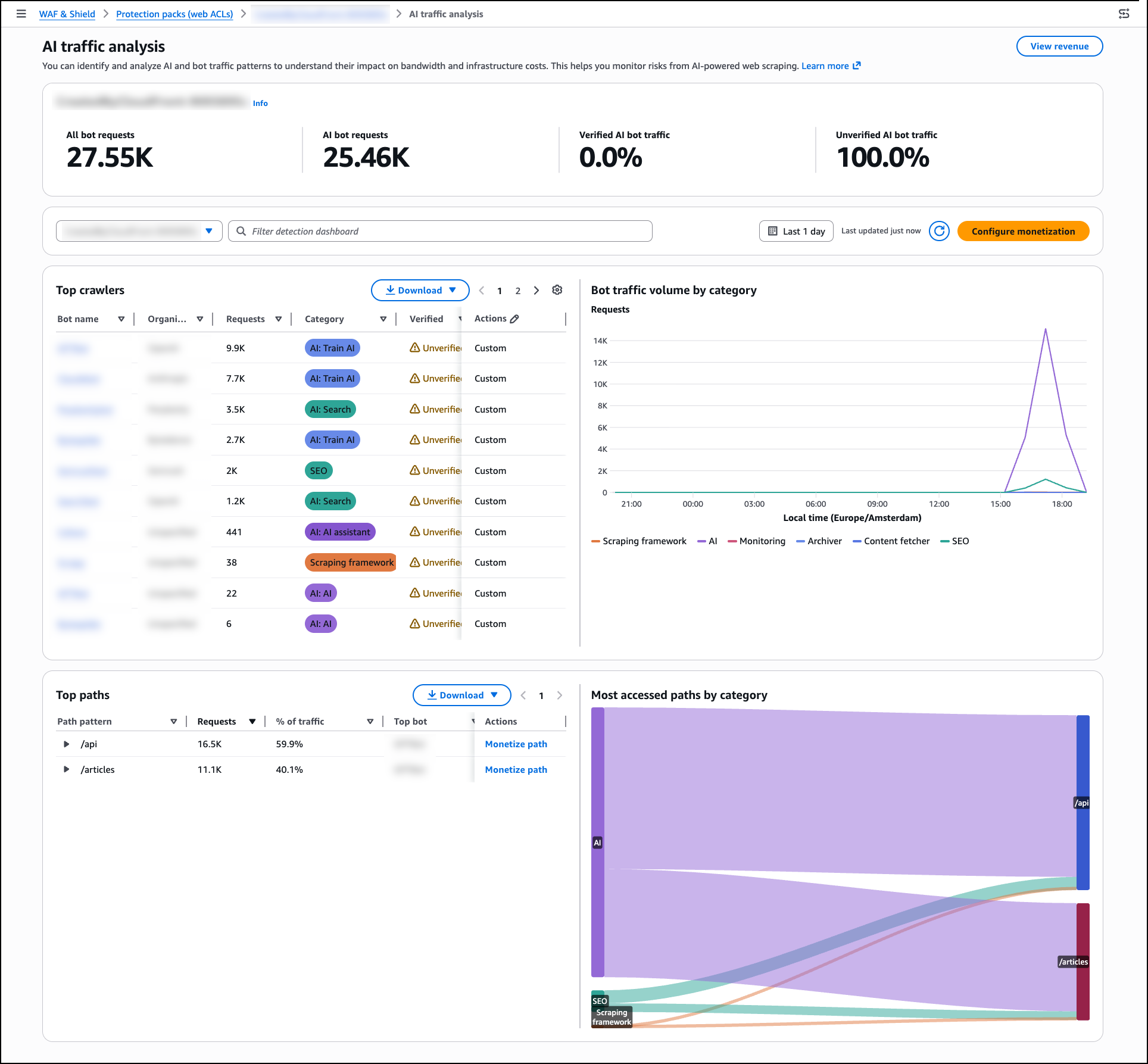
- Verification Tiers: By utilizing AWS WAF’s classification engine, which recognizes over 650 distinct bot types, publishers can now differentiate between "good" crawlers (which provide SEO value) and "parasitic" bots (which scrape data for competitor models).
The new dashboard provides granular metrics, including bandwidth consumption per bot type, estimated monthly cost of unmonetized traffic, and a heatmap identifying which content paths are most valuable to AI trainers.
Implementation: How the "Monetize" Action Works
The technical implementation of this feature is designed for scalability. Rather than requiring publishers to modify their application code or build custom billing backends, the monetization logic resides entirely within the AWS WAF edge environment.
The Protection Pack Configuration
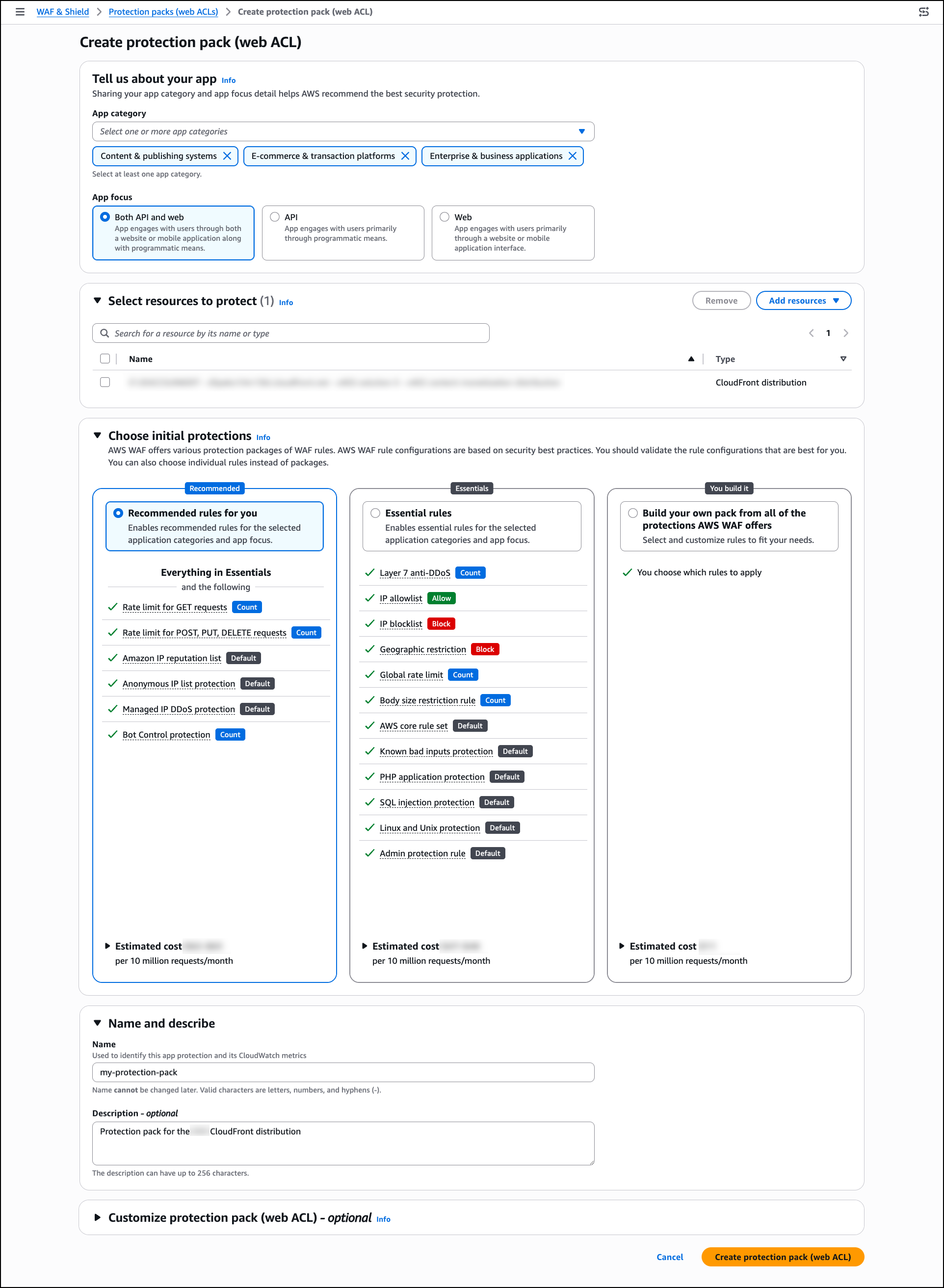
The core unit of configuration is the "Protection Pack." Administrators define their content scope, specify pricing in USDC (USD Coin), and select their preferred blockchain network. Because settlement occurs on-chain, publishers can receive payments directly to any supported wallet, including those managed by Coinbase or private cold-storage solutions.
The x402 Protocol Flow
When an AI bot requests a protected resource, the process unfolds as follows:
- Detection: AWS WAF identifies the requester as an AI bot.
- Challenge: Instead of blocking the request, the WAF returns a 402 Payment Required response.
- Manifest Delivery: The response includes a JSON-formatted manifest detailing the price, the accepted network, and the destination wallet address.
- Autonomous Settlement: A compatible AI agent, if configured to do so, automatically submits a signed payment authorization to the blockchain.
- Access: Upon verification, the WAF grants the agent access to the content, and the payment is settled on-chain.
This autonomous cycle removes the need for human intervention or the negotiation of restrictive licensing agreements, enabling a liquid, market-driven price for data access.
Implications for the Future of the Web
The introduction of native AI monetization via AWS WAF has profound implications for the future of the internet’s content ecosystem.
Rebalancing the AI Value Chain
This move forces AI companies to internalize the cost of the data they ingest. If an AI developer wants to train their model on high-quality, proprietary journalism or research, they must now account for the per-request cost of accessing that data. This effectively creates a "Data Marketplace" where the price of content is determined by its value to the AI agent.
A Potential Conflict with Open Access
Critics may argue that this could lead to a "pay-to-play" internet where only the most well-funded AI companies can access high-quality information, potentially creating a disparity between AI models. However, proponents suggest that this is the only way to save the independent publishing industry, which has been cannibalized by AI-generated search summaries.
The Rise of "Machine-to-Machine" Economies
Perhaps the most significant long-term implication is the normalization of the x402 protocol. By standardizing how machines pay each other for services, AWS is paving the way for a broader "Machine Economy." In this future, micro-payments for data, compute power, and API access will happen in milliseconds, entirely in the background, without a single human interaction.
Official Guidance and Best Practices
AWS emphasizes that this feature is currently available exclusively for Amazon CloudFront distributions, ensuring that payments are processed as close to the user as possible to maintain performance.
For organizations looking to deploy this, AWS recommends:
- Start with "Count" Mode: Use the monitoring tools to observe bot behavior without imposing charges. This allows publishers to gauge how much their traffic is worth and identify which bots are most active.
- Utilize Test Mode: The ability to switch between "Real" and "Test" currency modes is critical. Publishers should utilize testnets (like Base Sepolia) to ensure their payment manifests and wallet integrations are configured correctly before going live.
- Phased Implementation: Start by monetizing specific high-value content paths rather than the entire site. This allows for a "freemium" model where general navigation remains free, but deep data access requires payment.
Conclusion
The era of the "free ride" for AI crawlers is drawing to a close. With AWS WAF’s new AI traffic monetization capability, the power dynamic of the internet is shifting back toward the creators. By providing a secure, automated, and scalable way to extract value from AI activity, Amazon is not just updating a firewall—it is providing the financial infrastructure for the next generation of the digital economy. Whether this leads to a more sustainable publishing model or a more fragmented web remains to be seen, but one thing is certain: the cost of training the next great AI model just got a lot more transparent.
 Neng Nana
  Suro Senen
  Lina Hope