
 By rifanmuazin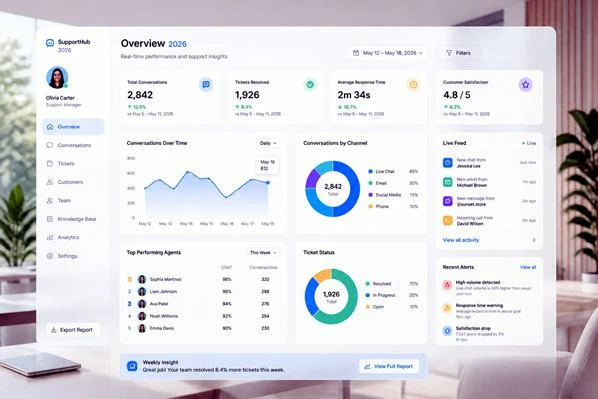
In the modern customer support landscape, waiting for the end-of-week report to identify service gaps is akin to performing an autopsy after the patient has already left the building. As consumer expectations for instantaneous resolution skyrocket, support leaders are shifting their focus from retrospective analysis to real-time observability.
By monitoring customer interactions as they unfold, organizations can now catch slow replies, inaccurate AI responses, and chaotic escalations while the shift is still in progress. This transition from "reporting" to "monitoring" is not merely a technological upgrade; it is a fundamental shift in how businesses maintain the human connection in an increasingly automated world.
The Shift: Moving from Retrospective Reporting to Live Observability
The traditional support model relies on lagging indicators—metrics that tell a story of what happened yesterday or last month. While these are useful for long-term strategic planning, they provide zero utility when a customer is currently trapped in a faulty AI loop or waiting on a silent chat queue.
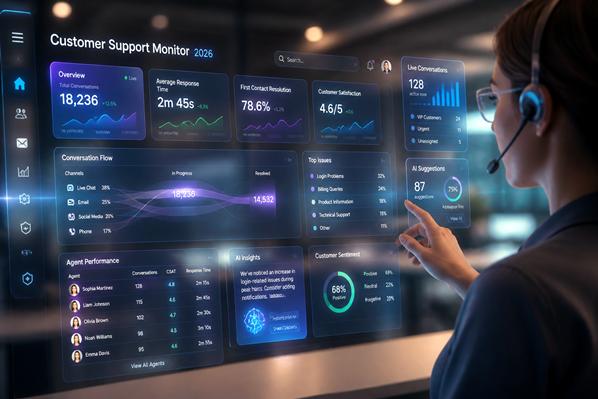
Real-time monitoring changes the paradigm by focusing on a select, high-impact set of metrics. The goal is not to flood managers with a dizzying array of charts, but to create a clean, actionable view of speed, quality, and sentiment. When every alert is tied to a specific, immediate next action, the dashboard ceases to be a passive display and becomes an active operational tool.
Defining the Metrics That Matter
To avoid "analysis paralysis," leadership must categorize metrics by their function:
- Leading Indicators (The Smoke Alarms): These metrics signal trouble in real-time. Key indicators include first response time, current queue length, active backlog, transfer rates, and live sentiment analysis. If a customer’s sentiment turns negative during a live chat, the system should flag it before the interaction ends.
- Lagging Indicators (The Results): These metrics confirm the efficacy of your interventions. Average handle time (AHT), resolution rates, CSAT scores, and repeat contact rates are vital for verifying that the "fix" applied during the shift actually solved the customer’s underlying problem.
According to HubSpot’s Annual State of Service Report, 90% of customers consider an immediate response to be "important" or "very important." However, speed without accuracy is a liability. A 20-second response that provides incorrect information only compounds customer frustration. Thus, the objective of real-time monitoring is to balance the velocity of the response with its quality.
The Dual Architecture: AI vs. Human Agent Monitoring
A common pitfall in modern support operations is the attempt to force AI agents and human agents into the same performance scorecard. While they both contribute to the same customer experience, they require distinct oversight mechanisms.
Monitoring the Digital Workforce (AI)
AI agents are software-driven and require technical guardrails. Monitoring should focus on:
- Intent Match & Accuracy: Did the bot correctly interpret the customer’s request?
- Confidence Scores: When does the AI feel "unsure," and does it know when to escalate?
- Fallback Rates: How often is the bot failing to find a resolution and punting to a human?
- Brand Safety: Are the responses within the company’s tone, policy, and ethical guidelines?
Monitoring the Human Element
Human agents possess the nuance that AI often lacks—empathy, complex problem-solving, and emotional intelligence. PwC research indicates that 59% of consumers feel companies have "lost touch" with the human element. Consequently, human-centric dashboards should monitor:
- Tone and Empathy: Is the agent connecting with the customer?
- Policy Adherence: Are they following established workflows while exercising necessary judgment?
- Handoff Quality: When an AI transfers a case to a human, is the transition seamless, or does the customer have to repeat themselves?
Building the Command Center: A Tactical Approach
A dashboard is only as good as the data it consumes. To be truly "real-time," data must be pulled from the source of truth—chat platforms, ticketing systems, telephony logs, and CRM records—with minimal latency.
The Anatomy of an Effective Dashboard
- Near-Real-Time Sync: If the dashboard lags by more than a few minutes, it becomes a "history lesson" rather than a tool for management.
- Drill-Down Capability: A manager should be able to click on a red alert—such as a spike in negative sentiment—and instantly view the specific chat transcript or call recording that triggered the alarm.
- Role-Based Views:
- Team Leads: Need visibility into queue health and agent bandwidth.
- QA Managers: Need to see patterns of failure and trends across interactions.
- Operations Leaders: Need high-level views of volume, SLA risks, and channel distribution.
The Art of the Alert
Alerts must be calibrated with precision. If the threshold is too loose, problems go unnoticed; if it is too tight, "alert fatigue" sets in, causing the team to ignore the system entirely. Alerts should be triggered by objective anomalies: a sudden 20% drop in resolution rates, a surge in "Agent, please" requests, or a decline in bot confidence scores.
From Insight to Action: The Chronology of Intervention
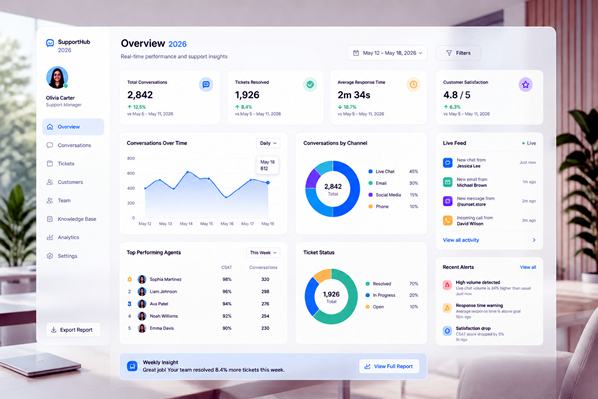
Monitoring is the easy part; the difficulty lies in the response. When a dashboard turns red at 2:17 p.m., what happens next?
Immediate Intervention (The "In-Shift" Correction)
- Dynamic Routing: If a specific queue is overwhelmed, real-time routing can divert complex cases to senior agents while automating simpler tasks to AI.
- Mid-Shift Coaching: If a supervisor notices an agent is struggling with a new policy, they can provide a quick, private message to correct the behavior before the next interaction, preventing the "domino effect" of poor service.
- AI Tuning: If the AI is failing on a specific, newly released product question, the system should allow administrators to update the knowledge base or modify prompt instructions within minutes, not days.
The Cost of Inaction
The financial and reputational stakes are high. PwC reports that 32% of customers will abandon a brand they love after just one bad experience. In the era of social media and real-time reviews, a single hour of poor service can lead to long-term customer churn. Proactive management isn’t just about efficiency—it is a competitive necessity for retention.
Maintaining Balance: Ethics and Accuracy
While data-driven management is powerful, it must be balanced with human context. One bad interaction does not make a poor agent, and one misinterpreted query does not mean the AI is broken.
Avoiding Metric Conflict
Leaders must be careful not to create perverse incentives. For example, focusing too heavily on "Average Handle Time" can encourage agents to rush customers off the phone, leading to higher "reopen rates" later. Effective monitoring looks at the cluster of data: if handle time is dropping while reopen rates are rising, the dashboard is signaling that efficiency is being prioritized over resolution.
Privacy and Trust
As organizations collect more granular data on customer and agent behavior, data privacy must remain paramount.
- Strict Access Control: Access to sensitive transcripts and personal customer information should be restricted to those who need it for performance improvement.
- Data Masking: Sensitive data should be anonymized where possible.
- Transparency: Agents should understand how their performance is being measured. When the methodology is transparent and consistent across the organization, it fosters trust rather than fear.
Conclusion: The Future of Support is Responsive
The goal of real-time monitoring is to create a support ecosystem that is as dynamic as the customers it serves. By integrating AI-driven insights with human-centered management, organizations can move from a reactive posture—where they are constantly cleaning up the messes of the past—to a proactive stance, where they are actively shaping the customer experience as it unfolds.
In a digital-first world, the speed at which you identify a problem is now a direct reflection of the value you place on your customers. Whether it is an AI agent that needs a nudge or a human agent who needs support, the ability to act in the moment is the defining characteristic of the world’s most successful support organizations.
 Iffa Jayyana
  Raul Delapena Setiawan
  Laily UPN