
 By Iffa Jayyana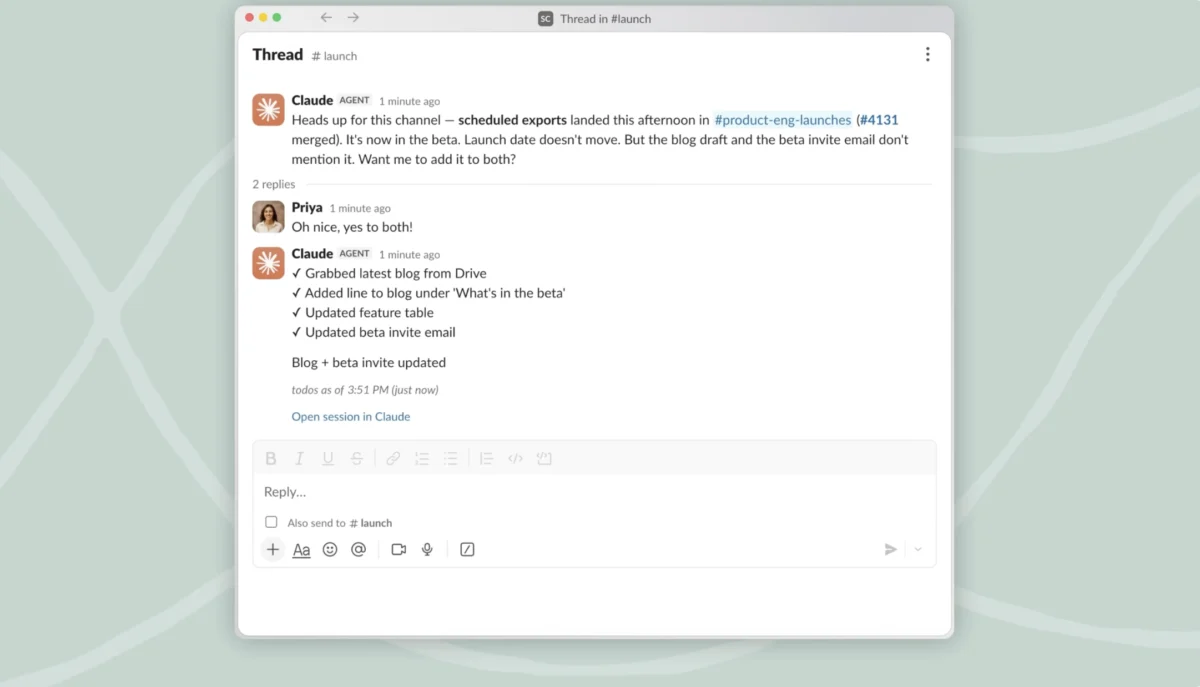
In the rapidly evolving landscape of enterprise artificial intelligence, the gap between a "chatbot" and a "coworker" is narrowing. Anthropic, the San Francisco-based AI research and safety company, has officially taken a significant stride toward bridging that divide with the introduction of Claude Tag. Designed as an "always-on" AI presence for Slack, Claude Tag moves beyond the transactional, on-demand nature of previous AI integrations, offering a persistent, context-aware teammate that lives directly within the flow of workplace communication.
Available in beta for Claude Enterprise and Claude Team customers, Claude Tag represents a fundamental shift in how organizations interact with large language models (LLMs). By allowing users to tag @Claude to delegate tasks, provide real-time insights, and maintain organizational memory, Anthropic is positioning its flagship AI as an indispensable member of the digital workforce.
The Evolution of AI Integration
To understand the significance of Claude Tag, one must look at the trajectory of Anthropic’s integration strategy. For the past year, the industry has moved from simple, standalone interfaces—where users had to visit a website to prompt an AI—to embedded agents that live within the tools workers already use.
Previously, users could DM @Claude in Slack or pull it into a channel for a quick query. Furthermore, the introduction of Claude Code allowed for specialized technical assistance, where the AI could handle complex coding tasks and report back to a thread. While effective, these tools were essentially "stateless" in the eyes of the team; once a conversation ended, the context was often lost, or at the very least, sequestered from other team members.
Claude Tag changes this dynamic. By existing as a persistent entity within a channel, the AI now builds a historical narrative. It learns the nuances of a project, the internal shorthand of a team, and the specific goals of ongoing initiatives. This evolution is not merely cosmetic; it represents the transition from AI as a "search engine" to AI as a "participant."
Chronology: How Anthropic Reached This Milestone
The path to Claude Tag has been one of incremental refinement. Following the launch of its Claude Enterprise tier, Anthropic identified a critical pain point: the "context tax." Employees were spending hours manually summarizing threads, transferring information between tools, and onboarding new team members to project histories.
- Early 2025: Anthropic solidified its foothold in the enterprise space with the launch of interactive Claude apps, integrating directly into workplace communication suites like Slack.
- Late 2025: The company experimented with "Claude Code," a specialized agent designed to handle technical workflows. This proved that AI could perform tasks in the background and update users asynchronously.
- Early 2026: Anthropic recognized that while specialized agents were useful, the lack of a shared, "ambient" memory was preventing deep collaboration.
- Present Day: The launch of Claude Tag fulfills the vision of a shared, persistent workspace where the AI holds the institutional memory of the channel.
The Mechanics of Persistent Memory
The core innovation of Claude Tag lies in its shared identity. When a user invites Claude into a channel, the AI is no longer a personal assistant; it is a shared team asset. Anyone in that channel can see what Claude has been working on, view the tasks it has been assigned, and seamlessly pick up a thread where a colleague left off.
Security and Scoping
Anthropic is acutely aware of the risks associated with persistent, context-aware AI—namely, the risk of "data leakage" across departments. To mitigate this, the service includes robust administrative controls. System administrators define the "perimeter" of the AI’s knowledge.
For instance, a Claude instance assigned to a Legal team channel will be strictly scoped to that environment. It cannot cross-pollinate with an Engineering channel, ensuring that sensitive data remains siloed according to corporate governance policies. Furthermore, admins control the specific tools and data sources the AI is permitted to access, allowing for a "least privilege" approach to AI intelligence.
Ambient Awareness and Task Management
Perhaps the most ambitious feature of Claude Tag is its "ambient mode." Rather than waiting for a direct prompt, the AI monitors the channel for relevance. If a task is mentioned that falls within its domain, Claude can proactively flag it, suggest solutions, or remind the team of pending deadlines.
When a user assigns a complex project to @Claude, the AI decomposes the request into distinct, actionable stages. It executes these stages using its authorized tools, posting updates directly into the Slack thread as it progresses. This "work in public" model creates transparency, allowing team members to see exactly how the AI is reasoning through a problem.
Implications for the Enterprise AI Land Grab
Anthropic’s move comes at a time of fierce competition for the "enterprise intelligence layer." As companies like Microsoft, Snowflake, and Databricks race to capture the internal data of the global workforce, the battle is no longer about which model is "smarter," but which model is more "integrated."
The Competitive Landscape
- Microsoft: Through its Graph and Copilot ecosystem, Microsoft is leveraging its deep integration with Office 365 and the underlying data fabric of the enterprise to keep Copilot relevant.
- Snowflake & Databricks: These platforms are positioning themselves as the "tacit knowledge" centers. They argue that if an AI doesn’t have access to the raw data stored in their warehouses, it cannot provide meaningful insights.
- Glean: A significant player in this space, Glean has carved out a niche by building an "intelligence layer" that sits between the LLM and enterprise data silos, effectively unifying search and discovery across fragmented workplace tools.
Anthropic’s strategy with Claude Tag is distinct because it prioritizes the human-AI conversation as the primary UI. While Microsoft focuses on the document (the file) and Snowflake focuses on the data (the table), Anthropic is focusing on the dialogue (the chat). By making Claude a participant in the Slack conversation, they are betting that the future of work happens in the thread, not just in the document.
Official Responses and Strategic Vision
In a statement regarding the launch, Anthropic emphasized that the goal is to reduce the friction of "context switching."
"As Claude follows along with its channel, it learns ever more about the work," the company stated. "Claude can also automatically gather facts from elsewhere in the organization, if it’s granted permission to read other channels."
The company believes that this creates a collaborative environment that feels less like using software and more like working with a highly capable, tireless colleague. By making the AI’s thought process visible—and by allowing it to operate autonomously within the boundaries of a team—Anthropic aims to set a new standard for AI-human synergy.
The Future of "Ambient" Work
What does this mean for the average employee? In the short term, it likely means fewer status update meetings and a significant reduction in the time spent hunting for information across different software platforms. If Claude Tag can successfully remember the context of a project, the need to "re-brief" team members—or the AI—becomes a thing of the past.
However, this also raises questions about the future of digital workplace etiquette. As AI agents become more proactive, companies will need to develop new norms for "AI-human collaboration." At what point does an AI’s proactive intervention become a distraction? How will companies audit the decisions made by an "ambient" agent that operates without constant human oversight?
Anthropic is clearly betting that the productivity gains outweigh these challenges. By embedding Claude directly into the social fabric of the enterprise, they are moving away from the "AI as a tool" paradigm and toward "AI as a colleague." As this beta rolls out, the tech world will be watching closely to see if the "always-on" Claude can truly deliver on the promise of frictionless, intelligent collaboration, or if it will require a new generation of management tools to keep the AI in check.
As the enterprise AI market matures, the success of Claude Tag will likely be a bellwether for the industry. If it gains widespread adoption, we may be looking at the beginning of a new era where "AI teammate" is a standard job title in every department, fundamentally altering the nature of the modern digital workspace.
 Sagoh
Sagoh  Lina Hope