
 By Nana Muazin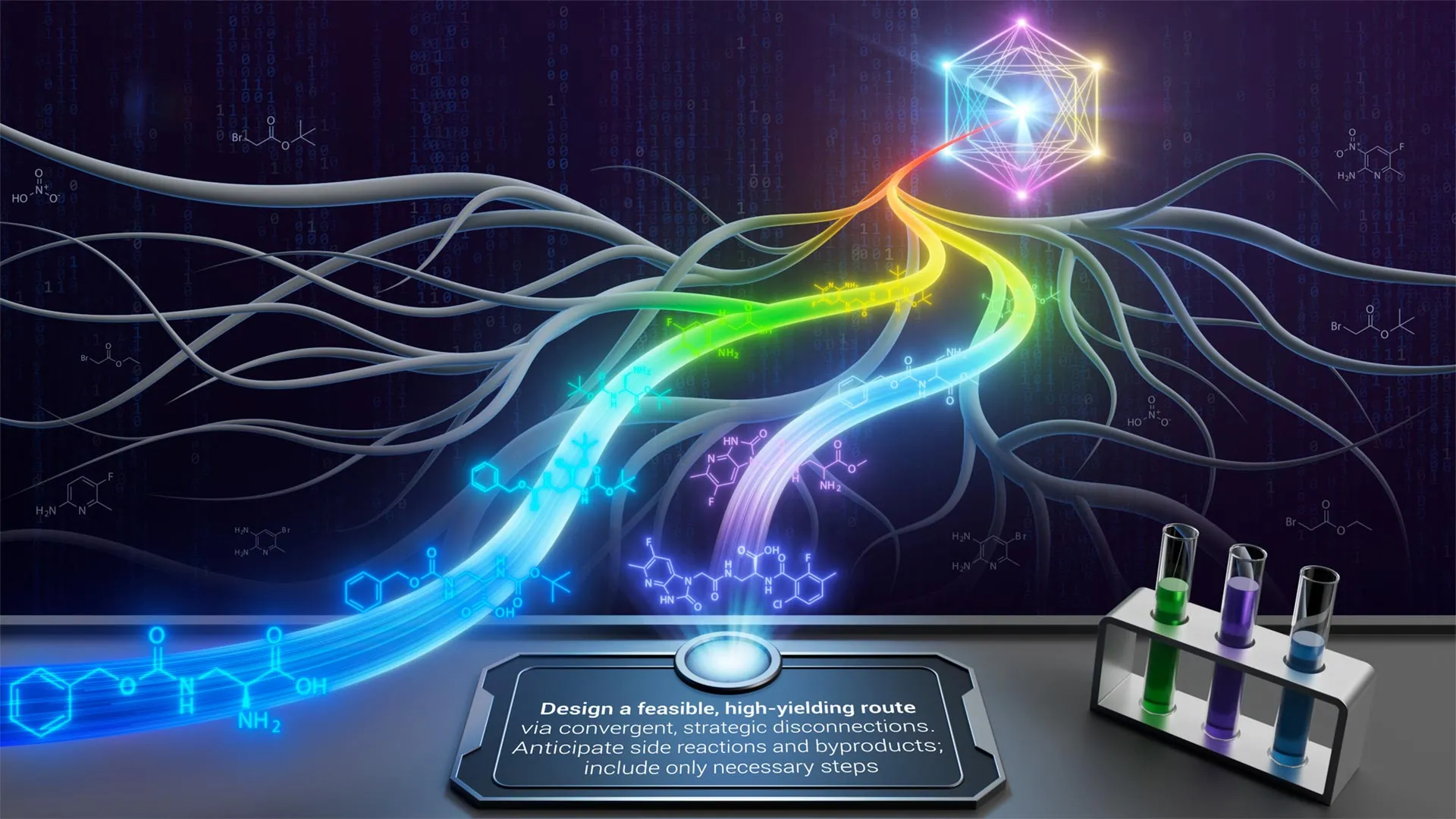
In the high-stakes world of medicinal chemistry and materials science, the creation of a new molecule is often compared to solving a multidimensional puzzle where the pieces are governed by the volatile, subatomic laws of quantum mechanics. For decades, the synthesis of complex compounds—whether for a life-saving oncology drug or a next-generation semiconductor—has been an artisanal pursuit, requiring years of doctoral training to master the art of "retrosynthesis."
However, a breakthrough from the Swiss Federal Institute of Technology Lausanne (EPFL) is poised to transform this labor-intensive discipline. Led by researcher Philippe Schwaller, a team has introduced "Synthegy," an innovative framework that leverages Large Language Models (LLMs) to bridge the gap between human strategic intuition and computational brute force. By treating chemical synthesis not just as a mathematical problem, but as a linguistic one, the researchers are fundamentally changing how chemists interact with the digital tools designed to assist them.
The Bottleneck of Chemical Intuition
To understand the magnitude of this advancement, one must first appreciate the Herculean effort required to design a synthetic route. Retrosynthesis involves working backward from a target molecule to discover commercially available starting materials. It is a process fraught with strategic dilemmas: Should a specific ring structure be formed early or late? Are certain functional groups too sensitive to survive the harsh reagents needed for the next step? Do we need to add a "protecting group" to prevent side reactions, even if it adds extra steps and reduces the final yield?
Historically, computational tools have struggled to answer these questions with the nuance of an experienced chemist. While algorithms can scan vast "chemical spaces" in seconds, they often lack the "strategic judgment" required to discard non-viable pathways. Furthermore, understanding reaction mechanisms—the precise, step-by-step movement of electrons—remains a domain where machines often fail to distinguish between theoretical feasibility and practical reality. Until now, the gap between the computational generation of a pathway and the human expert’s intuition has been a persistent wall, leading to endless cycles of trial and error in the laboratory.
Chronology of a Computational Shift
The evolution of computer-aided synthesis planning (CASP) has been characterized by three distinct phases:
- The Rule-Based Era (1960s–1990s): Early efforts relied on rigid, human-coded "if-then" rules. These systems were powerful but brittle, failing whenever a chemist encountered a novel structure not pre-programmed into the database.
- The Data-Driven Era (2010s–2023): The advent of deep learning allowed models to learn from millions of known reactions. While these models could predict products with high accuracy, they functioned as "black boxes," offering little in the way of reasoning or strategic alignment with a chemist’s specific project goals.
- The Reasoning Era (2024–Present): With the introduction of Synthegy, the focus has shifted from mere prediction to "chemical reasoning." By utilizing LLMs to evaluate and guide search algorithms, the field has entered an era where AI can communicate its rationale in natural language, effectively becoming a collaborative partner rather than just a calculator.
Synthegy: The Architecture of Dialogue
The Synthegy framework, detailed in the journal Matter, functions as a semantic layer between the chemist and the computational engine. Unlike previous AI models that were tasked with generating structures from scratch—a process prone to "hallucinations" or chemically impossible designs—Synthegy acts as a sophisticated evaluator.
When a chemist begins a project, they no longer need to navigate cumbersome, menu-driven interfaces. Instead, they provide a natural language prompt, such as: "Focus on forming the heterocyclic core early and avoid unnecessary protecting groups."
Synthegy takes this human intent and feeds it into existing search algorithms, which generate a broad array of potential synthetic pathways. The LLM then acts as a judge, reviewing each pathway, scoring it against the chemist’s specific instructions, and providing a textual explanation for why a particular route is superior. This creates a feedback loop that is vastly faster than traditional methods, allowing researchers to iterate on complex synthetic strategies in real-time.
Supporting Data: Validating the AI Expert
The efficacy of Synthegy was put to the test in a rigorous double-blind study. Researchers tasked the system with evaluating complex synthetic pathways and compared its output against the assessments of 36 professional chemists.
The results were striking:
- High Alignment: The system provided 368 valid evaluations, with human experts agreeing with the AI’s strategic assessments 71.2% of the time.
- Strategic Filtering: The model successfully identified "dead ends" in chemical planning—such as redundant protection-deprotection cycles—that would have wasted weeks of laboratory time.
- Scalability: Performance analysis revealed that the model’s reasoning capabilities scaled with the size of the underlying LLM. Larger, more sophisticated models exhibited a deeper understanding of chemical logic, successfully identifying functional group sensitivities that smaller models missed.
These metrics suggest that the AI is not merely mimicking human behavior but is capable of processing multi-level chemical concepts, from basic bonding patterns to the high-level logic of a multi-step total synthesis.
Official Responses and Strategic Vision
Andres M. Bran, the first author of the research paper, emphasizes that the user interface is just as critical as the underlying algorithm. "When making tools for chemists, the user interface matters a lot," Bran noted in an interview following the publication. "Previous tools relied on cumbersome filters and rules. With Synthegy, we’re giving chemists the power to just talk, allowing them to iterate much faster and navigate more complex synthetic ideas."
The EPFL team views this as a fundamental shift in the role of AI. Rather than aiming to replace the medicinal chemist—a goal that remains elusive due to the sheer creative complexity of molecular design—Synthegy positions the AI as a "cognitive amplifier." By unifying the search for synthetic pathways with the study of reaction mechanisms, the team is building a cohesive digital laboratory environment.
"The connection between synthesis planning and mechanisms is very exciting," Bran added. "We usually use mechanisms to discover new reactions that enable us to synthesize new molecules. Our work is bridging that gap computationally through a unified natural language interface."
Implications for Future Discovery
The implications of the Synthegy framework extend far beyond the walls of the EPFL laboratory. If widely adopted, this technology could revolutionize three key areas:
1. Accelerated Drug Discovery
In the pharmaceutical industry, the "time-to-market" for a new drug is often dictated by the synthesis speed. By reducing the time spent on trial-and-error in the lab, Synthegy could allow companies to explore more candidate molecules, potentially shortening the timeline for identifying viable drug leads.
2. Democratization of Expert-Level Synthesis
Advanced synthetic planning has historically been the province of those with decades of experience. By codifying expert-level reasoning into an accessible interface, Synthegy lowers the barrier to entry, allowing younger or less specialized researchers to design high-quality, efficient synthetic routes that would have previously required senior-level oversight.
3. Sustainability and "Green" Chemistry
One of the most important aspects of the model is its ability to prioritize efficient pathways. By flagging unnecessary protecting groups and minimizing the use of reagents, Synthegy can guide chemists toward "greener" synthesis, reducing chemical waste and energy consumption—a vital goal for modern, sustainable manufacturing.
Conclusion: A New Era of Chemical Reasoning
As we look toward the future, the integration of Large Language Models into the physical sciences represents a transition from "big data" to "big reasoning." The EPFL team’s work with Synthegy demonstrates that the language of chemistry is not just about the structures themselves, but about the strategic, logical, and often intuitive decisions that bring those structures into existence.
By allowing chemists to communicate their goals in plain language, the field of chemistry is moving toward a future where the bottleneck is no longer the ability to plan, but the ability to dream. Synthegy provides the roadmap, the logic, and the critical evaluation necessary to turn those dreams into tangible, molecular reality, marking a definitive step forward in our quest to master the building blocks of the physical world.
 Sagoh
Sagoh  Asro
Asro  Siti Muinah