
 By Pevita Pearce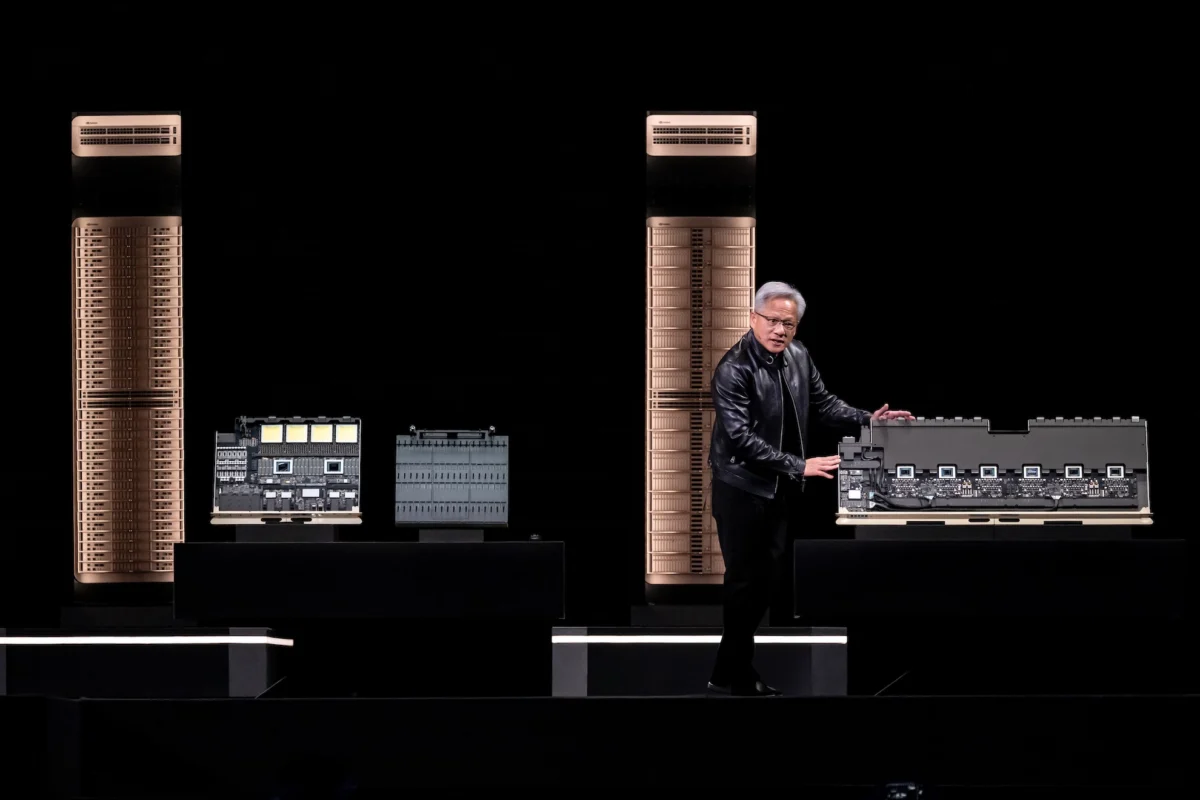
In a move that underscores the insatiable global appetite for artificial intelligence infrastructure, Amazon Web Services (AWS) and Nvidia announced a massive expansion of their strategic partnership this Wednesday. The deal, which will see Amazon integrate an additional 2 million high-performance Nvidia GPU chips into its massive data center network, signals a deepening dependency—and mutual synergy—between the world’s largest cloud provider and the undisputed king of AI hardware.
The expansion, confirmed during Nvidia’s quarterly earnings call, covers a multi-year rollout scheduled for 2027 and 2028. It represents a significant acceleration of a relationship that only five months ago saw Amazon commit to deploying 1 million Nvidia GPUs. According to Nvidia, that initial commitment was eclipsed by market demand, forcing both companies to scale their ambitions at a speed rarely seen in the history of enterprise computing.
The Core of the Deal: Powering the Future of AI
At the heart of this agreement are Nvidia’s next-generation architectures: the Blackwell Ultra, Rubin, and Rubin Ultra GPUs. These processors are not merely incremental upgrades; they are the specialized engines required to train and run the massive Large Language Models (LLMs) that are currently reshaping the global economy.
While financial terms were not disclosed, industry analysts estimate the deal is worth tens of billions of dollars. This investment is intended to satisfy the "surging demand" from a diverse ecosystem of stakeholders, including AI labs, enterprise software developers, government agencies, and startups.
The Vera CPU Expansion
Beyond GPUs, the partnership introduces Nvidia’s "Vera" CPUs into the AWS environment. Nvidia CEO Jensen Huang has positioned Vera as the cornerstone of a new $200 billion market for the company. By integrating Vera CPUs—some paired with Rubin GPUs, others serving as standalone processors—AWS is signaling its intent to offer a complete, vertically integrated hardware stack that optimizes performance for the most demanding AI workloads.
Chronology of an Accelerated Alliance
The trajectory of the Amazon-Nvidia relationship has moved from standard vendor-client interaction to a foundational industrial marriage.
- Early 2026: Amazon begins to showcase its proprietary AI silicon, specifically the Trainium chips, as a high-performance alternative to Nvidia’s offerings, aiming to reduce dependence on external suppliers.
- Spring 2026: Amazon reports its custom chip business reaches a $25 billion annualized revenue run rate, bolstered by massive commitments from AI titans like Anthropic and OpenAI.
- Mid-2026: Nvidia announces a deal to deploy 1 million GPUs across AWS. Within months, Nvidia notes that demand from hyperscalers and AI labs has "exceeded all expectations."
- August 2026 (The Current Deal): Amazon and Nvidia announce the addition of 2 million more GPUs and a comprehensive integration of Nvidia’s robotics and enterprise software stacks into the AWS ecosystem.
Supporting Data: A Market Defined by Scale
The scale of this partnership is best understood through the lens of Nvidia’s recent financial performance and its aggressive capital expenditure strategy.
Financial Dominance
Nvidia’s second-quarter earnings report served as the backdrop for this announcement, revealing a staggering $96.2 billion in quarterly sales. The Data Center division was the clear engine of this growth, contributing $89 billion—a 117% increase year-over-year. Nvidia expects third-quarter revenue to climb to $108 billion, buoyed by the initial shipment of Rubin-generation hardware.
Securing the Supply Chain
To ensure it can meet the needs of partners like Amazon, Nvidia has committed $279 billion to secure manufacturing capacity and memory supply for future projects. This figure is a dramatic jump from the $119 billion committed in the previous quarter. The company has allocated $92 billion for spending through the end of the current fiscal year, with another $87 billion earmarked for fiscal year 2028. This capital commitment is a testament to the "arms race" currently defining the AI sector.
Official Responses and Strategic Vision
Jensen Huang, Nvidia’s CEO, provided a candid assessment of the current state of the industry during the earnings call. "The thing that matters for the industry is that AI is now doing productive and useful work," Huang stated. "AI is generating profitable tokens. If we had more compute, we could generate more profitable tokens, which results in more profit for all of the services. This is the exact phase where we’re at, which is the reason why everybody’s leaning in."
For Amazon, the strategy is nuanced. While it continues to buy Nvidia hardware, it is simultaneously building its own chips. Peter DeSantis, Amazon’s AI chief, has made it clear that AWS is moving to commercialize its Trainium chips as a direct competitor to Nvidia’s flagship offerings. Furthermore, Amazon’s Arm-based Graviton CPUs continue to capture market share from traditional server chipmakers like Intel and AMD. By fostering a dual-track strategy—building its own hardware while acting as the primary host for Nvidia’s best-in-class technology—Amazon is attempting to hedge its bets in a volatile, high-stakes market.
The Robotics and Enterprise Frontier
The expansion is not limited to the cloud. Nvidia is bringing its full physical AI stack to Amazon’s logistics and enterprise operations. This includes:
- Omniverse: For simulation and creating digital twins of warehouses.
- Cosmos: Nvidia’s world model platform for spatial intelligence.
- Isaac: A comprehensive development platform for robotics.
- Jetson: High-performance computing modules for edge AI, including the newly introduced entry-level Orin Nano 2.
Additionally, on the software front, AWS will host Nvidia’s "Nemotron" family of open models on Amazon Bedrock and SageMaker. This move ensures that developers building on AWS have seamless access to Nvidia’s cutting-edge software libraries, effectively turning AWS into the primary laboratory for Nvidia’s AI ecosystem.
Implications: The "Profitable Token" Hypothesis
The partnership between Amazon and Nvidia raises a critical question for the broader tech industry: Does the massive investment in compute capacity translate into sustainable, long-term profit?
The Infrastructure Gamble
The current market is defined by a "build it and they will come" mentality. With hundreds of billions of dollars being poured into data centers, investors are closely watching to see if the "profitable tokens" Huang describes will manifest at scale for the enterprises buying this capacity. If the productivity gains from AI do not materialize as expected, the massive infrastructure build-out could face a correction.
A Coexistence of Giants
The Amazon-Nvidia alliance demonstrates that, in the short term, the leaders of the AI revolution are better served by collaboration than by total vertical independence. Amazon recognizes that Nvidia remains the "GOAT" (Greatest of All Time) of AI silicon, and providing their customers with access to that hardware is essential to maintaining AWS’s competitive edge.
Conversely, Nvidia realizes that to maintain its market dominance, it needs the reach, physical infrastructure, and enterprise relationships that only a company like Amazon can provide. Even as Amazon develops its own competing silicon, the sheer demand for compute ensures that both companies will remain tethered to one another for the foreseeable future.
Looking Ahead
As we look toward 2027 and 2028, the industry is entering a new phase of maturity. The focus is shifting from simply procuring chips to optimizing the entire pipeline—from the silicon to the robot fleet, and from the LLM model to the enterprise application. The Amazon-Nvidia partnership is the physical manifestation of this transition, setting a new benchmark for how the digital and physical worlds will be powered in the coming decade. Whether this investment will yield the dividends stakeholders expect remains the defining gamble of the modern AI era.
 Neng Nana
  Jia Lissa
  Lina Hope