
 By Nana Wu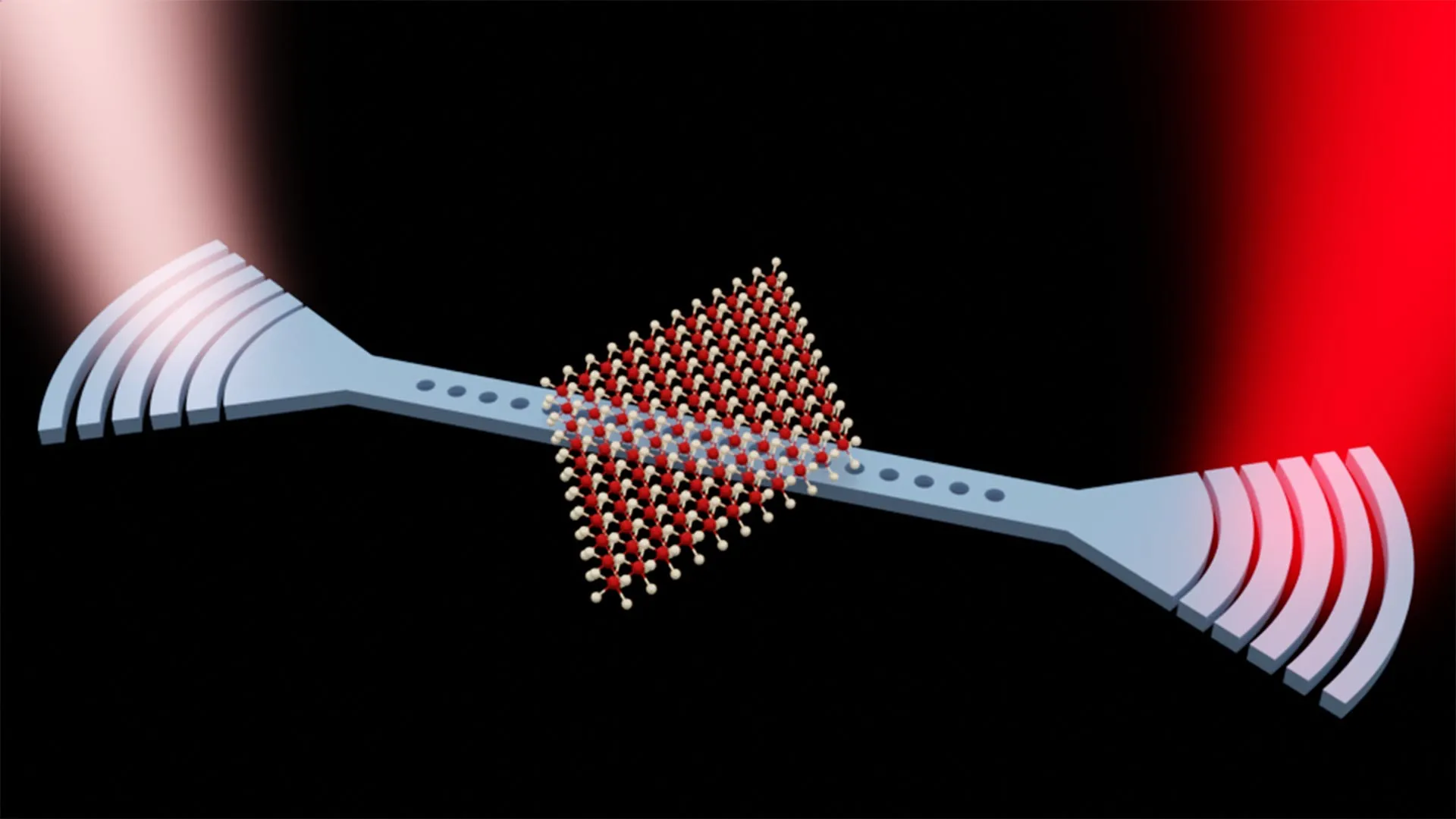
Eighty years after the University of Pennsylvania unveiled ENIAC—the gargantuan, room-sized machine that birthed the digital age—the institution is once again standing at the precipice of a technological revolution. Since the 1940s, the bedrock of human progress has been the electron. From the vacuum tubes of ENIAC to the nanoscopic transistors powering today’s most advanced Artificial Intelligence (AI) models, our civilization has run on the movement of charged particles.
However, as the demand for computational power skyrockets to support the next generation of generative AI and global data processing, the electron is beginning to hit a physical wall. Now, a team of researchers at the University of Pennsylvania is proposing a radical departure: abandoning the electron as the primary information carrier in favor of the photon. By harnessing light, scientists believe they can bypass the thermal and efficiency limitations that have defined computing for nearly a century.
The Legacy of ENIAC and the Electronic Bottleneck
The Electronic Numerical Integrator and Computer (ENIAC), developed by J. Presper Eckert and John Mauchly at Penn’s Moore School of Electrical Engineering, was a marvel of mid-century ingenuity. By using electronic pulses to solve ballistics trajectories, it proved that mathematical logic could be automated at speeds previously unimaginable.
For decades, the "Moore’s Law" paradigm—the ability to shrink transistors and pack more electrons into smaller spaces—served us well. But today, that paradigm is fracturing. Electrons possess an inherent electrical charge, a property that becomes a double-edged sword at modern scales. As these particles race through the dense architecture of a modern GPU or CPU, they encounter resistance, generating significant heat. This thermal dissipation is not merely a hardware nuisance; it is a fundamental energy sink that limits how fast and how dense our processors can become.
In the context of modern AI, where models like GPT-4 or massive neural networks require the simultaneous processing of trillions of parameters, the "von Neumann bottleneck"—the speed limit of moving data between memory and processing—is being exacerbated by the sheer energy cost of shifting electrons. We are reaching a point where the electricity required to power the cooling systems for AI data centers is beginning to rival the energy required to perform the actual computations.
The Photonic Paradox: The Promise and the Peril
In their search for a successor to the electron, physicists have long looked to the photon. As a particle of light, the photon is the gold standard for long-distance data transmission. Fiber-optic cables have already replaced copper wires in our global telecommunications infrastructure because photons travel at the speed of light, possess zero rest mass, and, crucially, carry no electrical charge.
"Because they are charge-neutral and have zero rest mass, photons can carry information quickly over long distances with minimal loss, dominating communications technology," explains Li He, co-first author of a groundbreaking paper published in Physical Review Letters and a former postdoctoral researcher in the Zhen Lab at Penn.
Yet, this very lack of charge, which makes light so efficient for transmission, renders it notoriously difficult to control for computing. In a computer, we don’t just need to move data; we need to switch it. Logic gates—the "if-this-then-that" switches that allow a computer to make decisions—require particles to interact with one another. Because photons are neutral, they tend to pass through one another like ghosts, failing to create the "switching" logic necessary for processing information. Until now, the challenge has been finding a way to make light act like a decision-maker without sacrificing its speed or efficiency.
The Breakthrough: Exciton-Polaritons as the Missing Link
The research team, led by Bo Zhen, the Jin K. Lee Presidential Associate Professor in the Department of Physics and Astronomy, has unveiled a potential solution: the "exciton-polariton."
To understand this breakthrough, one must look at the intersection of light and matter. The Penn team engineered a hybrid quasiparticle by confining photons within an atomically thin semiconductor material. Within this structure, the light becomes "strongly coupled" with the electrons of the semiconductor. The result is the exciton-polariton, a quantum entity that inherits the best traits of both worlds.
The polariton possesses the high-speed mobility of a photon but gains the ability to "feel" its environment—and therefore interact with other particles—due to its electronic component. This interaction allows the system to perform nonlinear activation steps—the essential decision-making operations that constitute the "intelligence" in AI—without the need for the sluggish, energy-intensive conversions that have plagued previous attempts at photonic computing.
Chronology of Innovation
- 1945: ENIAC is completed at the University of Pennsylvania, establishing the era of electronic digital computing.
- 1970s–2000s: The semiconductor industry masters the miniaturization of electronic transistors, following Moore’s Law and driving global computing performance.
- 2015–2020: The rise of Deep Learning causes a massive spike in energy consumption, highlighting the limits of silicon-based electronic hardware.
- 2023: The Zhen Lab at Penn begins investigating the use of light-matter coupling as a means to achieve ultra-low-energy signal switching.
- 2024: Publication of the findings in Physical Review Letters, demonstrating all-light switching at an energy scale of 4 quadrillionths of a joule.
Efficiency at the Quantum Scale
The most striking aspect of the Penn team’s discovery is the sheer energy efficiency of the process. In current experimental photonic AI chips, developers often encounter a "conversion trap." To perform the complex mathematical operations required for AI, light is used for transmission, but when a decision-making node (an activation function) is reached, the system must convert the optical signal back into an electrical one. This conversion is the "tax" that photonic computing has been paying for years; it consumes significant power and introduces latency that negates the speed advantages of light.
By utilizing exciton-polaritons, the Penn team demonstrated the ability to perform these switching operations entirely within the optical domain. The energy required for this operation was measured at approximately 4 quadrillionths of a joule—a figure so small it is virtually impossible to visualize. To put this in perspective, it is significantly less energy than what is required to briefly power a single tiny LED. This represents a paradigm shift: computing that doesn’t just move data faster, but moves it with a fraction of the carbon footprint.
Implications for the AI Economy
The implications of this research extend far beyond the laboratory. If this technology can be scaled, it suggests a future where AI chips could be integrated directly into sensory hardware, such as advanced camera sensors or environmental monitors, processing visual data in real-time without ever needing to convert the signal into an electronic format.
Furthermore, this discovery provides a pathway to mitigating the environmental impact of large-scale AI infrastructure. As data centers become the world’s largest consumers of electricity, the transition to photonics could be the critical technological intervention needed to sustain the growth of AI.
Beyond classical computing, the team notes that their approach may even have applications for basic quantum computing. Because the exciton-polariton operates at the quantum level, it could potentially be leveraged to perform quantum logic operations, opening a door to a new era of secure, hyper-fast, and computationally powerful machines.
Official Response and Future Outlook
"This is not just about making things faster," notes Bo Zhen. "It is about fundamentally rethinking how we interact with information. We are moving from a paradigm of ‘moving electrons’ to a paradigm of ‘managing light’."
The research, which also included contributions from Zhi Wang and Bumho Kim of the School of Arts & Sciences, was supported by the US Office of Naval Research and the Sloan Foundation. As the researchers move toward the next phase of development, the goal will be scaling these microscopic semiconductor structures into a viable, commercially reproducible chip architecture.
While we are likely years away from an "ENIAC 2.0" that runs entirely on light, the work conducted at the University of Pennsylvania marks a definitive transition. The electronic age, which began on the Penn campus eight decades ago, has served us well. But as we peer into the future of Artificial Intelligence, it is clear that the solution to our most complex problems may not lie in the density of our transistors, but in the speed and grace of light itself.
By bridging the gap between the speed of photons and the logic of matter, the Zhen Lab has not only honored the legacy of the university’s pioneering history—they have provided the blueprint for the next century of human computation. The challenge now is one of engineering: taking the quantum efficiency of the exciton-polariton and turning it into the hardware of the future. If history is any indicator, the next revolution in computing will be illuminated by the very light we have been trying to harness for generations.
 Sagoh
Sagoh  Asro
Asro  Siti Muinah