
 By Dwi Wanna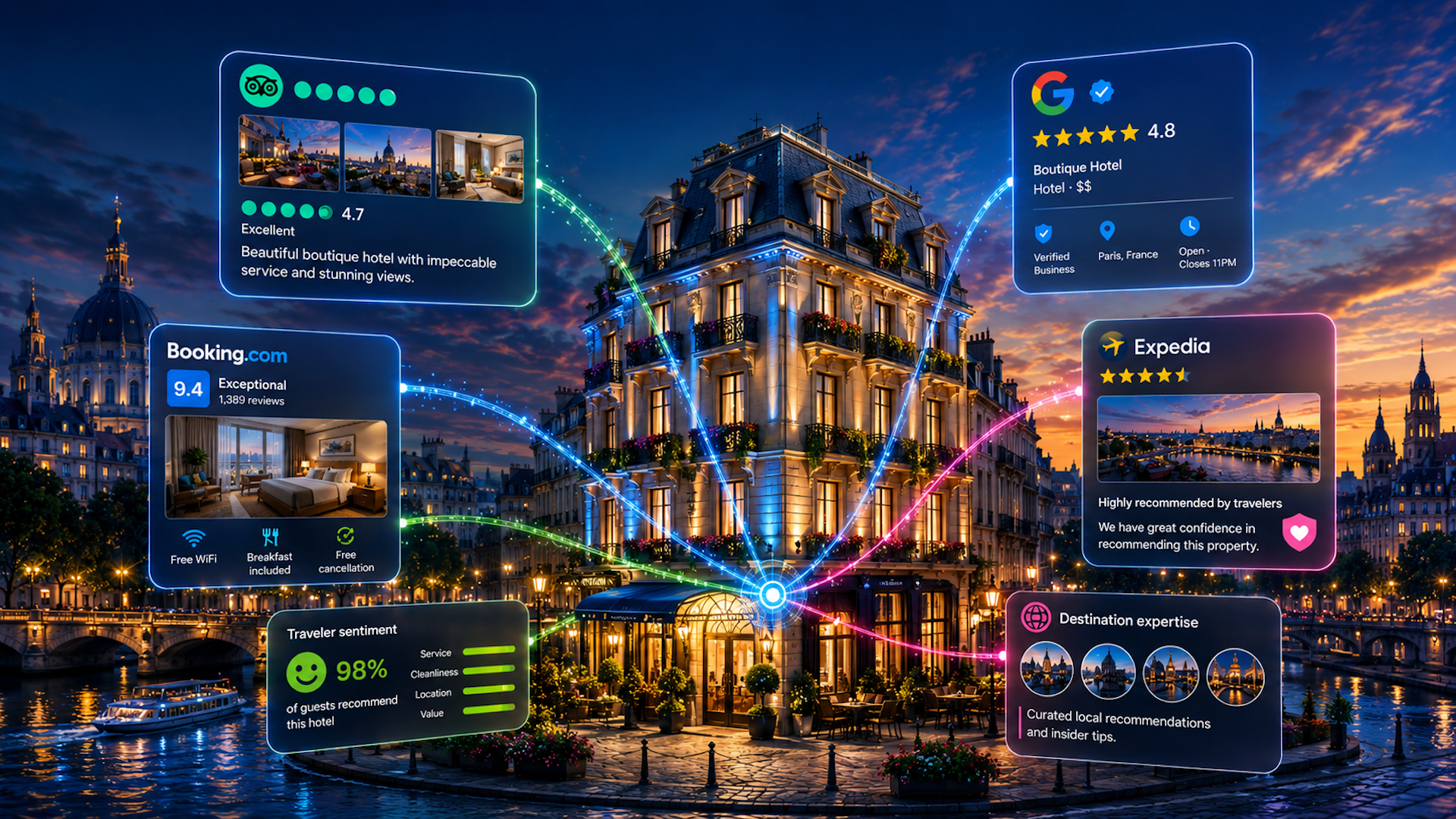
The landscape of search engine optimization (SEO) is undergoing its most profound disruption since the inception of the commercial internet. The rapid rollout of Google’s AI Overviews, alongside the integration of advanced conversational modes across platforms like ChatGPT, Claude, and Perplexity, has shifted the core paradigm of digital discovery.
For the travel and hospitality sectors, this evolution changes the mechanics of online visibility. Search is transitioning from an information retrieval tool to an automated recommendation engine. The challenge for travel brands is no longer simply optimizing pages to help search engines crawl and index their websites. Instead, the modern mandate is to feed and influence AI systems so they understand precisely when and why a business should be recommended to a traveler.
1. Main Facts: The Paradigm Shift in Travel Discovery
The traditional search experience was built on a simple transaction: a user typed a query, and the search engine returned a list of blue links. The user then had to click through multiple websites, manually synthesize the information, and piece together their own travel plans.
AI search engines have bypassed this manual synthesis. By leveraging Large Language Models (LLMs), platforms like Google and OpenAI can read, evaluate, and consolidate information from thousands of disparate web sources in real time. They present the user with a singular, cohesive response—often directly on the search results page.
+-------------------------------------------------------------------+
|                     TRADITIONAL SEARCH (SEO)                      |
|  User Query -> Search Engine -> List of Blue Links -> User Clicks |
+-------------------------------------------------------------------+
                                  vs.
+-------------------------------------------------------------------+
|                       AI SEARCH (GEO/AIO)                         |
|  User Query -> LLM Synthesis -> Curated Recommendation -> Action  |
+-------------------------------------------------------------------+
For travel brands, this shift introduces several critical realities:
- The Rise of the Recommendation Engine: AI assistants do not merely point users to resources; they act as digital concierges, making active judgments on which hotels, restaurants, or itineraries best suit a highly specific set of user constraints.
- The Compression of the Booking Funnel: A single conversational session can guide a traveler from broad destination inspiration to specific hotel selection, bypassing the traditional multi-week research phase.
- The Importance of Entity-Based SEO: Search engines are moving away from keyword matching and toward "entity resolution"—the process of identifying real-world things (hotels, destinations, attractions) and understanding their relationships, attributes, and reputations.
2. Chronology: The Evolution of Travel Planning
To understand where travel search is going, we must examine how the traveler’s digital journey has evolved over the past two decades.
[Early 2000s: Directory Era] ──> [2010s: Keyword & Meta Era] ──> [2024+: Conversational Era]
  - Fragmented searches            - Long-tail keywords            - Persistent AI chats
  - Manual link hopping            - Mobile-first optimization     - Context-aware itineraries
  - High friction                  - Aggregators & OTAs dominate    - Zero-click recommendations
The Directory and Portal Era (Early 2000s to 2010)
In the early days of the digital travel boom, planning was highly fragmented. Travelers relied on basic search queries to find directory pages or direct brand websites. A typical planning phase required dozens of individual searches, such as:
- "Best family hotels in Mallorca"
- "Flights to Paris in July"
- "Things to do in Tokyo"
Users manually cross-referenced flight schedules, hotel websites, and emerging review portals like TripAdvisor in separate browser tabs. The friction was high, and the onus of synthesis was entirely on the consumer.
The Aggregator and Semantic Search Era (2011 to 2023)
The rise of Online Travel Agencies (OTAs) like Booking.com and Expedia, combined with Google’s introduction of the Knowledge Graph in 2012, began to organize travel data more systematically. Search became smarter, understanding "long-tail" queries and displaying rich snippets, maps, and direct hotel booking modules directly in search results. However, the user journey remained transactional and keyword-driven.
The Conversational and LLM-Driven Era (2024 and Beyond)
Today, travelers are shifting their research habits toward persistent, contextual conversations with AI. Rather than executing disconnected searches, a modern traveler might create a dedicated workspace or folder—such as "Summer 2026"—within ChatGPT or Gemini.
The planning process now starts with a highly specific, multi-layered prompt:
"I am planning a 10-day trip to Southern Italy for a family of four in June 2026. We love historic sites but need a hotel with a kids’ pool. Can you draft an itinerary starting in Naples, keeping driving times under two hours per day, and suggest boutique hotels that fit this description?"
What follows is an ongoing, iterative dialogue. The traveler refines the plan over days or weeks, asking the AI to adjust for dietary restrictions, recommend nearby dining options, suggest local transportation, and curate day-by-day activities. Throughout this entire journey, the user may never click a traditional search result link. They are interacting with a synthesized recommendation.
3. Supporting Data: The Rise of Zero-Click Search and Semantic Validation
The shift toward AI-synthesized search results is heavily reflected in search performance metrics. Data from SEO industry analyses, including research by SparkToro and various click-through rate (CTR) studies, reveals that over 50% of Google searches now end without a click to an external website. This "zero-click" phenomenon is expected to expand as AI Overviews become the default interface for informational and transactional queries.

+---------------------------------------------------------+
|             Estimated Google Search CTR Shift          |
+---------------------------------------------------------+
| Traditional Organic Clicks:  [██████████████░░░░] ~70%  |
| Zero-Click / AI-Synthesized: [██████████████████] ~50%+ |
+---------------------------------------------------------+
Redefining Visibility: The Role of Assisted Conversions
While traditional SEO prioritized direct organic clicks, travel marketers must adapt to a more complex attribution model. An AI Overview might recommend a boutique hotel to a traveler, detailing its amenities and location. The traveler may not click the link provided in the AI response immediately. Instead, their path to purchase might look like this:
[1. AI Overview Discovery] ──> [2. Branded Google Search] ──> [3. TripAdvisor Review Check] ──> [4. Direct/OTA Booking]To capture this multi-touch journey, travel brands must monitor assisted conversions and branded search lift. In Google Analytics 4 (GA4), this data can be analyzed by navigating to Advertising > Attribution > Conversion Paths. This report reveals how early-stage AI interactions assist ultimate conversions, even if the final click originated from a direct or paid channel.
4. Industry Perspectives: Building Semantic Context and Trust
Search engine optimization professionals and travel industry analysts emphasize that AI models do not operate in a vacuum. To recommend a travel brand, an AI must have high confidence in the brand’s attributes, reliability, and relevance to the user’s specific context.
The Ecosystem of Trust
LLMs build confidence by validating information across multiple independent nodes. A hotel’s website is no longer treated as the sole source of truth. Instead, AI systems cross-reference the website’s claims with third-party platforms to build a semantic profile of the business.
                        +-----------------------+
                        |   Hotel Website       |
                        |   (Schema Markup)     |
                        +-----------+-----------+
                                    |
                                    v
+-----------------------+  +--------+--------+  +-----------------------+
|  OTA Listings         |<--+  AI Search     +-->| TripAdvisor Reviews   |
|  (Expedia, Booking)   |  |  Confidence     |  |  (Sentiment Analysis) |
+-----------------------+  +--------+--------+  +-----------------------+
                                    |
                                    v
                        +-----------+-----------+
                        |  Google Business      |
                        |  Profile Attributes   |
                        +-----------------------+
This multi-platform validation is particularly critical when AI models assess niche traveler requirements, such as:
- Pet-friendly boutique hotels with electric vehicle charging stations.
- Quiet workspaces with high-speed Wi-Fi in downtown business hotels.
- Locally sourced vegan menus in fine dining establishments.
If a hotel claims to be "family-friendly" on its website, but its TripAdvisor reviews frequently mention a quiet, adults-only atmosphere, or if its OTA listings omit kids’ activities, the AI system encounters conflicting data. This entity ambiguity reduces the model’s confidence, making it highly unlikely to recommend the property for family-centric queries.
5. Strategic Guidelines: 3 Practical Ways to Strengthen Entity Signals
To succeed in an AI-dominated search ecosystem, travel brands must focus on entity-based optimization. This requires establishing a clear, unambiguous, and highly validated digital footprint across the web.
1. Implement Advanced Structured Data (Schema Markup)
Structured data acts as a direct translator for AI models, converting unstructured web copy into machine-readable data. Travel brands should implement comprehensive schema markup to define their specific business attributes.
- Accommodation and Hospitality Schema: Use precise schemas (e.g.,
Hotel,Resort, orBedAndBreakfast) rather than a genericLocalBusinessmarkup. - Attribute Specification: Explicitly define amenities such as pet policies, pool availability, parking options, and dining facilities within the schema.
- Linked Data (
sameAsproperties): Use thesameAsattribute in your schema to link your official website to your corresponding Wikidata, Wikipedia, TripAdvisor, and official social media profiles. This directly helps search engines resolve entity identity.
2. Eliminate Entity Ambiguity Across the Web
Inconsistent information across third-party platforms is one of the primary reasons AI engines lose confidence in a brand. Marketers must conduct regular audits of their digital footprint to ensure absolute consistency in their Name, Address, Phone (NAP), and core offerings.
- Audit OTA and Local Directories: Ensure that amenities, operating hours, and contact details match exactly across Booking.com, Expedia, TripAdvisor, and Yelp.
- Unify Brand Positioning: If your primary positioning is a "luxury wellness retreat," ensure that this description is consistently reinforced across all digital PR, guest articles, and social profiles. Avoid trying to be everything to everyone; clarity helps AI categorize your entity correctly.
3. Leverage Operational Data and Sentiment Mining
AI models are highly sensitive to customer sentiment and operational realities. They actively mine user-generated reviews to understand the true nature of a business.
+-----------------------------------------------------------------------------+
|                         REVIEW SENTIMENT MINING FLOW                        |
+-----------------------------------------------------------------------------+
|  "The pool was great for the kids, and they loved the daily activities."    |
|                                     │                                       |
|                                     ▼                                       |
|                         [Natural Language Processing]                       |
|                                     │                                       |
|                                     ▼                                       |
|               AI Entity Profile:  Attributes: [Family Friendly]           |
+-----------------------------------------------------------------------------+- Review Auditing: Analyze your existing customer reviews to identify what terms and amenities guests highlight most frequently. If guests consistently praise your "quiet, central location," this sentiment will be picked up by LLMs.
- Optimize Google Business Profile (GBP): Keep your GBP operational data meticulously updated. Respond to reviews, answer user questions, and use the Google Updates feature to publish fresh, context-rich content that signals active operations.
6. Implications: The Democratization of Travel Marketing
The transition from keyword-based search to AI-driven recommendation engines represents a fundamental democratization of the travel industry. Historically, massive travel conglomerates and global OTA platforms dominated search results through sheer scale, backlink authority, and aggressive bidding strategies.
In a semantic, entity-driven search ecosystem, smaller boutique hotels, independent tour operators, and localized destinations have a distinct opportunity. AI engines prioritize relevance, accuracy, and trust over raw domain authority. If an independent resort can cultivate a highly consistent, well-structured, and positively reviewed digital presence, it can easily win the AI’s recommendation over a larger competitor with a generic digital footprint.
Ultimately, the future of travel discovery belongs to brands that look beyond simple rankings and clicks. By building a robust, trustworthy, and clearly defined semantic footprint, travel brands can ensure that when a traveler asks their AI assistant where to go next, their name is the one that gets recommended.
 Sagoh
Sagoh  Basiran