
 By Lina Irawan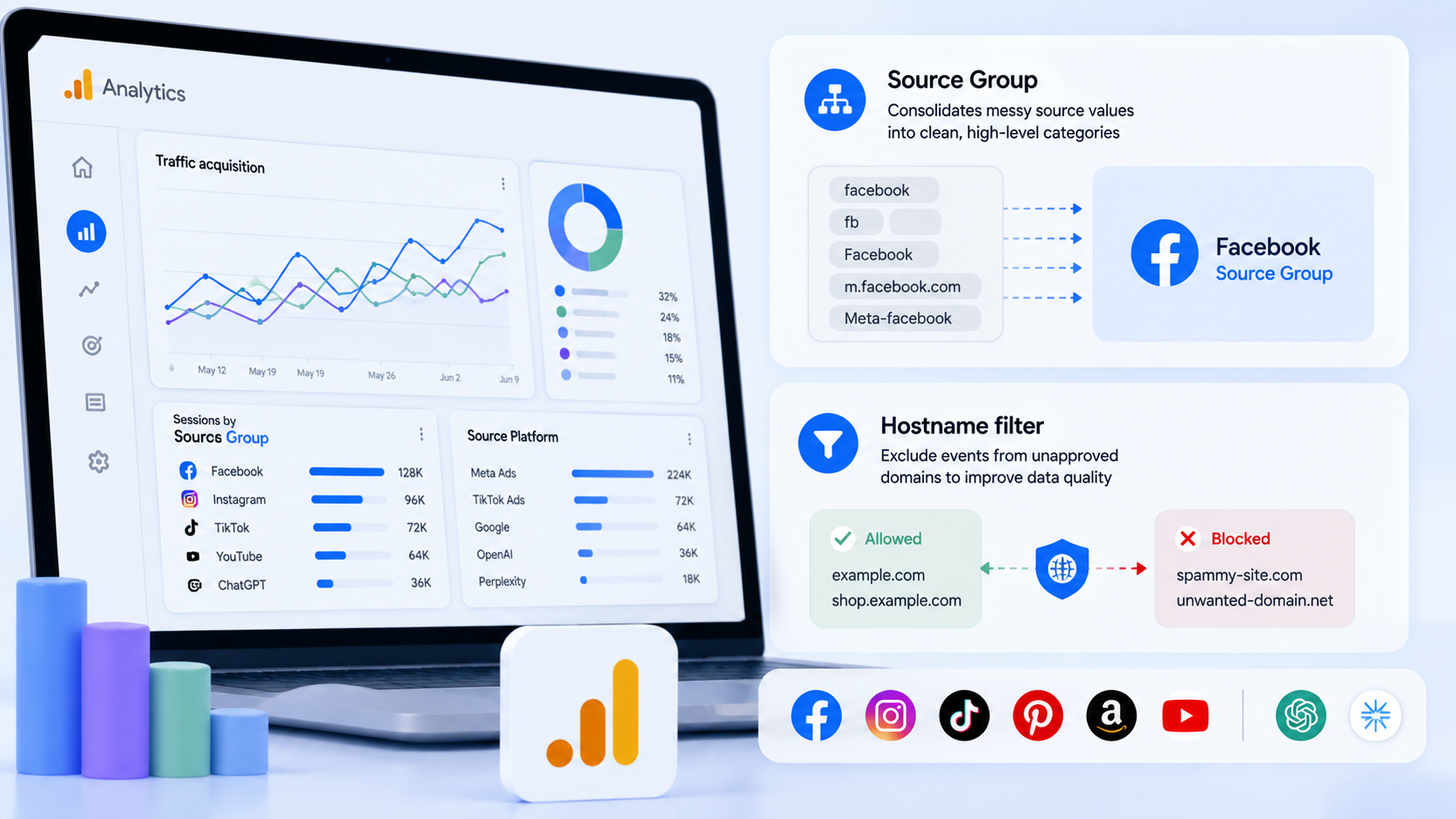
Digital marketers and data analysts have long grappled with the chaotic reality of modern web traffic. From fragmented referral paths to the sudden rise of artificial intelligence search engines, maintaining clean, actionable analytics data has become an increasingly uphill battle.
To address these challenges, Google has announced a major update to Google Analytics 4 (GA4). The platform is introducing a new Source Group reporting dimension and robust hostname filtering controls. Together, these updates aim to clean up fragmented traffic source reporting, improve cross-channel attribution, track emerging conversational AI traffic, and drastically reduce the "noise" that plagues modern analytics dashboards.
1. Main Facts: Standardizing the Fragmented Web
The latest updates to Google Analytics 4 center on two primary objectives: simplifying how traffic sources are categorized and giving administrators tighter control over data hygiene.
Standardizing Traffic Sources with "Source Group"
The headline feature of this update is the introduction of the Source Group reporting dimension. Historically, traffic from a single platform could appear under dozens of different names in GA4 reports. For example, a campaign or organic referral from Facebook might register as:
facebook.comm.facebook.com(mobile)l.facebook.com(link shim)lm.facebook.comfb
This fragmentation forced marketers to write complex Regular Expressions (Regex) or build custom channel groupings just to understand their total social media ROI.
The new Source Group dimension solves this by consolidating these disparate variations into a single, standardized category (e.g., "Facebook"). At the same time, Google is updating its existing Source Platform field to align with this new grouping structure, ensuring consistent classification across all paid and organic advertising channels.
Elevating AI Search to a Standard Source
In a major nod to the shifting search landscape, Google’s new source categorization expands beyond traditional search engines and social networks. The update officially introduces standardized classifications for emerging AI-driven conversational platforms, specifically ChatGPT (OpenAI) and Perplexity.
As users increasingly turn to AI engines for product recommendations and information, referral traffic from these platforms has surged. By categorizing these tools alongside traditional search engines and social platforms, Google Analytics is giving marketers an out-of-the-box solution to measure the impact of Generative Engine Optimization (GEO) and Answer Engine Optimization (AEO).
Hostname Filtering in the Admin Panel
In addition to reporting dimensions, Google is rolling out hostname filters within the Admin section of GA4. This feature allows advertisers to specify which domains are authorized to send data to their GA4 properties.
[Unapproved Domains / Spam Bots] ──x──> [ Hostname Filter (Admin) ] ──> [ Clean GA4 Reports ]
[Your Verified Domains (e.g., site.com)] ──> [ Allowed & Processed ] ──> [ Clean GA4 Reports ]
By excluding events originating from unapproved hostnames, businesses can prevent ghost spam, scraping activity, and staging-site data from polluting their live production reports.
2. Chronology of Google’s Attribution and Data Hygiene Journey
To understand why this update is so critical, it is helpful to look at how traffic attribution and data filtering have evolved within Google’s analytics ecosystem over the last decade.
Universal Analytics (Pre-2020)
  └── Manual filters, heavy reliance on UTM parameters, high vulnerability to referral spam.
       │
GA4 Launch & Transition (2020–2023)
  └── Shift to event-based tracking. Initial loss of robust filtering tools; rise of dark social.
       │
The Generative AI Boom (2023–2024)
  └── ChatGPT and Perplexity emerge as traffic drivers, but appear as fragmented, unclassified referrals.
       │
June 2024 Update (Current)
  └── Source Group introduced (retroactive), AI engines standardized, and hostname filters restored.
The Universal Analytics Era (Pre-2020)
In the legacy Universal Analytics (UA) platform, marketers relied heavily on manual view-level filters to keep data clean. Hostname filtering was a staple defense against "ghost referral spam"—a practice where malicious bots hit GA tracking IDs directly without ever visiting the actual website. UA also required extensive manual UTM tagging, and while it offered basic channel groupings, the system was prone to fragmentation.
The Transition to GA4 (2020–2023)
When Google transitioned users to Google Analytics 4, many of the legacy filtering tools were stripped away or rebuilt from scratch. GA4 shifted to an event-based data model, which offered superior cross-device tracking but initially lacked the intuitive data-cleaning tools of its predecessor. Marketers complained that GA4 made it harder to filter out internal developer traffic and spam. Meanwhile, the rise of privacy-first browsers (like Apple’s Safari with Intelligent Tracking Prevention) and in-app browsers (like Instagram’s webview) further fragmented referral data, driving up the percentage of unclassified "Direct" traffic.
The Rise of Generative AI (2023–2024)
By late 2023, the search engine landscape underwent its most disruptive shift in decades. Chatbots like ChatGPT and specialized search engines like Perplexity began answering user queries directly and linking out to sources. Marketers noticed trickle-down referral traffic from these AI tools, but without a standardized classification system, this traffic was lumped into generic referral categories or misclassified as direct traffic.
The June 2024 Update
Recognizing these compounding pressures, Google launched the Source Group and Hostname Filtering updates. This release represents a maturation of GA4, blending the sophisticated machine learning capabilities of the modern platform with the granular, administrative control that data analysts have demanded since the retirement of Universal Analytics.
3. Supporting Data: The Cost of Fragmented Analytics
The challenges this update addresses are not merely aesthetic; they have a measurable financial impact on advertising campaigns.

The Cost of Bad Data
According to industry research by the Marketing Science Institute, data quality issues cost organizations an average of 15% to 25% of their target revenue. In digital marketing, poor data quality leads to:
- Misallocated Budgets: Overestimating the performance of direct traffic while underestimating the contribution of assisting social channels.
- Skewed CPA Metrics: Inaccurate Cost-Per-Acquisition calculations caused by duplicate or fragmented source listings.
- Wasted Analyst Hours: Digital analytics agency Seer Interactive previously estimated that analysts spend up to 20% of their billable hours manually cleaning, deduplicating, and normalizing traffic source names in external platforms like Tableau, PowerBI, or Google BigQuery.
The Fragmentation of Social Media Referrals
To illustrate the severity of the fragmentation problem, consider a typical mid-sized e-commerce site’s raw traffic report prior to this update. A single campaign run on Meta might generate the following distinct referral strings:
| Raw Referral Source | Standardized Platform | Percentage of Total Campaign Traffic |
|---|---|---|
l.facebook.com |
42% | |
m.facebook.com |
28% | |
facebook.com |
15% | |
lm.facebook.com |
10% | |
fb |
5% |
Under the old GA4 reporting structure, an analyst looking at the "Source/Medium" report would see five separate line items. If they did not manually aggregate these rows, they risked reporting an inaccurate, deflated conversion rate for the primary "facebook" source to stakeholders.
4. Official Responses and Implementation Details
Google’s official developer and support documentation outlines how these new features operate under the hood and how administrators can implement them immediately.
Retroactive Data Access: A Major Win
In its official release notes, Google confirmed a crucial detail that has caught the attention of enterprise data analysts: Source Group data is retroactive.
Unlike custom channel groupings or historical filter modifications in GA4—which typically only apply to data collected after the configuration is saved—the Source Group dimension will apply historically to all existing data in the GA4 property. This allows brands to instantly run year-over-year (YoY) performance comparisons using clean, consolidated source categories without needing to backfill data via BigQuery.
How to Configure Hostname Filters
Google’s support documentation details the steps required to set up the new hostname filters:
- Navigate to the Admin section of Google Analytics 4.
- Under Data Collection and Modification, click on Data Streams.
- Select the appropriate Web Data Stream.
- Click on Configure Tag Settings under the Google Tag section.
- Under the settings menu, look for the option to Define Allowed Hostnames.
- Input the primary domains, subdomains, and third-party checkout tools (e.g.,
shopify.comorstripe.com) that are authorized to run your GA4 measurement ID.
Once configured, any hit sent to your Measurement ID that does not originate from an approved hostname will be discarded before it enters your reporting database, preserving the integrity of your conversion rates and session counts.
5. Strategic Implications for Advertisers and Marketers
The introduction of Source Groups and hostname filtering marks a significant milestone in the evolution of digital measurement. The strategic implications of these features stretch across several core pillars of modern digital marketing.
1. Seamless Multi-Channel Attribution
By consolidating fragmented sources (like TikTok, Pinterest, Amazon, and Meta) into standardized groups, marketers can finally view cross-channel performance through a clear lens.
- Accurate Assisted Conversions: Marketers can more accurately attribute assisted conversions to social channels that often suffer from mobile browser fragmentation.
- Simplified Executive Reporting: Instead of explaining why "l.instagram.com" and "instagram.com" are the same thing, agencies can present clean, unified dashboards to C-level executives.
2. Measuring the Impact of the AI Search Revolution
The formal inclusion of ChatGPT and Perplexity as recognized traffic sources signals that Google is preparing for a future where search is conversational rather than keyword-based.
[ User Query on ChatGPT/Perplexity ]
                │
                ▼
[ AI Engine Generates Answer with Citations ]
                │
                ▼
[ User Clicks Citation Link to Brand Website ]
                │
                ▼
[ GA4 Source Group: "AI Search" (ChatGPT/Perplexity) ]
As search engines shift from sending users to websites to answering queries directly, traffic volumes from traditional search may decline while highly qualified referral traffic from AI engines increases. By standardizing these sources, GA4 allows digital marketers to:
- Quantify GEO Efforts: Track whether optimizations aimed at AI models are actually driving click-through traffic to the brand’s website.
- Justify Content Budgets: Prove the business value of publishing high-authority, informational content that AI engines cite as sources.
3. Elimination of Ghost Referral Spam
Ghost spam has been a persistent headache for webmasters of all sizes. Spammers program bots to send fake HTTP requests directly to random Google Analytics tracking IDs, making it look as though thousands of users are visiting a site from a specific spammy URL. This artificially inflates session counts and tanks engagement metrics.
By enabling hostname filtering at the admin level, GA4 users can effectively shut the door on these bad actors, ensuring that their analytical insights are built entirely on genuine user interactions.
Conclusion: The Bottom Line for Modern Analytics
As the digital ecosystem grows more fragmented and complex, the tools we use to measure success must adapt. With this update, Google is giving advertisers the best of both worlds: automated, machine-learning-driven data classification through Source Groups, and granular, manual security controls through hostname filters.
For advertisers, the bottom line is clear: implementing these new tools will immediately improve reporting consistency, protect data streams from malicious interference, and provide the foundational framework needed to measure the next generation of AI-driven web traffic.
 Jia Lissa
  Nana Muazin
  Layla Zulfa