
 By Laily UPN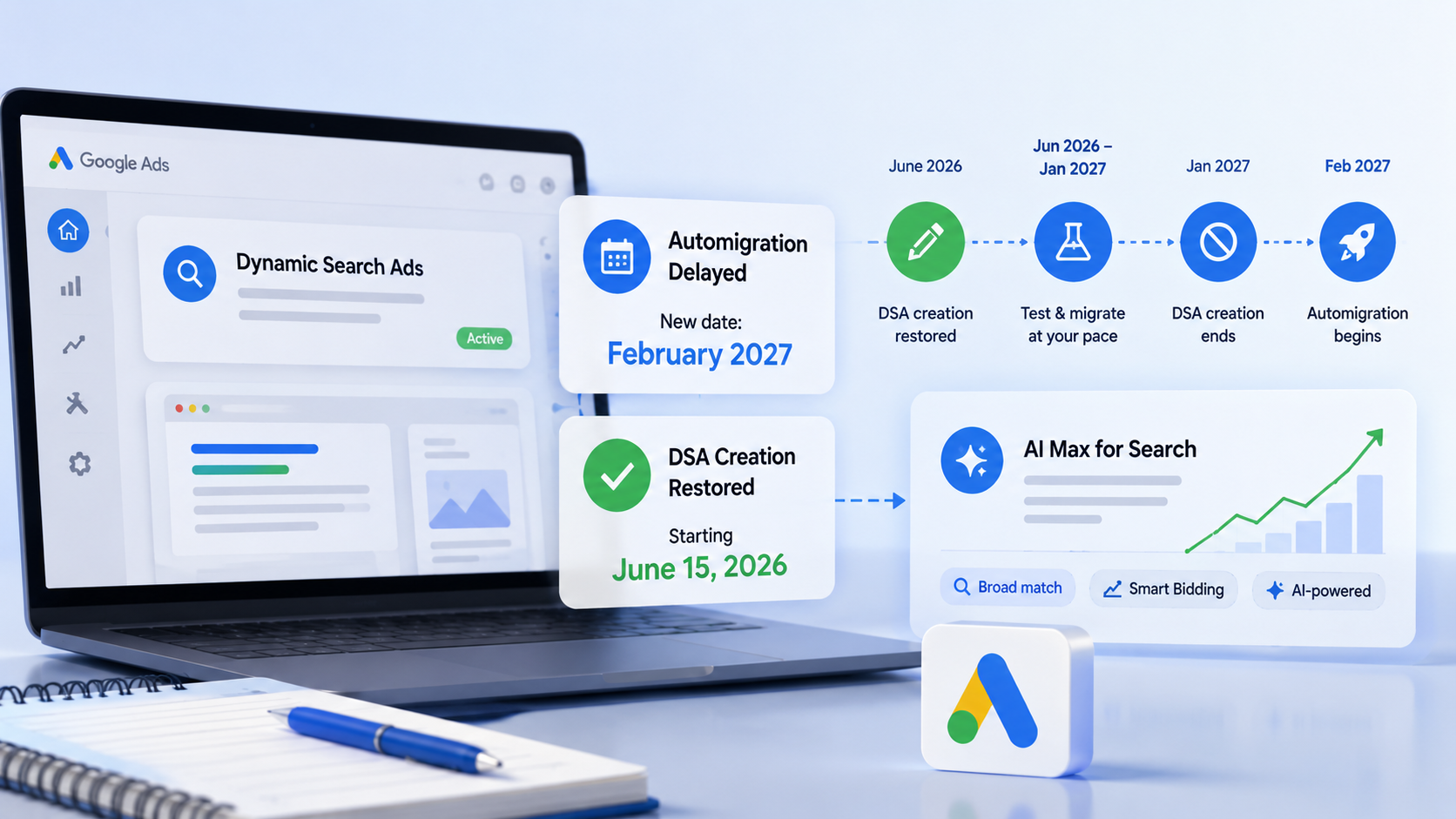
In a significant pivot that highlights the ongoing tension between automated advertising and manual advertiser control, Google has announced a five-month postponement of its planned mandatory migration of Dynamic Search Ads (DSA) to AI-powered search formats.
The search giant is also reversing a previous phase-out step by restoring advertisers’ ability to create new DSA campaigns. This move grants digital marketers a much-needed reprieve to test, benchmark, and manage their transition to Google’s next-generation AI Max for Search on their own terms.
1. Main Facts of the Announcement
Google’s transition plan for Dynamic Search Ads—one of the search engine’s longest-running and most reliable campaign formats—has undergone a substantial revision. The mandatory, automatic upgrade of DSA campaigns to AI Max for Search (or standard Search campaigns leveraging broad match paired with Smart Bidding) has been officially pushed back. Originally scheduled to take place in September 2026, the auto-migration deadline is now set for February 2027.
In tandem with this timeline extension, Google has rolled back a major restriction: starting June 15th, advertisers will once again be allowed to create brand-new DSA campaigns. This decision reverses an earlier phase-out phase that sought to restrict the creation of new legacy campaigns to force adoption of AI-driven alternatives.
However, Google is not halting its broader automation push. While the core DSA migration has been delayed, other AI-driven updates remain on track. Specifically, the transition of automatically created assets (ACA) and campaign-level broad match settings to the AI Max framework will still occur as originally scheduled in September 2026.
Furthermore, Google is cementing AI Max as its premier search offering by making it the default campaign type during the setup of new Search campaigns. According to Google, internal testing indicated that campaigns using this default setting achieved their first conversion significantly faster during the critical two-week post-launch window.
2. Chronology of the Transition
The road away from traditional Dynamic Search Ads to fully automated, AI-driven search campaigns is a multi-year journey marked by adjustments, developer updates, and shifts in policy. Below is the updated chronological roadmap for the transition:
June 15th: Restoration of DSA Creation Capabilities
Google officially restores the ability for all advertisers to create new Dynamic Search Ads campaigns. This step reverses prior restrictions and allows brands to build, test, and scale traditional DSA setups throughout the upcoming fiscal periods.
September 2026: Interim Automation Milestones
Despite the core migration delay, Google will proceed with key automated asset updates. During this month, campaign-level broad match settings and automatically created assets (ACA) will automatically transition to the AI Max structure. Advertisers must ensure their creative and targeting strategies are aligned to handle this intermediate shift.
February 2027: Final Mandatory Auto-Migration
This is the new hard deadline for the retirement of Dynamic Search Ads. Any remaining legacy DSA campaigns that have not been manually upgraded by advertisers will be automatically migrated by Google’s systems into AI Max for Search campaigns or standard Search campaigns utilizing broad match and Smart Bidding.
3. Technical Analysis: DSA vs. AI Max for Search
To understand why this delay is so impactful for the digital marketing industry, it is necessary to examine the technical differences between Dynamic Search Ads and the new AI Max for Search architecture.
+---------------------------------------------------------------------------------+
|                                 CAMPAIGN COMPARISON                             |
+---------------------------------------------------------------------------------+
| Feature                  | Dynamic Search Ads (DSA)    | AI Max for Search      |
+--------------------------+-----------------------------+------------------------+
| Target Determination     | Web crawling & index matching| Semantic AI & signals |
| Ad Copy Generation       | Dynamic landing page headlines| Multi-asset synthesis |
| Bidding Philosophy       | Manual or portfolio smart   | Pure Smart Bidding     |
| Match Type Integration   | Query-to-page indexing      | Broad match default    |
| Operational Visibility   | High search term control    | Algorithm-led matching |
+---------------------------------------------------------------------------------+
The Mechanics of Dynamic Search Ads
Introduced over a decade ago, Dynamic Search Ads revolutionized how inventory-rich websites managed search marketing. Instead of requiring search specialists to map out thousands of individual keywords, DSA technology crawls an advertiser’s website index. When a user enters a search query relevant to the content on the site, Google dynamically generates an ad with a headline tailored specifically to the search query and directs the user to the most relevant landing page.
For large e-commerce retailers, travel agencies, and publishers, DSAs provided a reliable safety net. They captured incremental, long-tail search traffic that keyword-based campaigns missed, while offering granular control through dynamic ad targets and URL exclusions.
The Mechanics of AI Max for Search
AI Max for Search represents Google’s vision of an AI-first advertising ecosystem. Rather than relying purely on website crawls and direct keyword-to-query matching, AI Max utilizes advanced semantic models, machine learning, and real-time auction signals to interpret user intent.

When paired with broad match and Smart Bidding, AI Max synthesizes various creative assets (headlines, descriptions, images, and videos) to dynamically serve the most effective combination to a user. Google’s data indicates that this predictive matching model leads to faster initial conversions, particularly in the first 14 days of campaign launch, because the algorithm optimizes bidding based on deep user-behavior analytics rather than static search terms.
The Friction Point: Control vs. Automation
The shift from DSA to AI Max represents a fundamental change in control. Search engine optimization (SEO) and pay-per-click (PPC) specialists appreciate DSA because it operates on clear, observable rules: a page exists, Google crawls it, and Google serves an ad based on the page’s actual text.
AI Max, conversely, operates as more of a "black box." It utilizes broad match settings that can occasionally match queries that feel conceptually distant to human managers, relying on downstream conversion data to self-correct. For brands with strict legal compliance, brand safety guidelines, or highly specific margins, the lack of granular control in automated match types has been a major point of concern.
4. Official Responses and Industry Context
The decision to delay the migration was not made in a vacuum. According to Ginny Marvin, Google’s Ads Liaison, the five-month extension was a direct response to extensive feedback from the global advertising community.
Taking to professional channels, including LinkedIn and official developer blogs, Marvin explained that advertisers requested more time to prepare their accounts, build out robust testing frameworks, and execute manual transitions without disrupting critical sales cycles.
"We heard from many of you that you wanted more time to prepare for this transition. By extending the timeline and restoring DSA creation, we want to give you the flexibility to test AI-powered search formats side-by-side with your existing setups."
— Ginny Marvin, Google Ads Liaison
Avoiding the Q4 Retail Crunch
The original September 2026 deadline sat at a critical juncture for retail and e-commerce advertisers. September is typically the final preparation phase for the lucrative fourth-quarter (Q4) holiday shopping season, which includes major retail events like Black Friday, Cyber Monday, and Christmas.
Forcing search teams to undergo a fundamental campaign migration right as they locked down holiday budgets was widely viewed by agency executives as a high-risk move. Pushing the final migration to February 2027 moves the transition completely out of the holiday rush and into the quieter first quarter (Q1) of the fiscal year, a move that has been warmly welcomed by brand managers.
5. Strategic Implications and Actionable Recommendations
This five-month delay is not a signal for advertisers to pause their transition efforts. Instead, it offers a valuable window to run methodical, data-driven tests to ensure performance stability when the legacy format is retired. PPC professionals and search marketers should focus on several key strategic areas.
1. Execute Side-by-Side A/B Experiments
Rather than waiting for the automatic migration tool to run in 2027, advertisers should use Google’s built-in draft and experiment features to run head-to-head tests.
- Methodology: Split budget 50/50 between an active DSA campaign and an AI Max for Search campaign.
- Metrics to Track: Monitor Cost Per Acquisition (CPA), Return on Ad Spend (ROAS), conversion volume, and search term relevancy.
- Analysis: Determine if AI Max successfully captures the same high-converting search queries as the legacy DSA campaign without driving up average CPCs.
2. Leverage Voluntary Manual Upgrades
Google’s voluntary migration tools allow advertisers to upgrade their DSA campaigns manually. Performing a manual upgrade is highly recommended over waiting for the system-forced auto-migration. Manual transitions allow search teams to:
- Preserve historical campaign data and learning states.
- Retain control over account structure and naming conventions.
- Review and refine automatically generated assets before they go live.
- Manually carry over extensive negative keyword lists to prevent budget waste on broad match terms.
3. Conduct a Comprehensive DSA Audit
Advertisers should audit their current Google Ads accounts to identify all active DSA ad groups and campaigns. Marketers need to map out which landing page targets are driving the highest ROI and ensure those specific URLs are well-optimized for organic crawling, as AI Max will continue to use landing page signals to inform its automated targeting models.
4. Prepare for the September 2026 Shift
Marketers must remember that the postponement is not a total freeze. The transition of automatically created assets and campaign-level broad match settings is still scheduled for September 2026. Search teams should audit their broad match strategies and ensure they have robust negative keyword lists in place to mitigate any unexpected query expansion when these settings transition.
6. Conclusion
Google’s decision to delay the sunset of Dynamic Search Ads and restore campaign creation represents a pragmatic compromise. It acknowledges that while fully automated, AI-driven search campaigns are the future of the Google Ads platform, the transition must respect the operational realities of the brands funding the ecosystem.
By pushing the mandatory migration deadline to February 2027, Google has protected advertisers from potential disruption during the high-stakes 2026 holiday shopping season. For search marketers, the clock is still ticking—but they now have the time, tools, and control required to transition into the AI-first era of search engine marketing smoothly and profitably.
 Jia Lissa
  Nana Muazin
  Layla Zulfa