
 By Layla Zulfa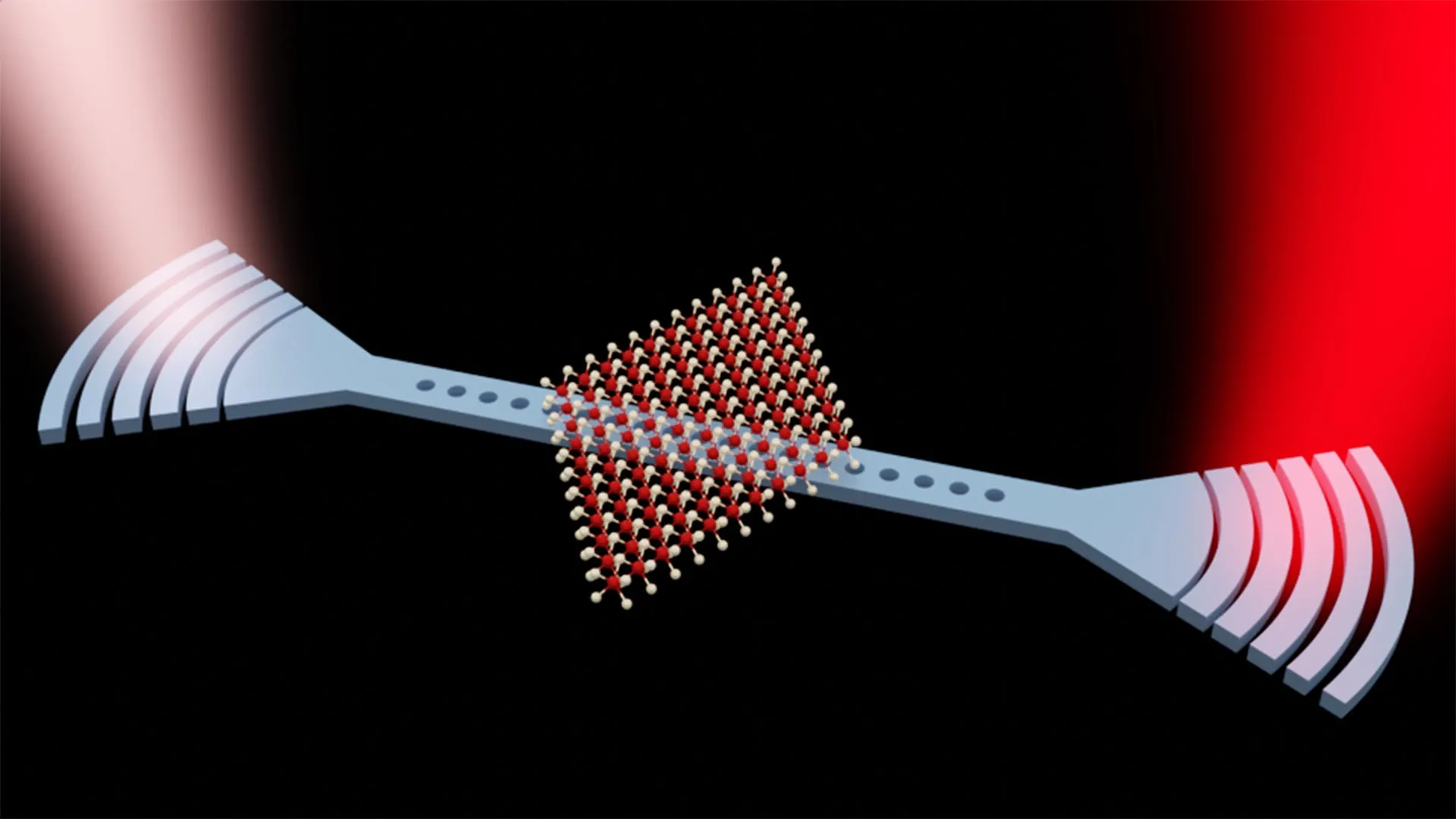
Eighty years ago, the University of Pennsylvania’s Moore School of Electrical Engineering birthed the modern era of computation. It was there that J. Presper Eckert and John Mauchly unveiled ENIAC (Electronic Numerical Integrator and Computer), a behemoth of vacuum tubes and wires that used streams of electrons to perform mathematical calculations at speeds previously unimagined. For eight decades, that fundamental reliance on the electron has served as the backbone of every smartphone, laptop, and server farm on the planet.
However, the laws of physics are beginning to push back. As the computational demands of artificial intelligence (AI) skyrocket, the limitations of electron-based hardware—namely heat generation and energy resistance—are becoming an insurmountable bottleneck. Now, a team of researchers at the University of Pennsylvania is returning to their institution’s roots to propose a radical departure: a shift from electrons to photons. By harnessing the unique properties of light, scientists are pioneering a new paradigm that promises to make AI faster, more efficient, and potentially quantum-capable.
The Chronology of Computing: From Vacuum Tubes to Photons
The history of computing is a story of miniaturization and efficiency. In the 1940s, ENIAC occupied 1,800 square feet and consumed 150 kilowatts of power, yet its processing power was a fraction of a modern digital watch. The invention of the transistor in 1947 revolutionized the industry, allowing for the creation of integrated circuits that packed millions, then billions, of electrons-based switches onto silicon chips.
For decades, Moore’s Law held steady, predicting that the number of transistors on a microchip would double approximately every two years. But as we approach the physical limits of silicon—where transistors are now measured in mere nanometers—the "electronic tax" has become impossible to ignore. Electrons, while reliable, are bulky and prone to scattering. As they travel through conductive pathways, they collide with atoms, generating heat and losing energy as resistance. In the world of AI, where massive datasets require billions of operations per second, this heat acts as a hard ceiling on performance.
The new research from the Zhen Lab, published in Physical Review Letters, represents the next logical step in this evolution. If the first era of computing was defined by the manipulation of electrical current, the coming era may well be defined by the manipulation of light.
Why Electrons are Hitting a Wall
To understand the necessity of this shift, one must look at the fundamental nature of the electron. Electrons carry a negative charge, which is both a blessing and a curse. Their charge allows them to be easily manipulated by electromagnetic fields, making them perfect for switching—the "on-off" logic (1s and 0s) that forms the basis of binary code.
However, that same charge is what causes the degradation of performance in high-density chips. Because electrons have mass, they encounter resistance when moving through a lattice. This resistance is dissipated as thermal energy. In modern data centers, cooling these processors consumes nearly as much power as the computation itself. Furthermore, as chips get smaller, the "quantum tunneling" effect occurs, where electrons leak out of their intended pathways, leading to errors and further energy waste.
"The electron has been a faithful servant," says one industry observer, "but it is a tired one. We are asking it to do things at scales and speeds that generate more heat than the silicon can safely dissipate."
The Photonic Paradox: The Best and Worst of Light
Photons, the elementary particles of light, offer a tantalizing alternative. They are charge-neutral and possess zero rest mass. This allows them to travel at the speed of light with almost no resistance and zero heat generation.
"Because they are charge-neutral and have zero rest mass, photons can carry information quickly over long distances with minimal loss, dominating communications technology," explains Li He, co-first author of the study and a former postdoctoral researcher in the Zhen Lab.
However, photons present a significant engineering challenge: they don’t like to talk to each other. Because they have no charge, they do not interact with their environment or with other photons. In computing, "interaction" is the key to logic. If a computer is to make a decision—to determine if a specific pattern in an image is a cat or a dog—the signals must interact. Without this interaction, light just passes through light, making it exceptionally difficult to perform the "switching" logic required for complex computation.
The Breakthrough: Exciton-Polaritons
The team, led by Bo Zhen, the Jin K. Lee Presidential Associate Professor in the Department of Physics and Astronomy at Penn, found a way to marry the speed of light with the interaction-heavy nature of electrons. They achieved this by creating a "quasiparticle" known as an exciton-polariton.
An exciton-polariton is essentially a hybrid. By trapping photons inside an atomically thin semiconductor material, the researchers forced the light to strongly couple with the electrons in the material. The result is a particle that is half-light, half-matter.
This hybrid state is the "holy grail" of photonic computing. The photon component provides the speed and low-loss transmission, while the electron component provides the necessary interaction for logic gates. This breakthrough allows the researchers to perform "nonlinear activation"—the process of switching a signal—without needing to convert the light back into an electronic signal.
Official Responses and Technical Feasibility
The implications of this discovery are profound, particularly for the AI industry. Current photonic AI chips are often "hybrid" in name only. They use light for the heavy lifting of matrix multiplication, but when it comes to the "nonlinear activation" steps—the actual decision-making—they must convert the light back into electrons. This conversion process is the "Achilles’ heel" of modern photonic chips: it is slow, energy-intensive, and introduces significant latency.
By using exciton-polaritons, the Penn team demonstrated an all-light switching mechanism that required only 4 quadrillionths of a joule of energy. To put that into perspective, this is orders of magnitude less energy than what is required to illuminate a tiny LED, and significantly more efficient than any electronic switch currently in existence.
"We aren’t just making a faster switch," says Bo Zhen. "We are eliminating the need for the constant, energy-draining conversation between the light domain and the electronic domain."
The research team, which includes contributors Zhi Wang and Bumho Kim, has been supported by the US Office of Naval Research and the Sloan Foundation, reflecting the high strategic importance of this technology.
Implications for the Future of AI and Beyond
The potential applications of this technology are vast. If successfully scaled, exciton-polariton chips could revolutionize several key sectors:
1. Edge Computing and Computer Vision
Currently, a camera processing data for an autonomous vehicle must send that data to a processor, which converts the light signals from the lens into digital electronic data. An all-photonic chip could process the light directly from the sensor, enabling near-instantaneous decision-making without the thermal constraints of a traditional CPU or GPU.
2. Large-Scale AI Models
The energy consumption of training Large Language Models (LLMs) has become a major environmental concern. By replacing the electronic pathways of AI accelerators with photonic ones, the massive power requirements of data centers could be significantly reduced, potentially curbing the carbon footprint of the next generation of AI.
3. Quantum Computing
While still in its infancy, quantum computing relies on the delicate state of subatomic particles. The ability to create and manipulate exciton-polaritons could provide a stable platform for quantum information processing, bridging the gap between classical optical computing and the strange, probabilistic world of quantum mechanics.
The Road Ahead: Scaling the Unscalable
Despite the optimism, the transition from the laboratory to the factory floor remains a significant hurdle. Creating atomically thin semiconductors requires precise manufacturing techniques that are not yet optimized for mass production.
"We have proven the physics works," says Li He, now an assistant professor at Montana State University. "The next challenge is integration. Can we build these structures onto silicon wafers at scale? Can we make them robust enough for daily use in a smartphone or a data center?"
The history of computing suggests that if the physics is sound, the engineering will eventually catch up. Just as ENIAC proved that electronic computing was possible, the Zhen Lab’s work proves that light-based computing is no longer the stuff of science fiction.
As we look toward the 100th anniversary of ENIAC, we may find ourselves in the midst of another fundamental shift. If the first 80 years were about capturing the electron, the next 80 years may be about harnessing the light. The path from the vacuum tube to the exciton-polariton is long, but for the researchers at Penn, the destination—a faster, cooler, and more intelligent world—is finally within reach.
 Sagoh
Sagoh  Asro
Asro  Siti Muinah