New research reveals that participants with cognitive disabilities identify nearly twice as many usability issues as general population testers, signaling a paradigm shift in how digital products should be vetted for the mass market.
In the rapidly evolving landscape of digital product design, a persistent blind spot has long plagued the industry: the assumption that "general population" (gen pop) testing is sufficient to ensure a seamless user experience. However, a landmark exploratory study conducted in collaboration between accessibility platform Fable and the University of California, Irvine, has fundamentally challenged this notion.
The study found that participants with cognitive disabilities—an umbrella term covering challenges with memory, focus, and learning—identified 1.8 times more usability issues and provided 1.8 times more suggestions for improvement than their neurotypical counterparts. As cognitive disability rates climb and the global population ages, these findings suggest that inclusive research is no longer just a matter of social responsibility; it is a critical driver of business efficiency and product quality.
Chronology: From Working Group to Data-Driven Validation
The journey toward these findings began in the summer of 2024. As the digital world became increasingly complex, industry experts recognized a lack of standardized methodology for performing accessibility testing with people who process information differently.
Phase I: Establishing the Framework (Summer 2024)
The initiative launched with the formation of an expert working group co-chaired by the VP of Innovation at Fable. The primary mission was to determine best practices for engaging with cognitive testers—a demographic often overlooked in favor of those with physical or sensory disabilities. The group established four core goals aimed at understanding recruitment, communication, and data collection for this specific audience.
Phase II: The Pilot Study
To refine their approach, the researchers conducted a pilot study with 25 initial testers. This phase was crucial for "fine-tuning" the methodology. It resulted in the creation of a specialized guide for running user interviews and the implementation of a survey designed to quantify cognitive experiences.
Phase III: The Joint Research Study
Building on the pilot’s success, a formal joint study was launched in collaboration with Syed Fatiul Huq and researchers from the University of California, Irvine. This study sought to validate a growing hunch: that cognitive testers are inherently more sensitive to "friction" in user interfaces, making them more effective at identifying design flaws that neurotypical users might simply "muddle through."
Methodology: Testing the "Hunch" with AI-Generated Environments
To ensure the study remained controlled and focused on specific task-based outcomes, the research team utilized AI prototyping tools to generate three distinct websites. These sites were designed with varying levels of complexity, aesthetic styles, and functional goals.
The Experimental Sites:
Strong Snacks: A "brutalist" and bright recipe site featuring high-protein, three-ingredient meals. It was designed to be the simplest of the three, focusing on filtering and newsletter subscriptions.
Turning Pages: A moody, complex bookstore site. It featured advanced functionality, including a "book swiping" profile builder, extensive filtering, and a full checkout flow.
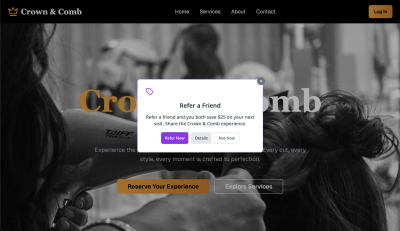
Crown & Comb: A clean, high-contrast hair salon site. This site was intentionally designed to be complex, featuring a VIP program and a notoriously difficult "bridal package" booking task.
The Participant Pool
The study involved 30 participants, split into two groups:
The Cognitive Group: Individuals who self-identified as having challenges with memory, focus, or learning (including ADHD, Dyslexia, and Autism).
The Gen Pop Group: A control group representing the general population without identified cognitive challenges.
Each participant underwent facilitated online interviews, completing specific tasks while researchers tracked concerns, questions, and missed cues. At the end of each session, participants completed the Accessible Usability Scale (AUS), a 10-question survey used to quantify digital usability.
Supporting Data: Quantifying the Insight Gap
The results of the study provided clear, quantitative evidence of the "Cognitive Efficiency Gap." Across all three websites, the cognitive group consistently outperformed the general population in identifying points of failure.
Total Findings Across All Sites:
Usability Issues Identified: Cognitive Group (197) vs. Gen Pop (113).
Suggestions for Improvement: Cognitive Group (93) vs. Gen Pop (54).
Site-Specific Performance
Metric
Strong Snacks (Simple)
Turning Pages (Medium)
Crown & Comb (Complex)
Gen Pop Issues (Avg)
6.4
11.0
5.0
Cognitive Issues (Avg)
9.8
17.0
12.0
Gen Pop AUS Score
90.5
78.0
49.5
Cognitive AUS Score
76.8
60.8
63.8
The "Crown & Comb" Anomaly
Interestingly, on the most difficult site (Crown & Comb), the cognitive group actually gave a higher usability score (63.8) than the gen pop group (49.5), despite finding more issues. Researchers believe this suggests that while cognitive testers are more adept at spotting errors, their perception of "usability" may be more resilient when they expect a task to be difficult, whereas neurotypical users become more quickly frustrated by unexpected complexity.
Issue Categories
When the data was categorized, the cognitive participants were significantly more likely to identify problems in:
Content: Confusion over wording and instructions.
Affordances: Buttons and links that didn’t look clickable or behaved unexpectedly.
Visual Elements: Icons that lacked clarity or distracting animations.
Media: Issues with how video and moving parts interfered with focus.
Official Responses and Qualitative Perspectives
The quantitative data tells only half the story. The qualitative feedback from the study highlights the profound emotional and mental impact of poor UX on different user groups.
The "Gen Pop" Perspective:
One neurotypical participant, when struggling with the Crown & Comb site, remarked:
"As soon as you click onto that, it should be that you can interact with that service straight away… This feels not particularly engaging."
For this user, the issue was one of frustration and engagement.
The "Cognitive" Perspective:
In contrast, a participant from the cognitive group described the same experience in terms of mental health and energy:
"The mental energy aspect of it… maybe the website or service has too many options to look through… It makes me feel drained and less able to focus."
This distinction is vital for researchers. While a neurotypical user might find a site "annoying," a user with a cognitive disability finds it "draining," leading to total task abandonment.
The Industry View:
The value of these insights is already being recognized by major players. A UX Manager at Bell Media summarized the efficiency of this approach:
"2 sessions with cognitive users feel like 200 because of the volume of insights we get."
Implications: The Future of Inclusive Design
The findings of this study have far-reaching implications for the tech industry, particularly as the "Silver Tsunami" of an aging population approaches.
1. The Curb-Cut Effect for Digital Products
Just as sidewalk curb cuts—originally designed for wheelchairs—ended up benefiting parents with strollers and travelers with luggage, cognitive inclusion benefits everyone. High cognitive load is not exclusive to those with permanent disabilities; it affects:
People experiencing high stress or burnout.
Non-native language speakers.
Individuals in distracting environments (e.g., using a phone on a busy train).
The aging population experiencing natural cognitive decline.
2. Economic Efficiency
If a small group of cognitive testers can identify 1.8 times more issues than a standard group, companies can significantly reduce the number of testing rounds required. By solving for the most sensitive users first, developers create a "buffer" of simplicity that ensures the product works for the widest possible audience.
3. The Aging Demographic Shift
According to U.S. Census projections, by 2060, one in four Americans will be aged 65 or older. This demographic shift means that cognitive decline will become a standard user state rather than an outlier. Companies that fail to adopt cognitive-first research today are essentially ignoring a quarter of their future market.
4. Accessibility as a Strategic On-Ramp
For many organizations, full accessibility compliance (such as screen reader optimization) feels like a daunting technical hurdle. The researchers suggest that cognitive accessibility is a powerful "on-ramp." By focusing on clarity, predictability, and reduced cognitive load, teams build a foundation of inclusive design that makes later technical accessibility requirements easier to implement.
Conclusion: A New Standard for UX
The exploratory study concludes that cognitive inclusion in UX research is no longer an optional "extra." In a world where digital interfaces are the primary gatekeepers to services, health, and commerce, the ability to process information easily is a fundamental right.
By leveraging the unique insights of neurodivergent participants, UX teams can move beyond "good enough" design and toward a standard of excellence that respects the mental energy and focus of every user. As the data proves, when you design for the most cognitively taxed, you create a better experience for the entire world.

 By Ammar Sabilarrohman


 Nana Wu
  Nana
Nana 