
 By Ammar Sabilarrohman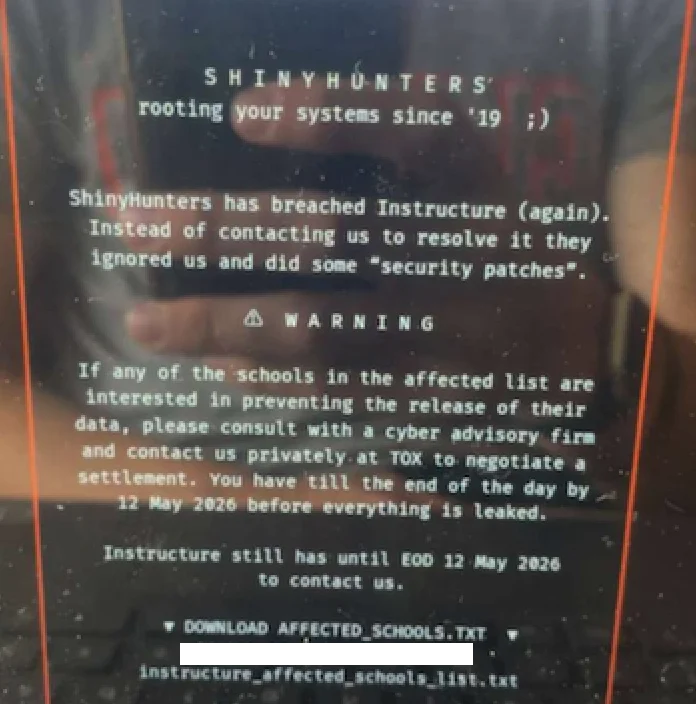
The digital backbone of the American education system faced a catastrophic challenge this May as the widely utilized learning management platform, Canvas, became the epicenter of a massive, escalating data extortion campaign. Orchestrated by the notorious cybercriminal collective known as ShinyHunters, the attack compromised the coursework and sensitive personal data of millions of students and faculty members, forcing a nationwide disruption that left school districts and universities scrambling for answers.
What began as a localized security concern in late 2025 evolved into a full-scale public relations and technical crisis for Canvas’s parent company, Instructure, culminating in a controversial ransom payment and the temporary suspension of core platform services.
The Anatomy of the Attack: A Chronology of Failure
The crisis was not an isolated event but rather the climax of an eight-month-long infiltration strategy. Security analysts, most notably Dipan Mann of the cybersecurity firm Cloudskope, argue that the May 2026 incidents were the "production run" of a threat actor that had been methodically mapping the Instructure environment since at least September 2025.
The September 2025 "Proof of Concept"
The pattern began with a breach at the University of Pennsylvania. At the time, the incident was largely framed by national media as a singular, institution-specific failure. However, evidence later confirmed that the attackers used an Instructure-mediated access path to exfiltrate donor records, internal memos, and confidential faculty files. When the university refused to pay a $1 million ransom demand, ShinyHunters published 461 megabytes of sensitive data in March 2026, signaling that they had successfully weaponized their access to the platform.
The May 2026 Escalation
- May 1, 2026: ShinyHunters publicly signaled a breach of Instructure.
- May 2, 2026: Instructure CISO Steve Proud issued a statement claiming the incident had been "contained" and that the platform was secure.
- May 6, 2026: Instructure acknowledged the breach of "certain identifying information," such as names, email addresses, and student IDs, while maintaining that the situation was under control.
- May 7, 2026: The crisis turned chaotic. Students and faculty across the U.S. attempted to log in to Canvas, only to be met with a ransom demand from ShinyHunters plastered directly onto the login page. The message mocked the company’s previous security efforts, claiming they had "ignored" previous warnings.
- May 7–8, 2026: Instructure took the platform offline, euphemistically labeling the forced shutdown as "scheduled maintenance."
- May 11, 2026: In a stunning admission, Instructure confirmed it had paid an undisclosed ransom to the attackers in exchange for the destruction of the stolen data.
The Mechanics of the Breach: "Free-for-Teacher" Vulnerabilities
Following the outage, Instructure revealed that the vulnerability stemmed from the platform’s "Free-for-Teacher" accounts. This specific tier of service, designed for educators to use Canvas independently of institutional IT oversight, lacked the robust security perimeter applied to enterprise-level school accounts.
By exploiting this specific gateway, ShinyHunters bypassed institutional firewalls, gaining access to the broader Instructure ecosystem. The attackers utilized tactics common to their repertoire: voice phishing and sophisticated social engineering. By impersonating IT personnel, they successfully compromised internal credentials, allowing them to pivot deeper into the network.
The decision to disable these accounts was a "difficult decision," according to Instructure, but one deemed necessary to halt the unauthorized access. The move, however, underscored a fundamental tension in modern EdTech: the trade-off between the accessibility required for rapid classroom adoption and the stringent security protocols required to protect student privacy.
The Shadow of ShinyHunters: A Prolific Threat Actor
To understand the severity of the Canvas attack, one must view it within the context of the broader threat landscape. ShinyHunters has emerged as one of the most fluid and aggressive data extortion groups in the current digital landscape. Their methodology is characterized by speed, social engineering, and a total lack of regard for the sensitivity of the data they target.
Just weeks prior to the Canvas attack, the group compromised the home security giant ADT, exfiltrating personal data on 5.5 million customers by breaching a single employee’s Okta account. Their recent hit list includes high-profile entities such as:
- Medtronic: A global leader in medical technology.
- Rockstar Games: A major player in the interactive entertainment industry.
- 7-Eleven: A multinational retail giant.
- Carnival Cruise Line: The travel and leisure operator.
Charles Carmakal, CTO of Mandiant Consulting, noted that these attacks are rarely isolated. "There are multiple concurrent and discrete ShinyHunters intrusion and extortion campaigns happening right now," he stated. This suggests that the Canvas breach was not a singular obsession for the group, but rather one revenue stream in a diversified portfolio of criminal enterprises.
Implications: The Ethics and Economics of Ransom Payments
The most controversial chapter of this saga was Instructure’s decision to pay the ransom. While the company claimed they received "digital confirmation of data destruction," the move has drawn sharp criticism from cybersecurity experts.
The Normalization of Extortion
Paying a ransom—even to secure the destruction of data—creates a dangerous feedback loop. It validates the business model of cybercriminal groups, ensuring that they will continue to target organizations that demonstrate a willingness to pay. Critics argue that once a company pays, they essentially become a "repeat customer" for future extortion.
The "Path of Least Resistance"
Dipan Mann of Cloudskope has been a vocal critic of how the education sector handles these incidents. He argues that there is a systemic preference for "quietly handling" breaches to avoid the reputational damage associated with transparency. By treating the Penn breach as a localized event and subsequently framing the May 2026 outage as "scheduled maintenance," Instructure initially attempted to manage the optics rather than address the root technical failures.
This "path of least resistance" often forces universities and school districts to decide for themselves whether to negotiate with criminals. During the May 7 outage, sources confirmed that several universities approached the attackers directly, desperate to prevent the publication of sensitive student data before final exams.
The Future of EdTech Security
The Canvas incident serves as a grim watershed moment for the EdTech industry. It highlights that the centralization of educational data creates high-value targets for attackers. When a single platform serves thousands of institutions, a single point of failure can disrupt the learning process for millions.
Recommendations for Educational Institutions
- Zero-Trust Architectures: Schools must move away from relying solely on the security of the vendor. Implementing multi-factor authentication (MFA) and strict access controls that do not rely on the vendor’s internal credentials is now a necessity.
- Transparency Requirements: The tendency to obfuscate breaches through vague status messages ("scheduled maintenance") must end. Transparency allows school districts to take proactive measures to protect their users.
- Third-Party Auditing: Institutions should demand more than just marketing assurances from their vendors. Independent, ongoing security audits of the software supply chain are the only way to ensure that "security patches" are more than just a public relations talking point.
As the dust settles, the education sector faces a difficult reality: the digital tools that revolutionized the classroom have also introduced existential risks. The Canvas breach proved that the era of "trusting the provider" is over; the future must be built on a foundation of rigorous, transparent, and proactive cybersecurity. Whether Instructure can regain the trust of the millions of students and faculty they serve remains to be seen, but the event will undoubtedly serve as a case study in how not to handle an organizational security collapse for years to come.
 Sagoh
Sagoh  Evan Lee Salim