
 By Nana Muazin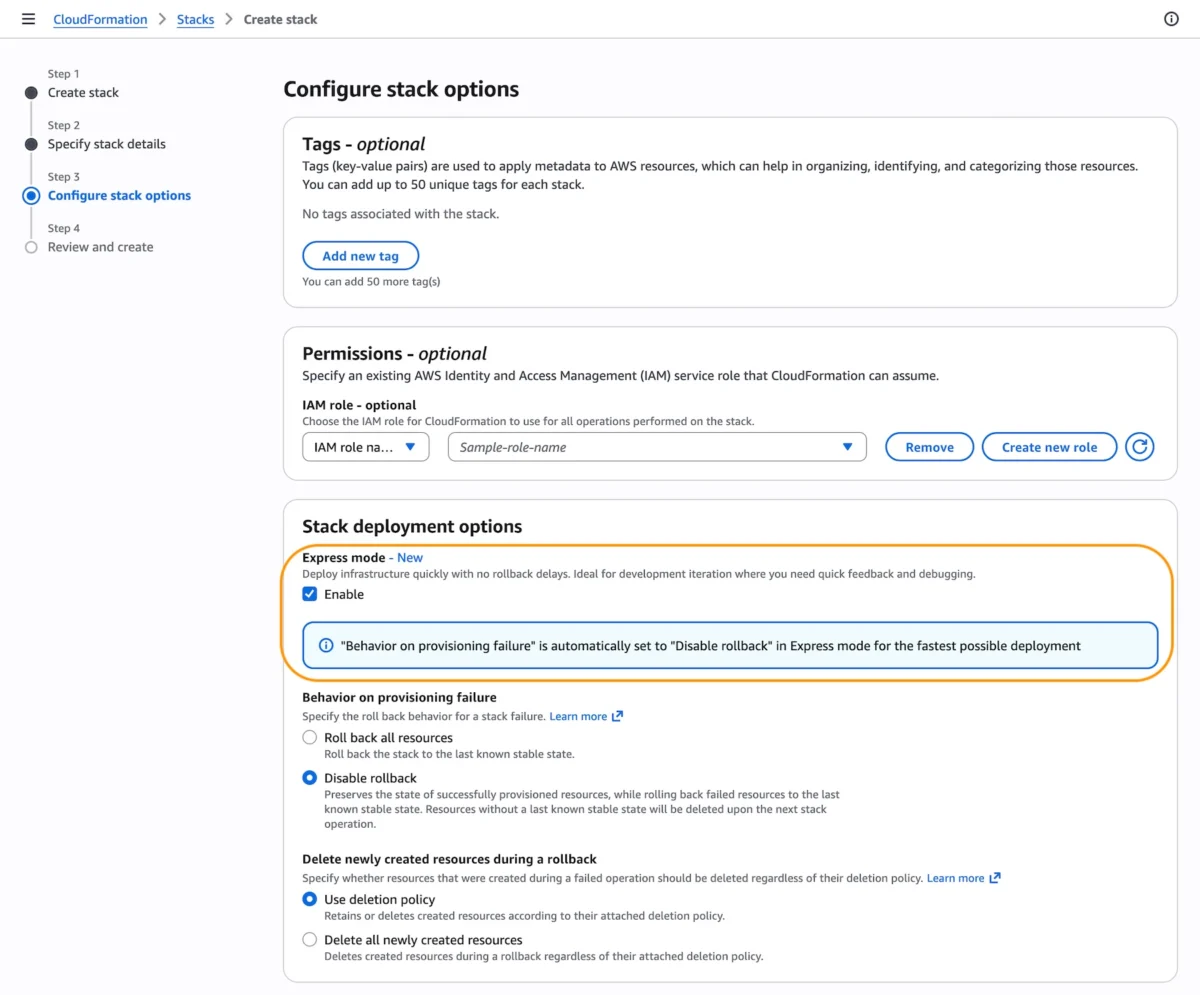
In a significant leap forward for Infrastructure as Code (IaC) agility, Amazon Web Services (AWS) has officially unveiled AWS CloudFormation Express mode. Designed to slash the time developers spend waiting for infrastructure deployments, this new deployment configuration promises to accelerate feedback loops by up to four times, fundamentally changing how engineers and AI-driven agents interact with the AWS cloud.
By decoupling the act of resource configuration from the time-consuming process of "stabilization checks," AWS is addressing a long-standing pain point for DevOps teams: the friction caused by waiting for long-running deployments during iterative development cycles.
The Core Innovation: Redefining Deployment Completion
At its heart, AWS CloudFormation Express mode is a strategic optimization of the deployment lifecycle. Historically, every CloudFormation stack update followed a rigid protocol: after an instruction was sent to provision or modify a resource, the system performed exhaustive stabilization checks to ensure the resource was not only created but fully "ready" to accept traffic or interact with other components. While essential for production-grade stability, these checks often become a bottleneck during the experimental or testing phases of development.
Express mode changes the definition of "done." Instead of waiting for these secondary verification steps to confirm that every resource is fully initialized, CloudFormation now signals completion the moment the configuration has been successfully applied to the AWS control plane. The resources continue to stabilize in the background, managed by the underlying AWS infrastructure, while the developer is freed to move on to the next task.
Why Stabilization Matters—And Why We Sometimes Need to Skip It
Stabilization is the safety net of cloud architecture. It ensures that if a load balancer is requested, it is not marked as "complete" until it is actually passing health checks and ready to route traffic. For production environments where uptime is paramount, this mechanism remains critical.
However, in scenarios where developers are iterating on infrastructure—such as building a new microservice, testing a minor configuration tweak, or employing AI coding assistants—this wait time is often counterproductive. Express mode acknowledges that for these specific workflows, the speed of iteration is more valuable than immediate verification of readiness.
Chronology of the Shift: From Standard to Express
The evolution toward Express mode follows years of AWS feedback loops. For nearly a decade, the standard CloudFormation model has been the "Gold Standard" for safety. Yet, as the industry moved toward CI/CD pipelines, containerization, and now AI-assisted infrastructure generation, the "wait-for-stabilization" model began to feel like a legacy hurdle.
- The Era of Standard Deployment: For years, developers accepted 60-second to 30-minute deployment cycles as the cost of doing business. Whether it was simple SQS queues or complex Lambda functions with network interface attachments, the time taken to verify state was fixed.
- The Demand for AI-Assisted Development: With the rise of tools like AWS Q and other AI-driven infrastructure generators, the need for sub-minute feedback loops became acute. AI agents iterating on code can now push updates at machine speed, but they were previously throttled by the manual pace of traditional infrastructure stabilization.
- The Launch: Following internal benchmarking and pilot testing, AWS has now made Express mode available globally across all commercial regions. This rollout represents a permanent shift in how AWS handles state management, prioritizing developer productivity without sacrificing the structural integrity of the AWS stack.
Supporting Data: Quantifying the Speed Gains
The performance improvements offered by Express mode are not merely incremental; they are transformative. Based on internal AWS benchmarking, the transition from Standard to Express mode yields dramatic time savings.
Case Study: SQS and Lambda Deployments
- Amazon SQS Queues: In a typical scenario involving the creation of an SQS queue paired with a Dead Letter Queue (DLQ), a Standard mode deployment takes approximately 64 seconds. With Express mode, the same stack completes in roughly 10 seconds. This is an 84% reduction in wait time.
- AWS Lambda with VPC Attachments: The gains are even more pronounced for complex resource types. Creating or deleting a Lambda function with a network interface attachment—a notoriously slow operation in traditional CloudFormation—can take between 20 and 30 minutes. In Express mode, this process is completed in just 10 seconds.
These figures illustrate a shift from a "wait-to-proceed" model to a "fire-and-forget" model, where the system handles the complexities of eventual consistency and transient failures behind the scenes. If a resource encounters a temporary issue during the asynchronous provisioning process, CloudFormation’s internal logic automatically retries the operation, sparing the developer from manual intervention.
Official Guidance and Implementation Strategies
AWS has integrated Express mode directly into existing workflows, ensuring that adoption requires minimal friction. There are no changes required to existing YAML or JSON templates.
How to Enable Express Mode
Developers can trigger Express mode through several channels:
- AWS Management Console: When initiating a stack, users can select the "Express mode" option under the "Stack deployment options" menu.
- AWS CLI: By adding the
--deployment-config '"mode": "EXPRESS"'parameter to existingcreate-stackorupdate-stackcommands, users can invoke the new logic immediately. - AWS CDK: For those using the Cloud Development Kit, the command
cdk deploy --expressautomatically interprets the infrastructure code and deploys it using the new, accelerated methodology.
The Trade-off: Rollbacks and Error Handling
A crucial consideration for users is the default behavior regarding rollbacks. Because Express mode is optimized for speed, it disables rollbacks by default. This is intended to keep the developer in the flow state, avoiding the lengthy cleanup processes that occur when a deployment fails.
However, AWS provides flexibility. In production environments where safety is the priority, users can set disableRollback to false within the deployment configuration. This allows teams to benefit from the speed of Express mode while retaining the robust, automated safety nets they expect from enterprise-grade cloud management.
Strategic Implications for Modern DevOps
The introduction of CloudFormation Express mode has profound implications for the future of cloud engineering.

1. The Rise of "Infrastructure-as-Speed"
As development cycles tighten, the ability to deploy infrastructure in seconds rather than minutes means that developers can perform more granular, frequent updates. This encourages a culture of "incrementalism"—deploying smaller chunks of infrastructure more often, which is inherently safer and easier to debug than large-scale, monolithic changes.
2. Empowering AI Agents
The most significant beneficiary of Express mode may be the AI-driven developer. AI coding assistants (like Amazon Q or other LLM-based agents) rely on rapid feedback to refine code. By providing a sub-minute feedback loop, AWS is effectively enabling AI to "learn" from infrastructure errors in near real-time, drastically increasing the sophistication and speed of AI-assisted infrastructure provisioning.
3. Consistency Across the Stack
Because Express mode is not a "special" version of CloudFormation but rather a configuration of the existing engine, it supports the full spectrum of AWS features. Change sets, nested stacks, and complex IAM role management remain fully compatible. When a parent stack is set to Express mode, all nested stacks inherit that speed, ensuring that the entire application architecture is deployed with equal velocity.
4. Cost and Accessibility
Perhaps most importantly, this feature is available at no additional cost. By removing the technical overhead of stabilization checks, AWS is essentially "giving back" time to developers. This move is consistent with AWS’s long-term strategy of reducing the operational burden of the cloud, allowing engineers to focus on application logic rather than the mechanics of infrastructure provisioning.
Conclusion: A New Standard for Iteration
AWS CloudFormation Express mode is more than just a speed boost; it is an acknowledgment of how modern software is built. By recognizing that different stages of the development lifecycle—from early-stage prototyping to mission-critical production—require different levels of verification, AWS has provided a tool that scales with the needs of the user.
As developers continue to integrate AI into their toolchains and look for ways to shorten the distance between "code" and "running service," features like Express mode will become the new baseline. For those looking to optimize their CI/CD pipelines, minimize idle time, and push the boundaries of how quickly they can ship, Express mode is an essential addition to the modern AWS toolkit.
For more information, developers are encouraged to visit the official AWS CloudFormation documentation, explore the AWS MCP server for AI integrations, and engage with the community via the AWS re:Post forums to share their experiences and benchmarking results. The era of the sub-minute deployment has arrived.
 Neng Nana
  Suro Senen
  Lina Hope