
 By Pevita Pearce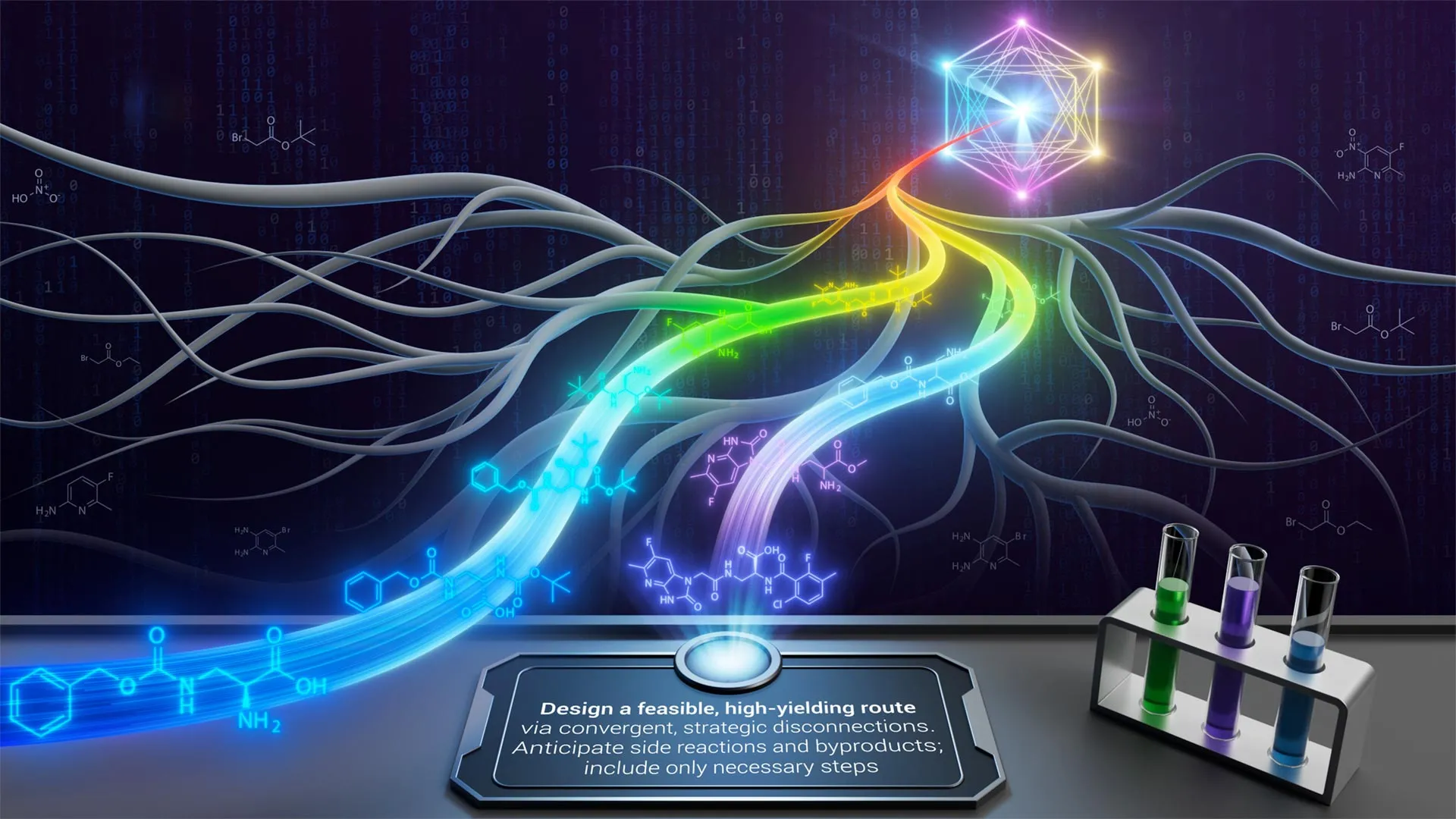
For decades, the art of chemical synthesis has been defined by a grueling apprenticeship. To create a life-saving pharmaceutical or a high-performance material, a chemist must navigate a labyrinth of molecular possibilities, balancing thermodynamic stability, kinetic feasibility, and the often-fickle nature of organic reactivity. It is a process that demands deep expertise, strategic foresight, and an intuitive grasp of how electrons dance between atoms.
However, a breakthrough from researchers at EPFL (École Polytechnique Fédérale de Lausanne) is poised to change this. Led by Philippe Schwaller, the team has introduced "Synthegy," a novel framework that leverages Large Language Models (LLMs) not as mere data processors, but as reasoning engines. By allowing chemists to "converse" with computational tools using natural language, Synthegy is bridging the chasm between raw algorithmic power and human strategic intuition.
The Retrosynthetic Challenge: Mapping the Molecular Maze
At the heart of organic chemistry lies the concept of retrosynthesis—the process of working backward from a complex target molecule to simple, commercially available building blocks. It is a puzzle of immense scale. Chemists must decide which bonds to break, which functional groups to mask with "protecting groups" to prevent unwanted side reactions, and the optimal order of operations.
Historically, this has been an arduous task. While traditional computational tools can scan "chemical space"—the hypothetical universe of all possible molecular structures—they have often been criticized for being "black boxes." They lack the nuanced judgment of an experienced scientist. A computer might suggest a theoretically valid pathway that is, in practice, a nightmare to execute in a laboratory.
Furthermore, the mechanisms governing these reactions—the step-by-step migration of electrons—are often buried in complex mathematical representations that are difficult for human researchers to query intuitively. Until now, bridging the gap between a high-level strategic plan and the granular, step-by-step electron movement required to execute it has been a significant bottleneck in chemical research.
The Advent of Synthegy: A Chronology of Innovation
The development of Synthegy represents a departure from traditional "direct generation" AI models. Rather than tasking an AI with hallucinating new chemical structures from scratch, the EPFL team repositioned the LLM as an expert auditor and guide.
The Developmental Timeline:
- The Conceptual Phase: The team identified that existing retrosynthesis software was hampered by rigid, cumbersome user interfaces that relied on complex rule-based filters. They hypothesized that natural language could serve as a more flexible "interface" for human intent.
- The Integration Phase: Researchers combined established search algorithms with LLMs capable of interpreting chemical logic. The goal was to create a system where the AI acts as a mediator between the user’s intent and the algorithm’s vast search capabilities.
- The Testing Phase: To validate the framework, the team conducted a rigorous double-blind study involving 36 chemists who evaluated 368 synthetic pathways.
- The Publication: The findings were formally unveiled in the journal Matter, signaling a shift in how the scientific community views the role of AI in laboratory settings.
Supporting Data: Validating the Machine’s "Intuition"
The performance metrics of Synthegy provide a compelling argument for its adoption. In the double-blind validation study, the system demonstrated a 71.2% agreement rate with human experts. This is a significant milestone, suggesting that the AI is not merely mimicking human behavior but is capable of internalizing the logical heuristics used by professional chemists.
The study also revealed a correlation between model size and reasoning capability. Larger models—those with more parameters—consistently outperformed their smaller counterparts, suggesting that the "reasoning" capability of an LLM scales with its complexity. This reinforces the idea that the model is performing a form of higher-order analysis, evaluating not just whether a reaction is possible, but whether it is strategic and efficient.
The system successfully:
- Identified Redundancy: It flagged unnecessary protecting groups that would have added labor and cost to a synthetic route.
- Assessed Feasibility: It evaluated the likelihood of success for complex transformations, filtering out pathways that were theoretically sound but practically improbable.
- Prioritized Efficiency: It ranked multiple pathways based on criteria specified by the user, such as "minimize step count" or "prioritize ring-closing reactions."
Official Responses and Expert Perspectives
"When making tools for chemists, the user interface matters a lot," says Andres M Bran, the first author of the Synthegy paper. "Previous tools relied on cumbersome filters and rules. With Synthegy, we’re giving chemists the power to just talk, allowing them to iterate much faster and navigate more complex synthetic ideas."
The sentiment among the research team is that the tool is designed to augment, not replace, the chemist. By offloading the "grunt work" of filtering thousands of potential pathways to an AI that understands chemical strategy, the scientist is freed to focus on the creative aspects of molecular design.
"The connection between synthesis planning and mechanisms is very exciting," Bran notes. "We usually use mechanisms to discover new reactions that enable us to synthesize new molecules. Our work is bridging that gap computationally through a unified natural language interface."
Implications for the Future of Chemistry
The implications of Synthegy extend far beyond the walls of the EPFL laboratory. If the process of drug discovery and materials design can be accelerated by even a small percentage, the economic and health-related benefits would be immense.
Accelerating Drug Discovery
In the pharmaceutical industry, time is money. A drug candidate might spend years in the "design and synthesis" phase before it even reaches a clinical trial. By allowing researchers to communicate their strategic intent—such as "avoid heavy metals" or "use green chemistry principles"—to an AI that can instantly rank thousands of potential routes, Synthegy could shave significant time off the development lifecycle.
Improving Reaction Design
The integration of mechanistic understanding—the "how" of a reaction—into a natural language interface means that scientists can test hypotheses on the fly. An researcher might ask the system, "What if I swap this solvent for a more sustainable alternative?" or "How would this electron movement be affected by this specific functional group?" The AI can simulate these changes and provide feedback based on its training data, essentially acting as a 24/7 laboratory consultant.
Democratizing Advanced Synthesis
Perhaps the most profound implication is the democratization of chemical expertise. By using a natural language interface, advanced synthesis tools become accessible to a wider range of researchers, including those who may not be experts in every specific sub-field of organic chemistry. As long as a chemist can clearly define their strategic goal, the system can assist in navigating the technical complexities required to achieve it.
Conclusion: A New Partnership
The story of Synthegy is not one of AI conquering chemistry, but of AI becoming a more effective teammate. For decades, the field has struggled with the disconnect between the human ability to form a "vision" for a synthesis and the computational ability to execute the search for that vision.
By utilizing the power of LLMs to parse, score, and explain the logic behind synthetic routes, researchers at EPFL have provided a blueprint for the future of the laboratory. In this future, the "cumbersome filters and rules" of the past will be replaced by a fluid, conversational partnership between human creativity and machine intelligence. As we look ahead, the ability to "talk" to our chemical tools may well become as fundamental to chemistry as the beaker or the chromatography column, ushering in an era of unprecedented efficiency in the molecular sciences.
 Sagoh
Sagoh  Asro
Asro  Siti Muinah