
 By Azzam Bilal Chamdy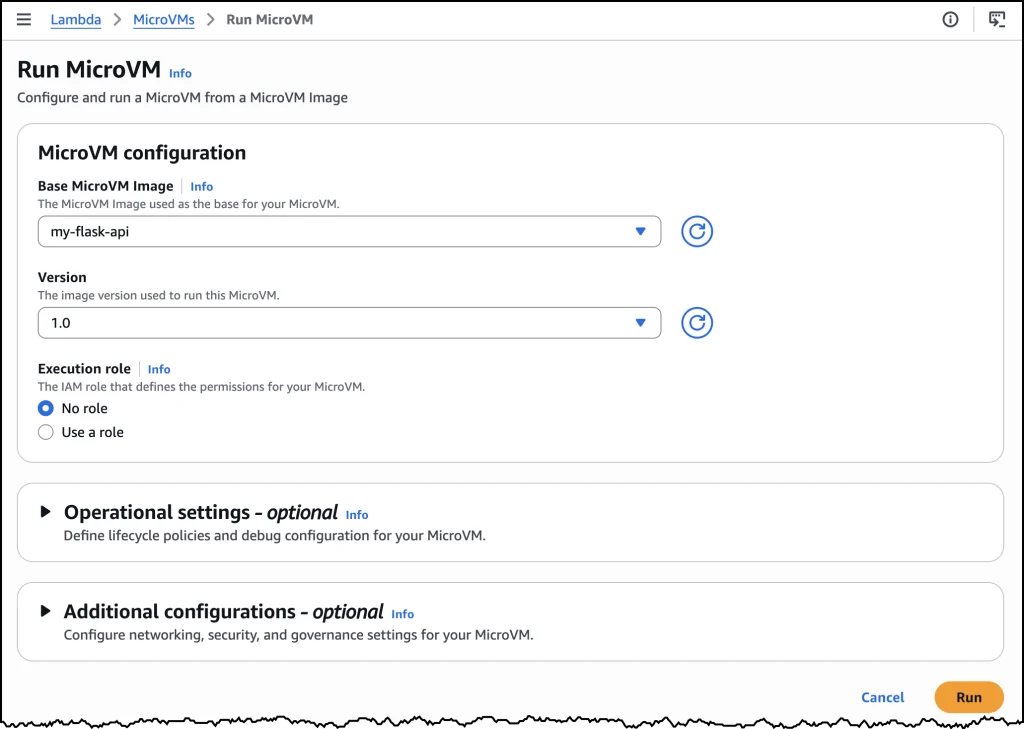
In a significant expansion of its serverless portfolio, Amazon Web Services (AWS) today unveiled AWS Lambda MicroVMs, a groundbreaking compute primitive designed to bridge the long-standing divide between ephemeral event-driven functions and persistent, resource-heavy virtual machines. By leveraging the industry-proven Firecracker virtualization technology, AWS is empowering developers to deploy isolated, stateful, and near-instantaneous execution environments for user-supplied or AI-generated code.
This launch addresses a critical pain point for modern developers building multi-tenant applications—such as AI coding assistants, interactive data science notebooks, and secure sandbox environments—who previously faced a binary choice between the weak isolation of shared-kernel containers or the sluggish, overhead-heavy management of traditional virtual machines (VMs).
The Core Innovation: Why MicroVMs Change the Landscape
For years, the serverless paradigm has been defined by the request-response model: a function wakes up, processes a payload, and shuts down. While revolutionary for backend microservices, this architecture is fundamentally ill-suited for the emerging generation of "agentic" applications.
Modern platforms—like AI-powered code editors (e.g., Cursor or GitHub Copilot extensions) or collaborative data analytics tools—require dedicated, long-running environments for every user. These sessions need to retain local memory, disk state, and process continuity across multiple user interactions.

The Infrastructure Dilemma
Historically, engineers tasked with building these applications faced a difficult "trilemma":
- Virtual Machines: Provide robust security through hardware-level isolation but suffer from slow boot times (measured in minutes), making them unresponsive for interactive user experiences.
- Containers: Offer faster startup times but share a host kernel. To safely run untrusted user code in a container, developers must implement complex, high-maintenance security hardening, diverting resources away from core product innovation.
- FaaS (Functions-as-a-Service): While perfect for event-driven logic, FaaS platforms are not designed to preserve state across sessions, leading to high latency during cold starts and technical debt when trying to "hack" persistence into a stateless architecture.
AWS Lambda MicroVMs resolve this by combining the security of Firecracker—the same technology underpinning the world’s most scaled serverless infrastructure—with a stateful, snapshot-based lifecycle.
Chronology of Development: From Firecracker to MicroVMs
The evolution toward Lambda MicroVMs began in 2018 with the open-sourcing of Firecracker, a Virtual Machine Monitor (VMM) purpose-built for creating and managing secure, multi-tenant container and function-based services. Firecracker was designed specifically to provide the security benefits of a VM with the speed of a container.
- 2018: AWS launches Firecracker, setting the foundation for high-density, secure serverless workloads.
- 2019–2024: AWS refines the snapshotting capabilities of Firecracker, allowing Lambda functions to "pause" and "resume" states, significantly reducing latency.
- 2025: Beta testing of specialized stateful execution environments begins for select enterprise customers building AI-assisted development tools.
- June 2026: AWS officially announces the general availability of Lambda MicroVMs, marking the first time these low-level primitives have been exposed as a distinct resource within the AWS Lambda API surface.
Supporting Data and Technical Architecture
The architecture of Lambda MicroVMs relies on an "image-then-launch" workflow that prioritizes developer velocity and runtime responsiveness.

The Build and Deploy Pipeline
The workflow begins with a standard Dockerfile. Developers package their application code, dependencies, and environment configurations into a zip artifact, which is then pushed to Amazon S3.
- Image Creation: The
create-microvm-imagecommand triggers an automated build process. Lambda pulls the artifact, executes the Dockerfile, and—crucially—performs a Firecracker snapshot of the initialized memory and disk state. - Snapshot Resumption: Because the environment is resumed from a snapshot rather than a cold boot, the system bypasses the "initialization phase" entirely. The application is "warm" from the millisecond it launches.
- Idle Lifecycle Policies: To balance performance with cost-efficiency, MicroVMs feature configurable idle policies. For example, a developer can set a 15-minute inactivity threshold, after which the VM is suspended. When a new request arrives, the VM resumes from the exact point it left off, state intact.
Technical Specifications
- Architecture: Optimized for ARM64.
- Compute/Memory: Scalable up to 16 vCPUs and 32 GB of RAM per MicroVM.
- Storage: 32 GB of persistent disk space per session.
- Regional Availability: Initially available in US East (N. Virginia, Ohio), US West (Oregon), Europe (Ireland), and Asia Pacific (Tokyo).
Official Perspectives: The Developer Experience
During the product unveiling, AWS engineers emphasized that MicroVMs are not intended to replace standard Lambda functions, but to complement them.
"Lambda Functions remain the gold standard for high-volume, event-driven backends," said an AWS spokesperson. "MicroVMs are a surgical tool for the specific category of multi-tenant, stateful, and interactive workloads. We wanted to remove the ‘undifferentiated heavy lifting’ of managing virtualization infrastructure so developers can focus purely on the logic of their AI agents or interactive environments."
The integration is seamless. Developers can use the AWS CLI to generate short-lived authentication tokens, enabling secure communication between their primary application and the dedicated MicroVM. Because the networking is abstracted, developers do not need to configure VPCs or load balancers for basic connectivity, further lowering the barrier to entry.

Implications for the Industry
The introduction of Lambda MicroVMs is poised to have a ripple effect across several technology sectors:
1. The Rise of "Agentic" AI
Current AI coding assistants often struggle with the latency of spinning up "sandboxes" to test user code. With MicroVMs, the "sandbox" is pre-initialized. This allows AI agents to execute code, debug errors, and iterate on data frames in real-time, creating a fluid, human-like collaborative experience.
2. Democratization of Secure Sandboxing
Startups building platforms that require user-uploaded code execution—such as interactive coding platforms, vulnerability scanners, or game servers—no longer need a dedicated DevOps team to manage a fleet of hardened VMs. By offloading this to Lambda, they gain enterprise-grade security as a managed service.
3. Cost-Effective Scaling
The ability to automatically suspend MicroVMs based on idle policies transforms the economics of stateful computing. Companies can now afford to offer interactive, long-running environments to thousands of users without incurring the costs of 24/7 dedicated instances. The "pay-for-what-you-use" model now extends to persistent, stateful sessions.
4. A Shift in Cloud Architecture
This move signals that AWS is moving away from a "one-size-fits-all" serverless model. By exposing lower-level compute primitives (the MicroVM), AWS is inviting developers to build their own higher-level abstractions. We may soon see third-party platforms built on top of Lambda MicroVMs that offer specialized environments for specific industries, such as medical research or financial modeling, where data state and security are paramount.
Getting Started
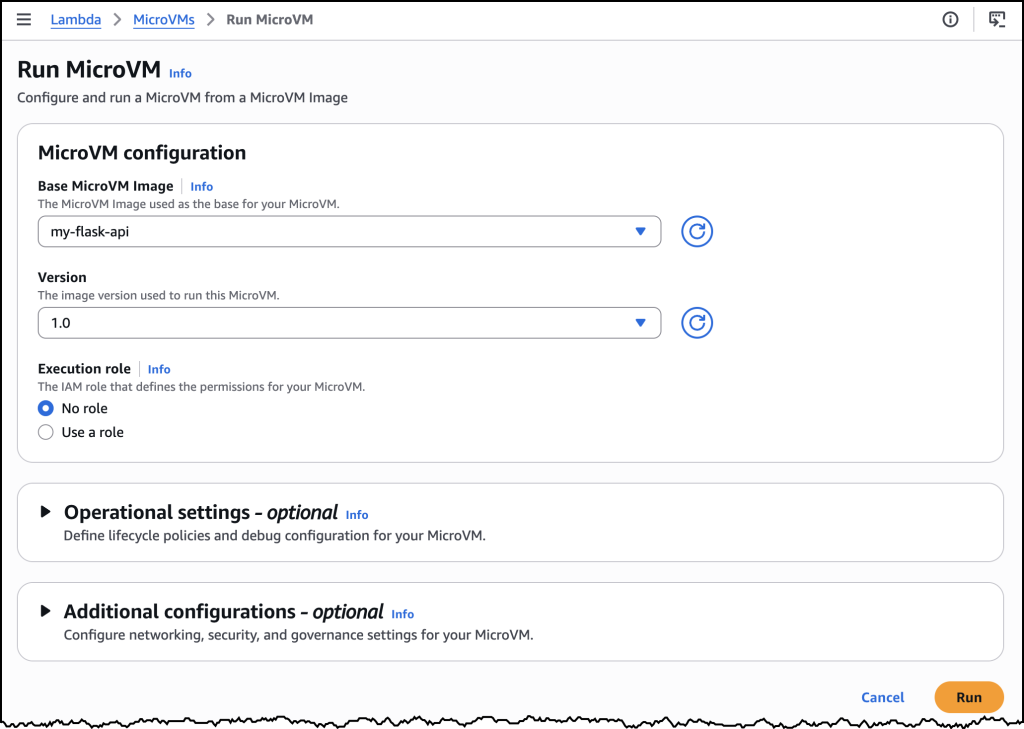
For developers eager to integrate this technology, the transition is straightforward. The AWS Lambda console now includes a dedicated MicroVM navigation menu.
Recommended First Steps:
- Package Your App: Create a simple Flask or FastAPI application using the
public.ecr.aws/lambda/microvms:al2023-minimalbase image. - Define Your Policy: Use the CLI to set your
idle-policy, ensuring you balance your user’s experience with your budget. - Audit Security: Review the IAM roles required for the MicroVM execution to ensure least-privilege access.
- Documentation: Refer to the Lambda MicroVMs Developer Guide on the official AWS documentation site for best practices regarding service-provided hooks, which are essential for handling unique content generation or network connections during the snapshot-resumption process.
As cloud computing continues to evolve, the distinction between "serverless" and "virtual machine" is rapidly fading. With Lambda MicroVMs, AWS has successfully navigated the complexity of high-performance, secure, and stateful computing, offering a blueprint for the next decade of cloud-native development. Whether you are building the next generation of AI agents or complex data platforms, the infrastructure is no longer a barrier—it is now a powerful, invisible ally.
 Neng Nana
  Suro Senen
  Lina Hope