
 By Lina Irawan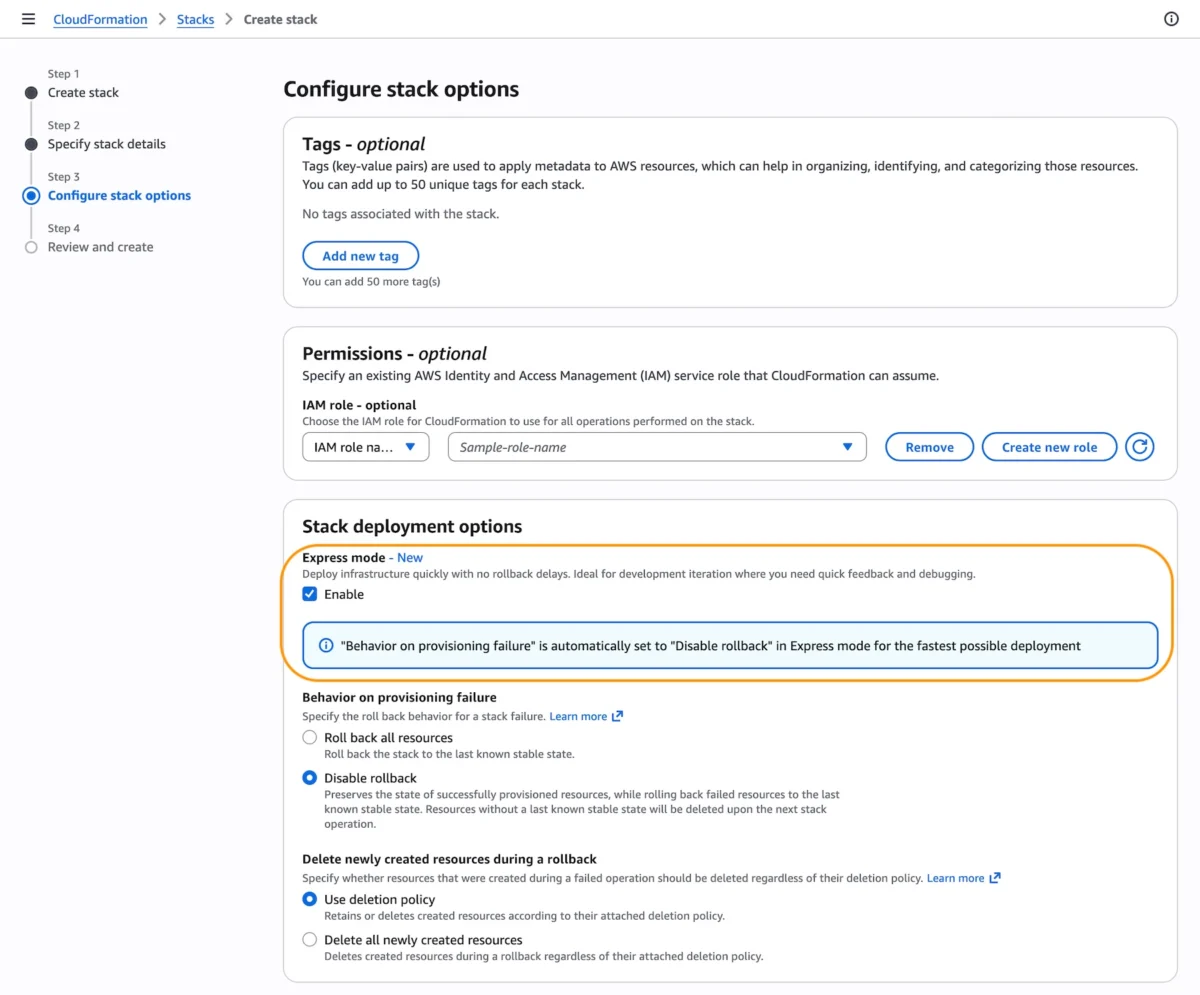
In a significant leap forward for cloud engineering, Amazon Web Services (AWS) has officially unveiled AWS CloudFormation Express mode, a transformative feature designed to drastically reduce wait times for infrastructure provisioning. By decoupling the act of resource configuration from the lengthy "stabilization" checks that have historically defined CloudFormation deployments, AWS is enabling a new paradigm of rapid, iterative infrastructure development.
This update addresses a long-standing pain point for DevOps engineers, platform architects, and developers leveraging AI-assisted coding tools: the latency associated with waiting for complex resource state confirmations. With Express mode, developers can now achieve deployment speeds up to four times faster than previous standards, fundamentally changing how teams build, test, and iterate on cloud architecture.
The Core Innovation: Redefining Deployment Completion
To understand the impact of Express mode, one must first recognize the mechanics of traditional CloudFormation deployments. Historically, when a user submitted a template, CloudFormation did not just create the resources; it entered a "stabilization" phase. During this period, the service continuously polled the requested resources to ensure they were fully operational, healthy, and ready to accept traffic. While this provided a high level of confidence in production environments, it created a significant bottleneck during the development and testing lifecycle.
A Paradigm Shift in Stabilization
Express mode fundamentally alters this process. Under the new configuration, CloudFormation triggers the creation or modification of resources and concludes the deployment cycle as soon as the configuration command is successfully acknowledged by the underlying AWS service. It does not wait for the often time-consuming background checks to verify that every component is fully "stabilized."
Instead, the service manages the state transition in the background. If a resource encounters a transient failure—a common occurrence in cloud environments—CloudFormation now features enhanced, built-in resilience, automatically retrying the provisioning without requiring human intervention. This allows the developer to move forward with their workflow almost instantly, while the infrastructure quietly settles into its intended state behind the scenes.
Chronology: From Latency to Instant Feedback
The evolution of AWS CloudFormation has always prioritized reliability and safety. Since its inception, the service has been the industry benchmark for "Infrastructure as Code" (IaC) safety. However, as the velocity of software development has accelerated—spurred by CI/CD pipelines and the explosion of AI-driven coding assistants—the traditional "check-everything-before-proceeding" model began to feel restrictive.
The Developmental Timeline
- The Era of Rigidity: For years, CloudFormation users accepted that deployment times were tied to the complexity of the stack. A stack with hundreds of resources meant waiting minutes, or sometimes longer, for the green light.
- The Rise of Iteration: As teams moved toward microservices and rapid experimentation, the "wait time" became a barrier to developer productivity.
- The AI Catalyst: The integration of AI tools—like Kiro and other generative coding assistants—into the infrastructure workflow created a requirement for sub-minute feedback loops. If an AI agent has to wait five minutes to verify a configuration, the efficiency of the entire loop degrades.
- The Launch: Today’s announcement marks the culmination of this pressure. By introducing the
EXPRESSdeployment configuration, AWS has provided a "fast track" that honors the need for speed without sacrificing the fundamental integrity of the AWS resource model.
Supporting Data: Quantifying the Speed Advantage
The efficiency gains promised by Express mode are not merely theoretical. AWS has provided empirical evidence demonstrating the dramatic reduction in deployment overhead.
Benchmarking Real-World Scenarios
- Simple Queue Service (SQS): When deploying an Amazon SQS queue paired with a Dead Letter Queue (DLQ), standard deployment processes typically require approximately 64 seconds. With Express mode, this duration drops to a mere 10 seconds.
- Lambda Network Attachments: Perhaps more striking is the management of AWS Lambda functions that require network interface attachments. In a standard environment, this process can take between 20 and 30 minutes due to the complexity of network stabilization. Express mode slashes this time to roughly 10 seconds—an efficiency gain of over 99%.
These figures represent a tectonic shift in the development lifecycle. For a developer performing a dozen deployments a day, this translates to reclaiming hours of productive time previously lost to "waiting for the cloud."
Official Perspective and Implementation Strategy
Channy Yun, a principal developer advocate at AWS, emphasized that Express mode is designed to be a flexible tool in a developer’s arsenal. "Express mode changes when the deployment completes, not how resources are provisioned," Yun noted. This distinction is critical for users concerned about the reliability of their production systems.
Getting Started: A Seamless Transition
Integration with existing workflows is straightforward. AWS has ensured that no template modifications are necessary to utilize the new mode. Whether using the AWS Management Console, the AWS Command Line Interface (CLI), or the AWS Cloud Development Kit (CDK), the process is additive:
- Console: Users can simply select "Enable" under the "Express mode" option within the stack deployment interface.
- CLI/SDK: By adding the
--deployment-config '"mode": "EXPRESS"'parameter to standardcreate-stackorupdate-stackcommands, users can toggle the speed of their deployments. - CDK: The integration is even more intuitive, with the new
cdk deploy --expresscommand acting as a direct interface to the high-speed deployment backend.
The Role of Rollbacks
A key consideration for architects is the default behavior regarding rollbacks. To maximize speed, Express mode disables automatic rollbacks by default. This is intentional; for iterative development, the overhead of rolling back a failed, non-critical change can be as frustrating as the deployment itself. However, for production environments where state integrity is paramount, developers can set disableRollback to false, allowing the service to revert to a known-good state if a failure occurs.
Implications for the Future of Cloud Architecture
The introduction of CloudFormation Express mode has profound implications for the future of cloud-native development.

1. Empowerment of AI-Driven Development
As infrastructure becomes increasingly generated by AI agents, the speed of the feedback loop becomes the primary constraint on developer velocity. Express mode effectively clears the path for AI tools to operate at the speed of thought, allowing agents to propose, deploy, and verify infrastructure changes in rapid succession.
2. The Shift to "Incrementalism"
By making deployments nearly instantaneous, AWS is encouraging a more "incremental" approach to infrastructure. Instead of grouping dozens of changes into a single, high-risk deployment, teams are now empowered to push smaller, more frequent updates. This granularity significantly reduces the "blast radius" of any single change, as issues can be isolated and identified with surgical precision.
3. A Mature Ecosystem Integration
Perhaps the most significant takeaway is that this is not a niche feature. It supports all existing CloudFormation templates, change sets, and nested stacks. By applying this mode to a parent stack, the efficiency cascades down through all nested resources. This ensures that organizations do not need to re-architect their entire infrastructure-as-code strategy to see the benefits.
4. Cultural Change in DevOps
For many years, the "slow" nature of cloud deployments was a cultural check—a moment for engineers to pause and reflect on the changes being pushed to production. While this was useful in the early days of cloud, modern DevOps demands agility. Express mode signals that AWS recognizes this cultural shift, providing the tools necessary for teams to move faster while maintaining the robust security and governance standards that have made AWS the dominant cloud provider.
Conclusion: A New Standard for Speed
AWS CloudFormation Express mode is available immediately in all commercial AWS Regions at no additional cost. It represents a mature, well-integrated solution to a modern problem: how to maintain the stability of enterprise-grade infrastructure while meeting the extreme speed requirements of modern software development.
As teams begin to adopt this new capability, we can expect to see a rise in the frequency of deployments and a decrease in the friction associated with testing complex, interconnected cloud architectures. For developers and architects alike, the days of "waiting for the stack to stabilize" are coming to an end. In the new era of Express mode, the cloud is as fast as the developers who build upon it.
 Neng Nana
  Suro Senen
  Lina Hope