
 By Suro Senen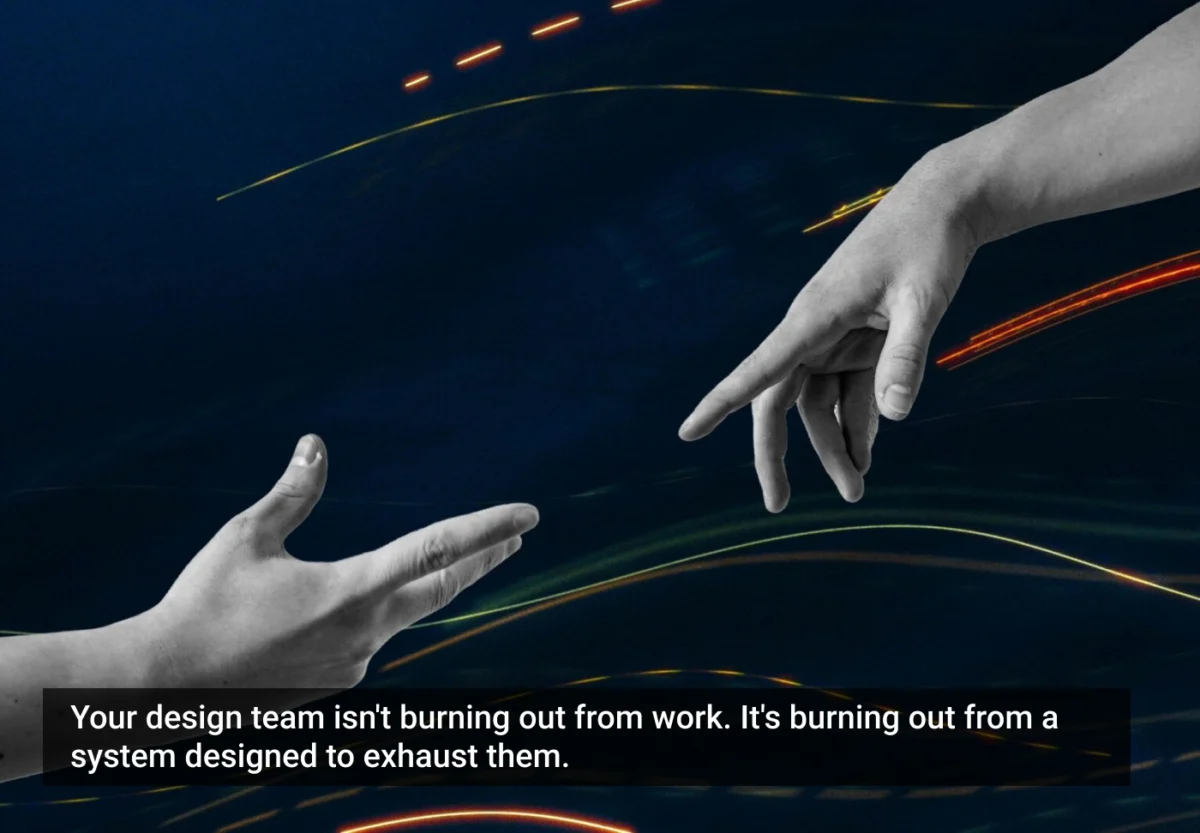
Burnout in the creative sector is often misdiagnosed as a personal failure of resilience. We frame it as a lack of grit, a poor work-life balance, or a simple inability to handle the pressure of the deadline. However, a deeper look at the operational landscape—led by insights from industry expert Pavel Bukengolts—reveals a starkly different reality: Burnout is often friction in disguise.
When high-performing designers and researchers find themselves drowning in "lost files, moving briefs, and unwritten decisions," they aren’t failing because they lack talent. They are failing because the system they inhabit is fundamentally broken. It is a slow-motion collapse of productivity where the "grind" is not a symptom of high output, but a tax paid for operational instability.
The Anatomy of Operational Friction
In the modern hybrid workplace, the workday begins with a veneer of professional normalcy. Coffee is poured, Slack channels are opened, and the team syncs up. But beneath the surface-level chatter, a second, more destructive dialogue is taking place.
It sounds like: "I spent an hour looking for the right file," or "I’ll just build it myself—it’s faster than finding the component," or "Leadership changed the goalpost again."
These aren’t just complaints; they are the distress signals of a failing design operation. In organizational theory, this is known as "hidden friction." It is the invisible drag that slows down every project, turning what should be a straightforward creative process into a game of digital hide-and-seek. Teams do not "blow up" overnight; they bleed out, one papercut at a time, until the sheer weight of administrative chaos renders them unable to function.
The Myth of "People Problems"
Leadership often responds to burnout with wellness initiatives—yoga sessions, mental health days, or team-building retreats. While these are noble, they address the symptoms rather than the root cause. If a designer is forced to rebuild the same flow four times because the product brief was updated without a centralized communication trail, no amount of yoga will fix the underlying frustration. The problem is not the people; it is the infrastructure.
The Translation Guide: Reading Between the Lines
To resolve burnout, leaders must learn to translate the background noise of their teams into actionable operational data. When a senior designer says, "I’ll just build it myself," they are not demonstrating initiative; they are signaling that the design system is either broken, outdated, or fundamentally untrustworthy.
Decoding the Distress Signals
- "Is this the latest file?" – This signals a lack of a single source of truth. Remote teams are essentially playing a game of digital hide-and-seek, leading to inevitable rework.
- "The goal changed again." – This indicates a leadership gap. When direction shifts mid-stream without context, designers are forced to abandon weeks of work, leading to deep feelings of futility.
- "Who is approving this?" – This reveals a broken feedback loop. When ambiguity reigns, team members stop acting and start waiting, creating a bottleneck that halts momentum.
Empathy Mapping: A Diagnostic Tool for Ops
Pavel Bukengolts suggests that the most effective way to identify operational failure is through empathy mapping—a method typically reserved for user research, but equally potent when applied to internal organizational health. By observing what team members say, do, think, and feel, leadership can identify exactly where the system is failing.
| Persona | Say | Do | Think | Feel |
|---|---|---|---|---|
| Designers | "Did the requirements change again?" | Recreates work, chases info. | "If they decided, I’d be done." | Frustrated/Disempowered |
| Leads | "Let me get clarity." | Absorbs chaos, acts as a shield. | "The system is set to fail." | Drained/Resentful |
| Product Mgrs | "We must hit the Q4 date." | Juggles/pushes for delivery. | "If we miss, I’m at fault." | Pressured/Stressed |
| Leadership | "Why are we moving slowly?" | Adds check-ins/new tasks. | "Why isn’t it flowing?" | Impatient/Disconnected |
When the "say" and the "feel" columns do not align, it is not a talent gap—it is an operational one. Empathy is not just a soft skill; it is a hard diagnostic tool that highlights where the scaffolding of the organization is crumbling.
The Role of DesignOps in Sustainability
DesignOps is often mistaken for bureaucracy—a way to add more rules to an already stifled process. In reality, it is the opposite. Good DesignOps is the architecture that allows for creativity. It provides the "scaffolding" that removes the need for constant, manual decision-making.
The Pillars of a Sustainable System
- Centralized Truth: Ensuring every team member works from the same version of the truth, effectively eliminating the "is this the right file" friction.
- Intentional Mentorship: In remote settings, mentorship no longer happens by osmosis. DesignOps must formalize the transfer of knowledge so that juniors aren’t left to guess.
- Feedback Loops: Clearly defining the "who, when, and how" of approvals. This removes the anxiety of waiting and prevents the bottlenecking of projects.
Measuring What You Can’t See: The Data-Driven Shift
For too long, team health has been measured by "vibes"—a subjective, unreliable metric. To move forward, organizations must adopt a more analytical approach, such as the Team Capability Engine. This model functions like an MRI for an organization; it doesn’t judge individual employees but instead measures how the system holds up under pressure.
By tracking capability gaps—such as the time lost to searching for assets, the frequency of design re-dos, or the time spent in approval limbo—leaders can see where the organization is leaking fuel. This isn’t micromanagement; it is the ultimate form of clarity. It allows leaders to shift from reactive firefighting to proactive system design.
The Cost of Staying Blind
Ignoring operational debt is never a neutral act. It is a hidden tax that compounds over time. Every unclear decision adds drag; every deferred operational fix taxes tomorrow’s momentum. When a company ignores its DesignOps, it pays the price in three ways:
- Financial Drag: Time spent on rework is pure lost revenue.
- Talent Attrition: The best people do not leave because of the work; they leave because of the chaos.
- Market Lag: In a competitive landscape, the speed of execution is determined not by the speed of the designers, but by the speed of the operational process.
A Call to Awareness: The Friction Log
If you are a leader and you suspect your team is burning out, do not start by asking them to work fewer hours. Start by asking them to document the friction.
Implement a Friction Log for one week. Ask your team to anonymously note every instance where a process slowed them down, where they had to guess a requirement, or where they had to recreate work. Do not ask for solutions yet; just ask for observations. When you review these patterns at the end of the week, you will have a roadmap of exactly where your organization is leaking its potential.
As W. Edwards Deming famously noted: "Every system is perfectly designed to get the results it gets." If your team is exhausted, your system is working exactly as it was designed—to burn them out.
The path to change is not through more effort, but through more clarity. DesignOps is not about control; it is about reclaiming the time and energy that your team needs to do their best work. By clearing the path of friction, you aren’t just saving your designers; you are saving your product, your culture, and your bottom line. It is time to stop managing the people and start managing the system.
 Ammar Sabilarrohman
  Neng Nana
  Sagoh
Sagoh 