
 By Nana Wu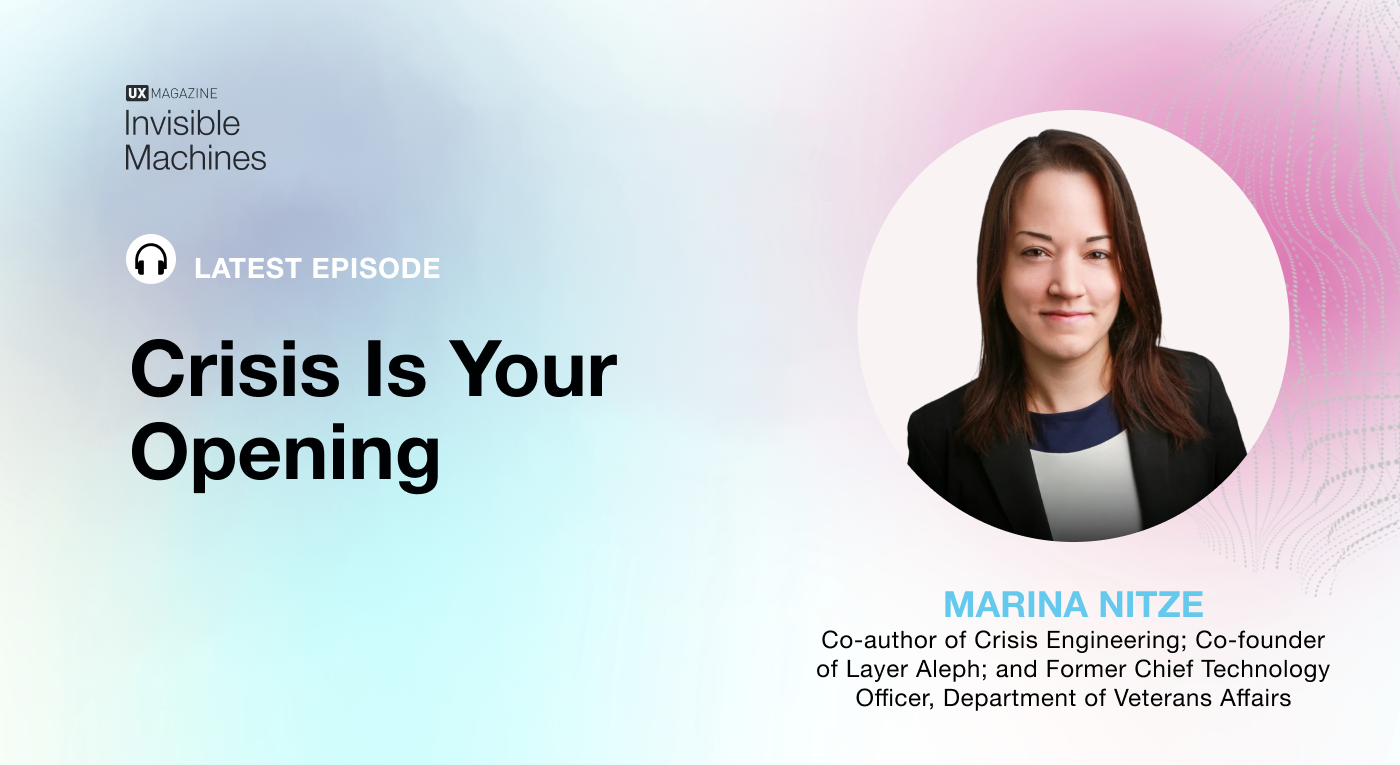
In the quiet corners of modern institutions, a dangerous phenomenon persists: the "ghost process." It is a workflow that exists in the minds of executives and the manuals of policy, but has long since vanished from the actual, physical reality of the workplace. When the world is stable, these ghosts go unnoticed. But when a crisis hits, they shatter—revealing that the story an organization tells itself is often a dangerous fiction.
Marina Nitze, a former Chief Technology Officer of the U.S. Department of Veterans Affairs and co-founder of the consultancy Layer Aleph, has spent her career uncovering these systemic delusions. Her work, codified in her framework Crisis Engineering, suggests that we are entering an era where the mismatch between organizational "maps" and the real-world "territory" will be exploited by AI at an unprecedented scale. To survive, organizations must stop building committees and start practicing the discipline of the "useful crisis."
The Phantom Call Center: A Case Study in Institutional Mirage
The most striking illustration of this phenomenon occurred during the COVID-19 pandemic. California’s unemployment system, overwhelmed by an unprecedented surge in claims, faced a complete operational collapse. As citizens lost their livelihoods and stability, they turned to the state for support. The state’s answer, repeated by everyone from frontline workers to the Governor’s office, was a mantra: "Don’t worry. We have the call center."
When Nitze and her team at Layer Aleph were brought in to diagnose the failure, they followed the bureaucratic breadcrumbs to the physical location of this supposed support system. They expected a bustling hub of activity. Instead, they found a room of empty, silent cubicles.
The "call center" was a myth. There was no central hub; there were no dedicated operators. In reality, a single phone number was programmed to route calls randomly to the desks of individual unemployment specialists. These employees were tasked with processing claims, not answering phones. When the pandemic forced them to work from home, the calls were routed to abandoned desks in a vacant room.
The employees weren’t negligent, and the executives weren’t intentionally lying. They were practicing "sensemaking"—the cognitive process by which individuals and groups construct stories to explain their environment. For years, the story that "we have a call center" provided a coherent, comforting mental model that no one had ever bothered to stress-test.
Sensemaking and the Psychology of Denial
Karl Weick, the pioneer of organizational psychology, defined sensemaking as the automatic way we construct narratives to make sense of a complex world. These stories are rarely objective; they are curated subsets of facts that align with our existing beliefs. Once a story is established, it becomes "remarkably resistant to revision."
Nitze draws a parallel to jury deliberation research. The legal system assumes jurors objectively weigh evidence to reach a verdict. In reality, jurors often form a narrative early on and then cherry-pick evidence to support that pre-existing story.
In an organizational context, this creates a "delusion loop." Executives perceive their organization through the lens of a story they were told years ago. When reality diverges from that story, the organization doesn’t update its map; it ignores the evidence. It takes a crisis—a "fundamental surprise"—to force the map and the territory to realign.
Defining the "Useful Crisis"
Nitze isn’t interested in the emotional weight of a crisis. She defines a "useful crisis" through five cold, clinical indicators. Identifying these allows leaders to stop panicking and start acting:
- Fundamental Surprise: The event was entirely unforeseen.
- Core Function Disruption: The organization’s primary mission (processing claims, shipping goods, serving customers) has halted.
- Rigid Timeline: There is no "wait and see" option; a hard deadline (e.g., a service launch) is looming.
- High Visibility: The crisis is public, trending on social media, or catching the attention of leadership.
- Failure of Sensemaking: The events unfolding contradict the official story of how the organization works.
The fifth indicator is the most critical. It creates a state of "cognitive dissonance" that is physically uncomfortable for the people involved. In that window of discomfort—before a new, flawed story is fabricated to soothe the ego—there is a brief, powerful opportunity to implement radical, positive change.
The Trap of Institutional "Busywork"
When a crisis hits, most organizations default to a predictable, ineffective pattern: they form committees, request progress reports, and schedule deliberation meetings.
"This behavior gets rewarded," Nitze notes. "A task force looks like seriousness. A status meeting looks like engagement." But this is merely a stalling tactic, designed to fill the "window of opportunity" until the crisis either fades or the status quo reasserts itself.
The alternative is what Nitze calls "novel action." This isn’t about recklessness; it’s about hypothesis testing. If a system is down, don’t hold a six-day audit. Form a theory—"I think it’s the DNS"—and test it. If you’re wrong, you’ve gained a piece of hard data about how your system actually works, rather than how you thought it worked.
The Foster Care Lesson: Mapping the Gaps
The power of this approach was proven in Nitze’s work regarding foster grandparent licensing. The process took six months, leaving many children without the support they needed. Nitze decided to "walk the process," following the paperwork from start to finish—a task no one else had ever performed.
She discovered a caseworker who spent hours every week filling out carbon-copy forms to request driving records from the DMV, a task she despised. Nitze went to the DMV to investigate. The clerk there was baffled: "I just open my email, click a folder, and send them back in an hour. We don’t use those forms."
The two departments were trapped in a cycle of mutual resentment, each believing the other was incompetent. The truth was that the dysfunction existed in the gap between them. By simply introducing the two parties, the timeline dropped by 30 days. Eventually, the step was deleted entirely; as it turned out, a grandmother’s parking tickets were irrelevant to her ability to care for a child.
The AI Reckoning: Why the Stakes are Higher
The framework of Crisis Engineering is no longer just a management preference; it is a necessity for the AI age.
Robb Wilson and Josh Tyson, hosts of the Invisible Machines podcast, have highlighted a growing disparity: consumer adoption of AI is drastically outstripping organizational adoption. Today, a single customer with an AI-agent tool can probe a company’s IVR (Interactive Voice Response) system thousands of times, finding the "cracks" in the organizational map in seconds.
If an organization thinks it has a robust, human-staffed call center, but that "center" is actually a series of broken routing rules, AI will find that gap and exploit it. The "fictional" call center that failed during the pandemic will be exposed by AI with brutal, algorithmic efficiency.
Automating the "Carbon Copy"
The danger, according to Wilson, is that companies are rushing to automate processes without walking them first. They are taking the "carbon copy" forms of the digital age and encoding them into AI agents. They aren’t fixing the system; they are simply making the dysfunction more efficient.
Preparing for the Inevitable Window
The crisis is coming. The question is: what do you have "laying around" when it arrives?
Milton Friedman famously remarked that in a crisis, the ideas that are implemented are the ones lying around. To be ready, Nitze advises:
- Build the Infrastructure Early: Establish a crisis center and separate communication channels that function even when the primary system goes down.
- Practice "Spicy Days": Use high-traffic events (product launches, seasonal surges) to run drills, not just for technical stability, but for organizational coordination.
- Keep a "Back Pocket" Project: Have a pilot or a reform proposal ready to go. When the window opens and the old story shatters, the organization will be desperate for a new one. The proposal that is ready—the one backed by data and tested in the field—is the one that will be adopted.
Conclusion: Truth as a Discipline
At its core, Crisis Engineering is a discipline of radical honesty. It is about closing the gap between the map and the territory by constantly questioning the stories we tell ourselves.
As artificial intelligence begins to stress-test our institutions, the cost of living in a fictional version of reality will become unsustainable. Organizations that continue to prioritize the "story" over the "territory" will find themselves dismantled by their own inefficiencies. Conversely, those that embrace the crisis as a moment to reveal the truth will find that the very tools of collapse can be used to build a faster, more resilient, and more human-centric future.
The crisis is not an anomaly; it is the truth-teller. The question is whether your organization is ready to listen.
 Ammar Sabilarrohman
  Neng Nana
  Sagoh
Sagoh 