
 By Nana Wu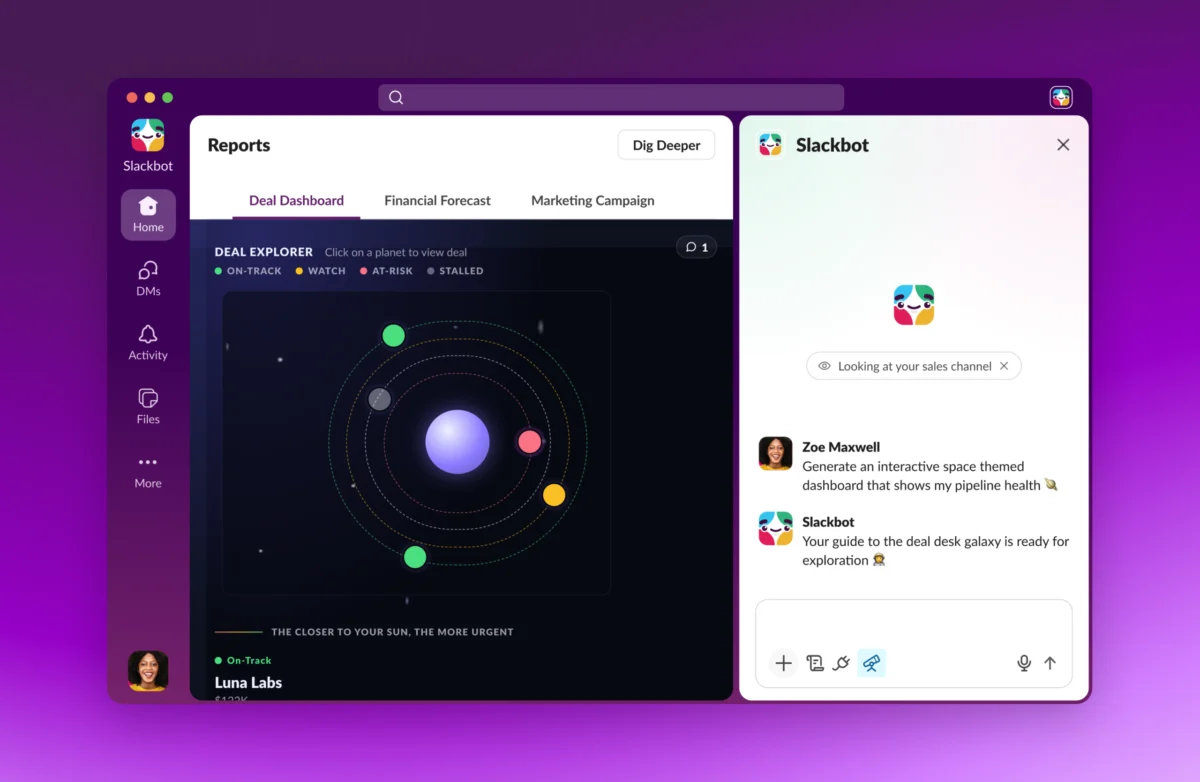
SAN FRANCISCO — In a major leap forward for enterprise software and conversational artificial intelligence, workplace messaging giant Slack has announced a transformative new feature called Slackforce Surfaces. Set to fundamentally alter how teams interact with their data, the tool allows users to generate complex, interactive digital artifacts—ranging from live dashboards and multi-slide presentations to polls, micro-sites, and structured reports—directly within a chat interface simply by talking to Slackbot.
Rather than forcing users to context-switch, export data, and build visualizations in siloed third-party software, Slackforce Surfaces harnesses generative AI to synthesize real-time information from ongoing workspace conversations and deeply integrated enterprise applications like Google Drive and Salesforce. The result is a unified, collaborative workspace where insights are not just viewed, but dynamically acted upon by entire teams in real time.
Main Facts: What is Slackforce Surfaces?
At its core, Slackforce Surfaces is designed to bridge the gap between unstructured workplace chatter and structured, actionable business intelligence.
When a user prompts Slackbot with a specific request—such as asking for a visual breakdown of project milestones or a pulse check via a team poll—the AI assistant queries connected corporate data silos and chat history. It then instantly renders a "Surface": a self-contained, interactive digital canvas that can be pinned to specific Slack channels, shared via direct message, or embedded into wider workflows.
Key capabilities of Slackforce Surfaces include:
- Multi-Format Generation: Users are not limited to simple text or static images. Surfaces can render fully interactive reports, data visualizations, live-updating dashboards, slide presentations, microsites, and functional team polls.
- Omnichannel Data Aggregation: The AI pulls information seamlessly from both native Slack discussions and external productivity and enterprise resource planning (ERP) platforms, including Google Workspace and Salesforce.
- Deep Interactivity: Once a Surface is generated, it is not a dead-end graphic. Colleagues can view the data, interact with filters, leave contextual comments, and collaborate on the artifact directly inside the thread.
- Universal Access: Unlike many enterprise features gated behind expensive tier upgrades, Slackforce Surfaces is rolling out to all Slack customers—including those on free plans—provided they have Slackbot enabled in their workspace. While the static and generative layout tools are deploying immediately, full integration with live, real-time external data streams will officially go live in October.
Chronology: The Evolution of Slack’s AI Strategy
The launch of Slackforce Surfaces does not happen in a vacuum; it represents the latest, most ambitious milestone in Slack’s rapid, aggressive evolution into an AI-first platform.
Late 2023 to Early 2024: Laying the Groundwork
As generative AI dominated the technology landscape, Slack recognized that traditional chat logs were becoming overwhelming. Workers were spending too much time searching for lost files, catching up on unread threads, and manually summarizing lengthy multi-day discussions. Slack began laying the technical infrastructure to integrate large language models securely into its enterprise messaging ecosystem.
Spring 2024: The Slackbot AI Overhaul
A pivotal turning point arrived when Slack rolled out a comprehensive overhaul of Slackbot. Moving far beyond its historical role as a rudimentary onboarding bot or simple command-line helper, the upgraded Slackbot was imbued with advanced conversational AI capabilities. Suddenly, workers could ask Slackbot to summarize extensive channel histories, distill hundreds of unread messages into bullet points, and intelligently parse schedules to find optimal meeting times across large teams.
Mid-2025: Collaborative Vibe Coding and Agentic Workflows
Momentum continued to build last month when Slack introduced collaborative "vibe coding" channels, signaling a pivot toward letting non-technical employees build lightweight software tools and automated workflows through natural language prompts. This paved the way for users to become creators rather than just consumers of digital artifacts within the platform.
Today: The Dawn of Slackforce Surfaces
With the announcement of Slackforce Surfaces, Slack has closed the loop. By allowing users to summon fully fledged dashboards and presentations via conversational prompts, Slackbot has evolved from an administrative assistant into an active creative partner. The feature represents the culmination of years of engineering focused on reducing software fatigue and keeping enterprise users anchored within a single pane of glass.
Supporting Data and Real-World Use Cases
To understand the practical impact of Slackforce Surfaces, it helps to examine how the feature performs in real-world workplace scenarios. During early previews, Slack demonstrated several imaginative yet highly functional implementations of the technology.
1. Creative Data Visualization
In one demonstrated use case, a user prompted Slackbot with a playful yet complex request: to create an "arcade-themed visualization of AI token usage." Rather than requiring a data analyst to write custom Python scripts or build a Tableau dashboard, Slackbot immediately generated an interactive, retro-styled dashboard. The visualization broke down token consumption cleanly across disparate corporate divisions—separating metrics for sales, design, and engineering teams—complete with live filters and interactive elements.
2. Customer Support Queue Monitoring
Support operations often suffer from fragmentation, with metrics trapped in dedicated ticketing systems while triage conversations happen in Slack channels. With Surfaces, a team lead can instruct Slackbot to build a live, updating dashboard tracking the customer support queue. Support agents can view real-time ticket volumes, monitor resolution times, and discuss bottlenecks right beside the live data feed.
3. Dynamic Financial Forecasting
Financial forecasting traditionally requires pulling CSVs, opening spreadsheet software, and manually building charts. Slackforce Surfaces streamlines this by pulling live data from connected enterprise apps (such as Salesforce pipelines and Google Sheets) to generate weather-themed financial forecasts—or standard executive decks—on the fly, complete with secure permission controls ensuring that only authorized personnel view sensitive financial data.
Security and Data Privacy Guardrails
As organizations grow increasingly cautious about artificial intelligence consuming proprietary or sensitive data, Slack has baked strict governance parameters into Surfaces. The platform explicitly notes that Surfaces will only ingest and display information from conversations and connected apps that the user’s organization has already granted the AI explicit permission to access.
Official Responses and Industry Perspectives
The announcement of Slackforce Surfaces has generated substantial buzz across the enterprise technology sector, highlighting a broader industry shift toward conversational software interfaces.
In an exclusive email interview with technology publication The Verge, Ryan Gavin, Slack’s Chief Marketing Officer, articulated the core philosophy driving the new feature:
"You’re not exporting your data to some other tool to make sense of it," Gavin explained. "You’re asking Slackbot to build the dashboard, the deck, the report right where the conversation already is, and your whole team can act on it together."
Gavin’s comments strike at the heart of modern productivity friction. For decades, the standard knowledge-worker workflow has been plagued by fragmentation: finding data in App A, exporting it to App B to build a visualization, pasting a static screenshot of that visualization into App C (Slack) to discuss it, and then losing track of the context when the data inevitably updates. Slackforce Surfaces aims to collapse this multi-step pipeline into a single conversational turn.
Industry analysts have similarly praised the move, noting that as AI assistants become ubiquitous, the competitive advantage shifts from who has the smartest chatbot to who can embed that chatbot most naturally into daily workflows. By making Surfaces available even to free-tier users, Slack is aggressively lowering the barrier to entry, ensuring that individual contributors and enterprise executives alike experience the power of AI-generated dashboards without friction.
Implications: The Future of Work Without Context-Switching
The long-term implications of Slackforce Surfaces extend far beyond convenience; they signal a fundamental reimagining of software architecture and enterprise collaboration.
1. The Death of the Traditional SaaS Silo
For years, the software-as-a-service (SaaS) landscape has been defined by hyper-specialized point solutions. There were tools exclusively for dashboards, tools exclusively for presentations, tools exclusively for polling, and tools exclusively for messaging. Slackforce Surfaces challenges this siloed model by positioning Slack as an orchestrator layer. While underlying applications (like Google Drive and Salesforce) remain essential repositories of data, the presentation layer is increasingly being absorbed by conversational interfaces.
2. Democratization of Data Analysis and Design
Creating polished presentations, live-updating dashboards, and structured corporate reports has traditionally required specialized technical skills or dedicated graphic design and data science resources. By abstracting these complexities behind natural language prompts, Slackforce Surfaces democratizes creation. A junior marketing associate can now generate a boardroom-ready presentation or an interactive team poll as easily as typing a sentence to a colleague.
3. Redefining Team Velocity
Speed is the ultimate currency in modern business. When teams no longer have to schedule alignment meetings just to review data pulled from three different systems—because the data has already been synthesized into an interactive Surface pinned directly to their project channel—decisions happen asynchronously and instantaneously.
Looking Ahead
As Slackforce Surfaces rolls out its full live-data integration capabilities this October, the enterprise software market will be watching closely. If teams successfully adopt Surfaces as their primary medium for collaboration, Slack will solidify its position not merely as a chat app, but as the central operating system for modern knowledge work. The days of hunting for files, exporting data, and drowning in static screenshots may finally be coming to an end.
 Siti Muinah
  Asro
Asro  Suro Senen