
 By Nana Muazin
Just hours after Apple’s highly anticipated foldable flagship—the iPhone Duo—hit store shelves on Friday, social media feeds quickly transformed from celebratory unboxing videos into digital forums tracking disaster. Across platforms like X, Reddit, and TikTok, early adopters began uploading photographs depicting a uniform and alarming defect: a jagged fracture slicing down the middle of the flexible inner screen directly above the device’s central hinge, frequently accompanied by bleeding vertical pixel lines and dead zones along the right-hand display panel.
By Monday, facing mounting public pressure and a growing viral narrative dubbed “Crackgate,” Apple issued a brief acknowledgment conceding an “issue” affecting the device. The tech giant quietly promised to replace damaged units, though it declined to provide specific metrics regarding the volume of defective hardware returned during the critical launch weekend.
While the official corporate response remains measured, hardware analysts, repair specialists, and durability testers have rushed to dissect the device. Their findings point to a complex interplay of tight tolerances, mechanical misalignments, and the immutable vulnerabilities of first-generation foldable screen technology.
Main Facts: What is Causing the iPhone Duo Failures?
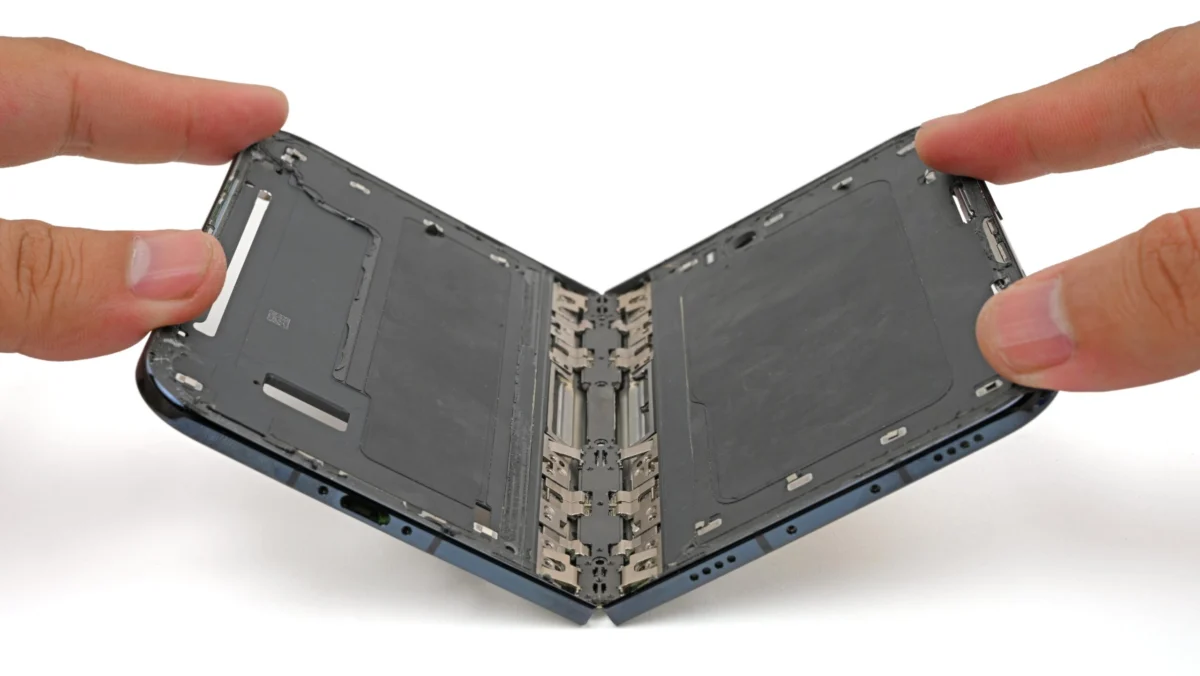
To understand why brand-new devices are breaking down within hours of unboxing, experts have turned to teardowns and stress-test analyses. Shahram Mokhtari, lead teardown technician at repair advocacy group iFixit, has systematically taken apart the iPhone Duo to expose the mechanical underpinnings of the failure.
According to Mokhtari, the root of the problem lies along the complex hinge mechanism. The Duo’s hinge is an intricate assembly of tiny gears, springs, and moving joints designed to achieve two difficult engineering feats simultaneously: allowing the phone to close completely flat and providing enough slack inside the housing to prevent a harsh, deep crease in the flexible OLED panel when folded.
However, this tight spatial economy appears to have introduced a fatal flaw. At the exact location where users are reporting failures, iFixit’s teardown reveals that the flexible inner screen comes into direct contact with a portion of the internal hinge architecture.
"That inner screen is already extremely sensitive," Mokhtari explained in an interview. "If you took a pick or a sharp tool and poked at the edges of the screen, you’re going to break that screen."
When examining user-submitted photographs of damaged iPhone Duos, a distinct black focal point consistently appears precisely where the display sits over the hinge mechanism. This visual signature strongly supports the theory that internal metal components are striking or exerting excessive pressure against the underside of the display.
iFixit’s comprehensive written and video teardowns further illustrate how the hinge transitions. As the central hinge support shifts to make clearance for a crossing flex cable, it creates several sharp internal edges and tight clearances. The damage patterns suggest that the center support bar occasionally fails to retract or drop down far enough during the folding process, creating a mechanical "hot spot" that pinches the flexible display against the flat metal bar when the phone is snapped shut.

Chronology of the Crisis
The unfolding events surrounding the iPhone Duo follow a rapid, high-stakes timeline characteristic of modern hardware launches:
- Friday Morning: The iPhone Duo officially goes on sale globally, with long queues forming outside Apple Stores and delivery couriers dropping off packages to eager pre-order customers.
- Friday Afternoon (Within 6 Hours of Launch): The first reports of hardware failure emerge online. Users on Reddit and X post images of dead pixels and stress fractures appearing directly over the central hinge axis.
- Friday Evening: Anecdotal accounts multiply. At least one prominent early adopter documents feeling an unusual internal resistance while showing the device to a friend, followed by an audible "crack" as the screen fails during a routine opening motion.
- Over the Weekend: Independent tech creators and durability testers subject the iPhone Duo to rigorous testing. Popular YouTuber CuriousHagi conducts stress tests involving debris exposure, capturing a screen failure in the exact same geographic region of the display. Subsequent teardowns by CuriousHagi reveal a snapped structural component within the hinge assembly connected to the central bar.
- Monday Morning: Apple breaks its silence, officially acknowledging an unspecified "issue" affecting the device. The company rolls out a replacement policy for impacted customers while withholding broader failure rate statistics.
- Mid-Week: Repair firms like iFixit publish their complete hardware teardowns, pinpointing the hinge clearance issue and shifting the public discourse from a random QA defect to a systemic mechanical design challenge.
Supporting Data and Real-World Observations
The physical evidence gathered by independent researchers offers valuable context regarding how and why these failures occur under real-world usage conditions.
User testimonies collected across enthusiast forums highlight a tactile warning sign before catastrophic failure occurs. One Reddit user, whose screen cracked within six hours of ownership, noted that they "felt something around the internal hinge" while demonstrating the device. Moments later, after opening the housing once more, they heard an audible snap, instantly rendering the main display inoperable.
Similar mechanics were captured on film by durability channels. During extreme stress testing by YouTuber CuriousHagi—who exposed the folding mechanism to fine dirt and grit—the display suffered a catastrophic breach in the identical structural zone. A subsequent internal examination of that specific test unit uncovered a fractured hinge component directly tied to the central support bar, indicating that mechanical binding or particulate interference could exacerbate an already narrow structural tolerance.
Despite these dramatic failures, industry observers emphasize a critical nuance: the vast majority of consumers who purchased an iPhone Duo are currently using their devices without incident. Mokhtari notes that millions of units are operating normally in the wild, proving that the hardware is capable of surviving day-to-day use when manufacturing tolerances align favorably.
Nevertheless, the fragility of the components involved means that even a minor deviation in assembly alignment can transform a state-of-the-art hinge into a mechanical guillotine for ultra-thin OLED panels.
Official Responses and Industry Reactions
Apple’s official posture toward the crisis has been characteristically guarded. In its Monday statement, the corporation maintained that the defect impacts only a "small number" of total units produced. However, because Apple controls all internal warranty and return data, independent experts remain in the dark regarding the true scale of the issue.
"In terms of numbers, we don’t know," Mokhtari stated. "Apple definitely has all the data here. And I suspect they know more than they’re telling us as well."
When pressed on whether the situation warrants a widespread device recall, industry analysts urge caution. Foldable displays and multi-part articulating hinges are, by nature, exceptionally delicate technologies. A baseline failure rate is anticipated with any first-generation foldable device released to the mass market.

At present, Apple has opted against a product recall, relying instead on its standard retail replacement warranty to absorb the immediate customer service blow. However, industry watchers are monitoring the situation for long-term indicators.
"If three months from now, we’re still seeing the same kind of failure, then it’s a more widespread problem, and that might lead to a recall," Mokhtari warned.
Implications for Apple and the Future of Foldables
The iPhone Duo represents a historic milestone: Apple’s long-awaited entry into the foldable smartphone category, a market previously pioneered by competitors like Samsung, Google, and OnePlus. Because this is Apple’s inaugural generation of foldable hardware, the engineering team is navigating uncharted territory regarding real-world stress data, drop dynamics, and long-term hinge fatigue.
The emergence of "Crackgate" carries significant implications for both consumer trust and future product iterations. Historically, Apple has delayed entering emerging product categories until it could refine the user experience and iron out manufacturing liabilities—a strategy famously summarized by executive philosophies prioritizing polish over speed to market. The early struggles of the iPhone Duo suggest that even Apple’s rigorous testing protocols cannot fully simulate the chaotic variables introduced by millions of consumers handling a complex mechanical device in the wild.
Looking forward, industry insiders view this setback as an inevitable growing pain rather than an existential threat to Apple’s foldable roadmap.
"I guarantee you," Mokhtari noted, "Apple will redesign what’s at fault here for its next-generation foldable."
For current owners, the immediate path forward involves utilizing Apple’s replacement program for defective units. For Apple, the challenge will be quietly tightening manufacturing tolerances on production lines and refining the hinge geometry in future revisions to ensure that subsequent generations of the Duo live up to the company’s gold standard for hardware reliability.
 Raul Delapena Setiawan
 Pevita Pearce
 Sagoh
