
 By Ali Ikhwan
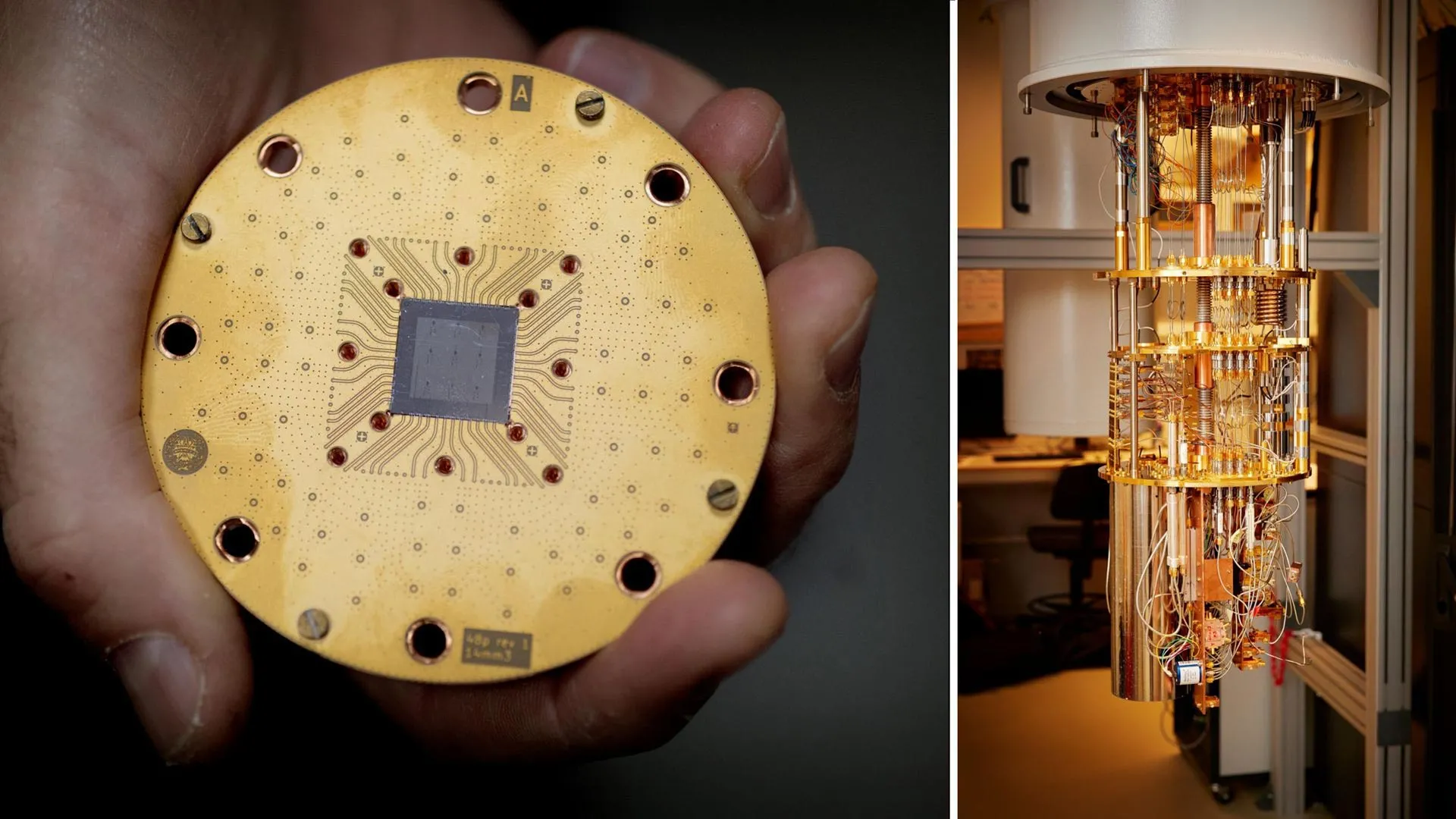
Quantum computing, once the domain of theoretical physics and speculative science fiction, is rapidly maturing into a tangible, transformative technology. With the potential to revolutionize industries ranging from pharmaceutical drug discovery and cryptography to artificial intelligence and complex logistics, the stakes for achieving a functional, fault-tolerant quantum computer have never been higher.
However, the field faces a monumental "Achilles’ heel": the fragility of quantum information. Researchers at the Chalmers University of Technology in Sweden have recently unveiled a breakthrough that addresses this vulnerability head-on. By developing a method to perform advanced quantum operations more than a thousand times faster than previously possible, the team has taken a significant stride toward stabilizing these ultra-sensitive systems.
The Fragility of the Quantum State
To understand the magnitude of this discovery, one must first grasp the inherent volatility of quantum information. Traditional computers operate using bits—binary switches that exist as either a 0 or a 1. These are robust, easily managed, and shielded from minor environmental fluctuations.
Quantum computers, by contrast, rely on qubits. These building blocks utilize the principles of superposition and entanglement, allowing them to process vast amounts of data simultaneously. However, qubits are notoriously temperamental. They are sensitive to "quantum noise"—disturbances caused by electrical interference, cosmic radiation, or even minute fluctuations in temperature.
"The fundamental building blocks of quantum computers, known as qubits, are so sensitive that even the smallest disturbance can cause the quantum state to deviate from the target, resulting in the loss of information," explains Lei Du, a researcher in Applied Quantum Physics at Chalmers and the lead author of the study, which was recently published in the journal Physical Review Letters. "If too many errors accumulate before they can be corrected, the computation fails entirely."
In the current quantum landscape, the longer a calculation takes, the more exposure it has to the environment. This creates a race against time: can a computation be completed before the cumulative errors render the result useless?
A Shift in Strategy: Bosonic Quantum Codes
Historically, the industry has focused on protecting individual qubits. However, the Chalmers team is shifting the paradigm toward "bosonic quantum codes." Rather than forcing information into the narrow, fragile confines of a single qubit, this method encodes information within the microwave fields of superconducting circuits.
"Rather than storing quantum information in individual qubits, bosonic codes encode information in the microwave fields found within superconducting circuits," says Tangyou Huang, a researcher in Quantum Technology at Chalmers and co-author of the study. "This approach has been shown to provide stronger protection against certain types of errors, acting as a buffer that makes the system more resilient."
While promising, bosonic codes present their own operational challenges. Traditionally, creating and manipulating these states required thousands of repeated "driving cycles"—a slow, laborious process that paradoxically created more time for errors to creep into the system. The speed of the operation was, effectively, the enemy of its own accuracy.
Chronology of a Breakthrough
The development of this new method represents the culmination of several years of focused research.
- The Conceptual Phase: The team began by analyzing the limitations of "Floquet control," a method that uses periodic signals to drive quantum systems. They identified that earlier iterations of this control were too reliant on redundant, slow cycles.
- The Birth of Quantum Lattice Gates: Recognizing the bottleneck, the researchers proposed a new set of "Quantum lattice gates." These act as a universal set of building blocks for bosonic states, designed to consolidate complex instructions into a more efficient format.
- The Single-Cycle Milestone: The breakthrough occurred when the team successfully demonstrated that these gates could perform operations within a single driving cycle. By effectively eliminating the need for thousands of redundant cycles, they slashed the processing time by a factor of over 1,000.
- Validation: Following rigorous theoretical testing and mathematical modeling, the findings were peer-reviewed and published in Physical Review Letters, titled "Single-Period Floquet Control of Bosonic Codes with Quantum Lattice Gates."
The "Lego" Analogy: How the Innovation Works
To simplify the technical complexity of their discovery, the researchers utilize an elegant analogy involving construction toys.
"You can think of it like building a large Lego castle," says Tangyou Huang. "Instead of assembling it brick by brick and risking mistakes along the way—where a single nudge can ruin the whole structure—quantum lattice gates act like pre-built, high-stability Lego modules that can be connected quickly and efficiently."
By consolidating thousands of micro-steps into one, the system spends significantly less time in the "active" state where it is most vulnerable to external noise. This effectively shrinks the "error window," providing the stability required for more sophisticated, longer-duration computations.
Implications for the Quantum Industry
The implications of this research extend far beyond the laboratory at Chalmers. As the world moves toward the era of Large-Scale Quantum Computing (LSQC), the ability to perform operations at high speed without sacrificing fidelity is the "holy grail."
1. Toward Fault-Tolerance
The ultimate goal in the field is a fault-tolerant computer—a machine that can detect and correct its own errors in real-time. By providing a faster, more reliable way to control bosonic codes, the Chalmers team has provided a new tool for error correction protocols, bringing the industry closer to this threshold.
2. Integration with Superconducting Technology
One of the most significant advantages of this method is its immediate compatibility with existing infrastructure. Superconducting quantum circuits are currently the most prominent hardware platform for quantum computing (used by giants like IBM and Google). Because this research was specifically designed for these platforms, it can be implemented with minimal changes to current hardware architectures.
3. Scaling Up
Chalmers University of Technology is already at the forefront of hardware development, currently building a 100-qubit quantum computer. The integration of the "Single-Period Floquet Control" method could prove pivotal in scaling that machine to higher levels of complexity. The researchers are already in discussions with their colleagues to initiate experimental realizations of this method in the lab.
Official Responses and Future Outlook
The scientific community has noted the work as a vital contribution to the field. By addressing the "bottleneck" of control speed, Du and Huang have opened a door that was previously thought to be firmly shut.
"Our results address one of the major bottlenecks in the field: how to quickly and reliably create and control the error-correcting quantum states that could play an important role in future quantum computers," Lei Du notes.
The research was supported by the National Natural Science Foundation of China (NSFC), the Wallenberg Centre for Quantum Technology (WACQT), and the Knut and Alice Wallenberg Foundation. This collaboration highlights the international nature of the quantum race and the shared commitment to solving the foundational problems of physics.
What Comes Next?
The next phase for the team is the experimental validation of their theoretical model. While the math holds up, the "real world" of a superconducting lab introduces variables that theoretical models cannot always predict. However, given the team’s close collaboration with hardware engineers at Chalmers, the transition from theory to demonstration is expected to be swift.
If successful, this technology will not only speed up quantum calculations—it will redefine the threshold for what is possible. By turning the "race against decoherence" into a sprint that the quantum computer can finally win, the researchers have brought the dream of a practical, fault-tolerant quantum computer one step closer to reality. The transition from the "NISQ" (Noisy Intermediate-Scale Quantum) era to a truly stable, fault-tolerant era may well be powered by the very speed that this new method provides.
 Reynand Wu
 Ammar Sabilarrohman
 rifanmuazin
