
 By Nana Wu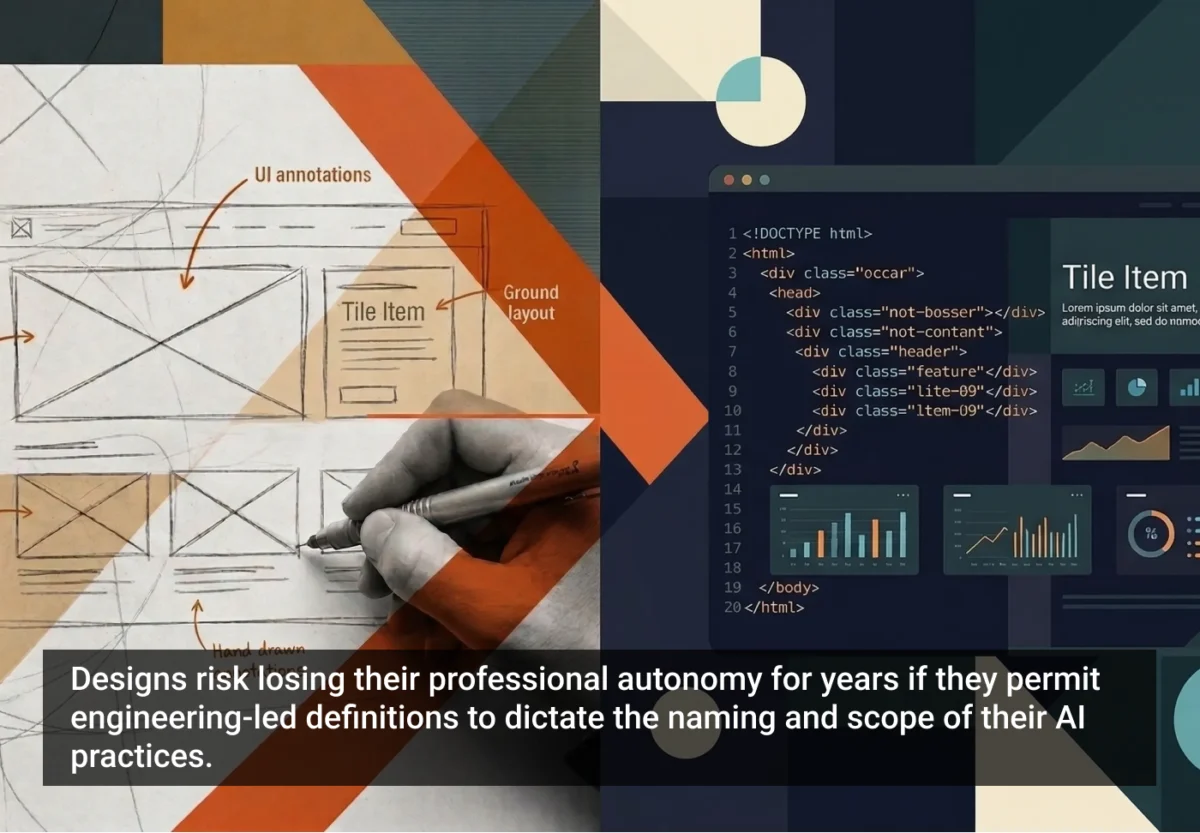
By [Author Name/Staff Writer]
Published: June 2026
Main Facts
The contemporary design landscape faces a critical identity crisis driven by the rapid integration of artificial intelligence. At the heart of this tension is a linguistic mismatch: the uncritical adoption of engineering-centric jargon—most notably the term "vibe coding"—by the design community.
Originally coined by AI researcher Andrej Karpathy in early 2025 to describe loose, low-accountability software generation, "vibe coding" has since bled into broader creative workflows. However, design leaders argue that accepting this label undermines the foundational rigor, intent, and authorship of professional design.
While low-accountability generation has its place in rapid prototyping, mature AI-assisted design relies on directed generation, where human judgment strictly precedes machine output. In this model, designers do not merely prompt and accept; they curate references, establish rigorous spatial and typographic constraints, and author the underlying grammar that intelligent systems execute. As the industry transitions toward non-deterministic design systems and agentic delivery, defining the practice accurately has become vital for preserving professional value, shaping client expectations, and mentoring the next generation of creatives.
Chronology of an Identity Shift: How Engineering Jargon Colonized Design
To understand how the creative industry arrived at its current linguistic crossroad, it is necessary to examine the timeline of AI vocabulary adoption over recent years.
- Early 2025: The term "vibe coding" enters the tech lexicon. Coined by Andrej Karpathy, it serves as an accurate, descriptive shorthand for a specific software development behavior: describing an application concept loosely, accepting whatever code the model outputs, and maintaining minimal concern for underlying mechanics.
- Mid-to-Late 2025: As generative models gain advanced multimodal capabilities—capable of processing complex visual inputs, layout constraints, and design tokens simultaneously—the engineering vocabulary spills over into product design circles. Software and AI developers begin using "vibe coding" as a blanket descriptor for all human-machine creative collaboration.
- Early 2026: A widening chasm forms within the design community. While a majority of designers adopt AI tools, a distinct philosophical split emerges. One faction accepts the passive, prompt-and-ship workflow implied by tech shorthand. The other develops highly intentional, reference-guided methodologies where human judgment acts as the absolute gatekeeper.
- Present Day (Mid-2026): Design leaders begin actively pushing back against passive nomenclature. Articles, manifestos, and industry debates—such as those hosted by the Design Systems Collective—call for a new lexicon, proposing terms like directed generation, reference-guided practice, and compositional prompting to accurately capture the rigor of modern AI-assisted design.
Supporting Data & Conceptual Frameworks: Deterministic vs. Non-Deterministic Design
The friction between passive generation and directed generation highlights a fundamental shift in how design systems operate at scale. Traditional methodologies relied heavily on deterministic outputs: fixed components, heavily documented UI kits, and pixel-by-pixel specifications. Consistency was achieved strictly through replication, which often crippled design flexibility.
[Traditional Model]
Human specifies every instance -> Pixels are locked -> Consistency via strict replication.

[Directed Generation Model]
Human curates reference & constraints -> Machine interprets context -> Non-deterministic scale.
In contrast, advanced AI-assisted workflows leverage non-deterministic design. When a machine understands a design pattern abstractly—comprehending the underlying spatial, typographic, and behavioral relationships rather than blindly copying visual assets—the pattern becomes a dynamic grammar.
Key Structural Differences in Modern Workflows
| Metric / Dimension | Passive Generation ("Vibe Coding") | Directed Generation (Intentional Design) |
|---|---|---|
| Primary Driver | The generative model output | Human curation of references and constraints |
| Locus of Authority | Reactive (accepting margins of error) | Proactive (judgment arrives first) |
| Output Type | Fixed components or unedited generation | Context-aware, cross-surface pattern interpretation |
| Role of Designer | Supervisory / passive reviewer | Author of primitives, grammar, and systemic rules |
| Risk Tolerance | Low barrier to entry, highly unpredictable | Managed risk through rigorous upstream constraints |
By shifting the designer’s role from specifying every single instance to defining the conditions under which good instances reliably emerge, teams can achieve unprecedented velocity without sacrificing quality.
Official Perspectives and Industry Responses
The debate over terminology is far from semantic nitpicking; it touches on the core professional standing of designers in enterprise environments.
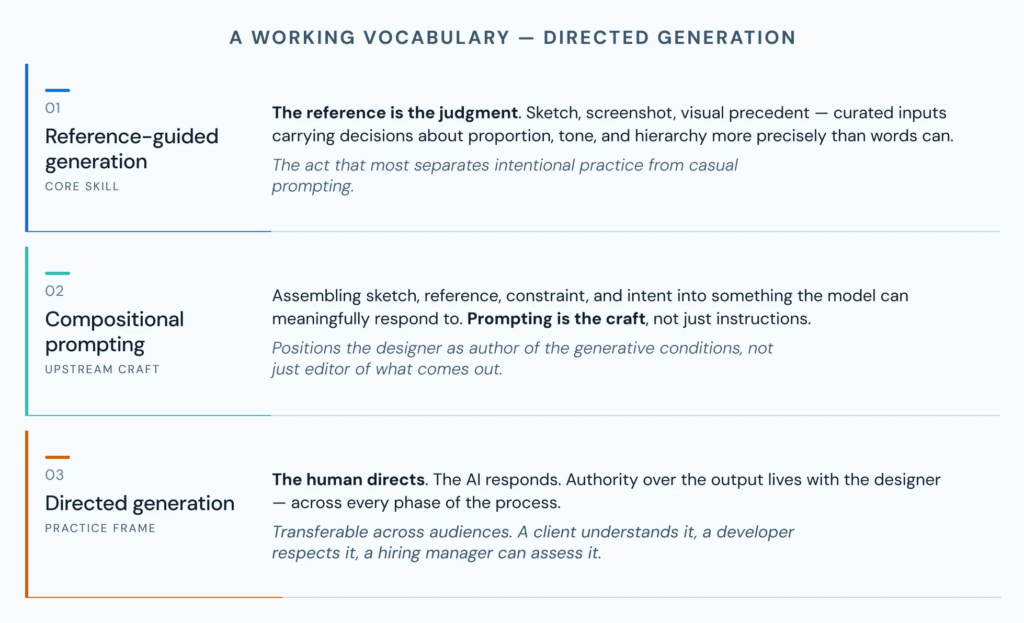
Prominent design thinkers have increasingly spoken out against the passive framing of AI workflows. In recent commentaries circulating through design system communities, critics draw heavily upon George Orwell’s timeless observation regarding language: the slovenliness of language makes it easier to have foolish thoughts, while precise language makes precise thinking possible.
"When an imprecise term colonizes an emerging practice, it doesn’t just misdescribe the work," notes design system strategist Jim Gulsen. "It pre-shapes how the work gets understood, hired, and valued before anyone’s had a chance to define it properly."
Engineering leadership, conversely, has historically viewed AI generation through a utility lens—focusing on speed, code output, and shipping velocity. This divergence has forced design directors to explicitly state where human authority lies.
Industry veterans note striking parallels to the early days of User Experience (UX) design. When UX first emerged as a distinct discipline, practitioners who actively claimed titles like interaction designer or information architecture specialist successfully shaped how corporations valued their craft for a generation. Conversely, practitioners who allowed adjacent engineering or business disciplines to define them spent years fighting to recover professional ground. AI-assisted design now presents an identical inflection point.
Implications for the Future of Design Practice
As the industry moves beyond the initial hype cycle of generative AI, the long-term implications of how we name and structure these workflows are coming into sharp focus.
1. Upstream Craft and the Rise of Agentic Delivery
As generative tools evolve toward agentic delivery—systems capable of carrying out design direction autonomously across multiple digital surfaces—the nature of craft is shifting upstream. Designers are no longer judged solely by their pixel-level execution, but by the quality of their primitives, the precision of their visual references, and the rigor of their systemic constraints.
2. The Hybrid Production Model
Mature design organizations are adopting a hybrid approach that acknowledges varying risk tolerances across different project phases.
- Early-Stage Explorations: Rapid concept generation, generative wireframing, and cross-surface pattern testing benefit immensely from non-deterministic, directed generation approaches.
- Late-Stage Production: Production-ready components, accessibility compliance, and strict brand guidelines still require deterministic oversight, locked specifications, and careful human review.
3. Reclaiming Professional Agency
Ultimately, the push for terminology like directed generation, reference-guided practice, or compositional prompting is about professional self-determination. While "vibe coding" remains a useful shorthand for casual exploration or low-stakes scripting, it has no business describing the rigorous leadership required to steer complex brand and product ecosystems.
Designers who wish to maintain authorship over their practice must first own its description. By establishing a precise, confident vocabulary, the design community can ensure that the next era of AI-assisted creativity is defined by intentional human judgment rather than algorithmic happenstance.
 Neng Nana
  Sagoh
Sagoh 