
 By Jia Lissa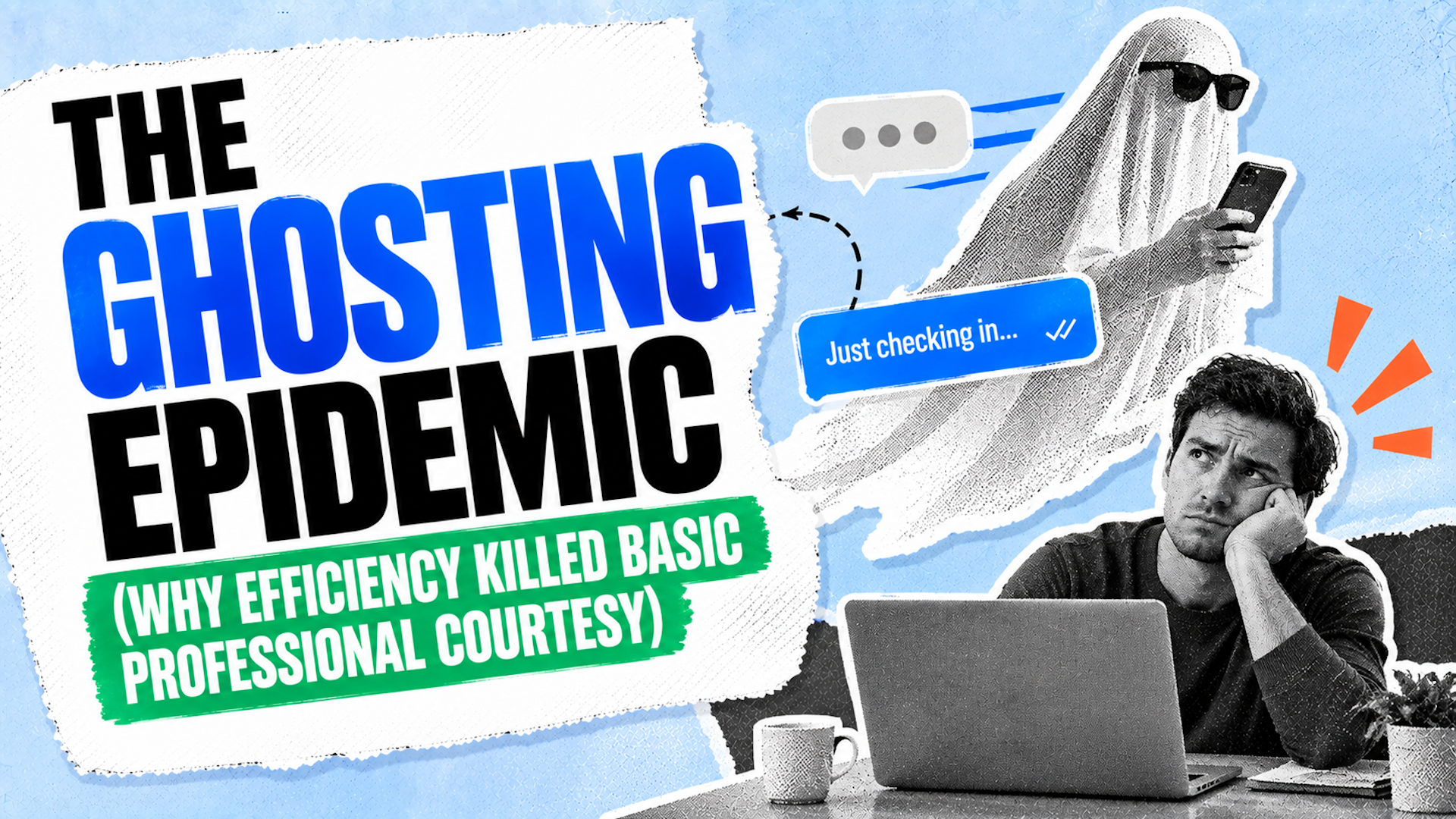
By Staff Editorial
Published: September 2026
Main Facts
The modern professional landscape is facing a profound cultural shift, and not for the better. As businesses increasingly lean toward automation, artificial intelligence platforms, and rapid-fire "easy-button" solutions, a troubling side effect has permeated corporate communication: the professional ghosting epidemic.
While the phenomenon of job applicants being ignored after multiple interview rounds has long been a frustration in the employment market, this casual disregard for basic communication has now infected high-level B2B relationships, sales pipelines, vendor interactions, and consulting engagements.
Key takeaways from this escalating trend include:
- The Dehumanization of Expertise: Companies are increasingly trading human nuance, long-term strategic context, and risk management for automated deliverables, which ultimately commoditizes the human professionals behind the work.
- The Breakdown of Warm Introductions: Connections forged through mutual professional networks—traditionally the highest-converting and most trusted source of new business—are increasingly ending in silent, unexplained withdrawals.
- The Myth of "No Time": Despite technological advancements meant to streamline communication, corporate entities and decision-makers are citing artificial efficiency as an excuse to avoid difficult conversations, opting for complete silence over a simple "no" or "not right now."
- The Cost of Indecision: Ghosting shifts the burden of follow-ups, wasted scheduling, and administrative drag entirely onto the unsuspecting party who played by the rules and fulfilled requested obligations.
Chronology
To understand how professional ghosting manifests in the modern digital consulting and agency ecosystem, one need only look at recent firsthand accounts from industry veterans navigating today’s client acquisition cycles.

Case Study 1: The Broken Promise of a Warm Intro
A veteran search marketing consultant and industry commentator recently shared a textbook example of modern professional abandonment. A trusted former coworker initiated a warm introduction to a prominent Chief Marketing Officer (CMO).
- The Initial Outreach: Following a mutual introduction, the parties engaged in an introductory video call to discuss potential collaboration. While it quickly became apparent that there was no immediate alignment—a standard and entirely acceptable outcome in business—the conversation proceeded respectfully due to the shared professional history.
- The Broken Commitment: As the call concluded, both the CMO and the former colleague explicitly committed to providing a status update or next steps by "next Tuesday," a deadline captured cleanly in automated transcription software logs.
- The Result: Tuesday came and went. Weeks passed. Neither the CMO nor the former coworker offered a single word of explanation, leaving the consultant hanging on a promise that evaporated into thin air.
Case Study 2: The Disappearing NDA
In a separate instance highlighting inbound sales friction, a mid-sized brand proactively reached out to the same consultant to explore fractional SEO services.
- The Setup: Following an initial discovery call covering high-level business challenges, the prospective client requested that the consultant sign a Non-Disclosure Agreement (NDA) to facilitate the sharing of deeper proprietary data.
- The Fast-Track: To bypass corporate legal delays, the brand asked the consultant to provide their own standard, pre-vetted NDA agreement. The consultant promptly updated, reviewed, and returned the paperwork, explicitly asking for confirmation to expedite the timeline.
- The Result: Total silence. Subsequent follow-up emails sent days and weeks later were met with complete apathy. Despite the prospective client initiating the entire dialogue, requesting the call, and dictating the next administrative step, they vanished without offering a reason, pausing the project, or closing the loop.
Supporting Data and Industry Insights
While anecdotal evidence highlights the day-to-day frustrations of consultants and freelancers, the broader digital marketing and tech sectors report that these experiences are far from isolated.
Industry message boards, professional networking sites, and private forums are inundated with similar accounts. Well-known search agencies and boutique firms report spending hours preparing customized pitch decks, conducting technical audits, and completing multi-stage interview panels—only to be met with absolute radio silence from prospective corporate employers or enterprise clients.
| Interaction Type | Typical Process | Common Point of Failure | Resulting Burden |
|---|---|---|---|
| Warm Referral | Intro call -> Alignment chat -> Promised follow-up | The "promised deadline" passes with zero communication | Eroded trust in professional referral networks |
| Consulting Pitch | Inbound request -> Discovery -> NDA / Proposal | Document submission followed by unreturned emails | Wasted billable hours and administrative lag |
| Agency Hiring | Recruiter screen -> 2–3 Technical rounds -> Final panel | Post-interview silence or automated generic rejections | Candidate frustration and reputational damage to the brand |
What makes this data alarming is the asymmetry of the behavior. In most reported cases, the ghosting party is the one who initiated the contact, requested the paperwork, or set the timeline. The imbalance turns a standard professional interaction into a one-sided exercise in patience and wasted calendar management.

Official Responses and Perspectives
Industry leaders and independent operators are beginning to push back against the normalisation of corporate ghosting, arguing that the practice undermines the foundational trust required for healthy commerce.
"Nobody is entitled to a client, a partnership, a job offer, or even a response justifying the answer they gave you," notes industry analysis from active consultants. "Sometimes the answer is no. Sometimes a company goes another direction. Sometimes the budget disappears, priorities change, or the fit just is not there. That is business."
However, a clear distinction is being drawn between a rejection and an avoidance of conversation:
- Rejection is normal: Companies pivot, budgets freeze, and strategies change. Stakeholders fully understand that "no" is a standard part of the B2B lifecycle.
- Avoidance is unprofessional: Refusing to acknowledge an ongoing thread, ignoring emails after requesting proprietary documentation, or breaking explicit communication deadlines crosses the line from a failed deal into poor etiquette.
Critics argue that companies hiding behind automated communication systems or simply dodging uncomfortable conversations are eroding their own professional reputations. In tight-knit industries like digital marketing, SEO, and tech consulting, word travels fast; brands that consistently ghost potential partners soon find themselves labeled as untrustworthy collaborators.
Implications for the Future of Work
The rise of professional ghosting is not merely an annoyance—it points to deeper, systemic shifts in how modern businesses view human capital, client relationships, and technological efficiency.

1. The Paradox of Automation
We live in an era defined by efficiency tools. Calendars sync automatically, AI transcribes meetings in real-time, and CRM systems manage pipelines with minimal human intervention. Yet, rather than using these tools to free up mental bandwidth for higher-order communication, businesses are using them as a shield. When an AI tool can draft an email or log a contact, the human element of accountability often gets outsourced or forgotten entirely.
Efficiency was supposed to give professionals more room for judgment, relationships, and human nuance. Instead, it has paradoxically become an excuse to open more conversations than organizations are willing or equipped to finish.
2. The Devaluation of Professional Reputation
In B2B services, reputation is currency. When a brand treats a vendor, a consultant, or a referral partner with casual disrespect, it signals an internal culture lacking in empathy and baseline operational discipline.
As the author and industry observer bluntly puts it: "If you ghost people, don’t be surprised if those people start telling others that you’re an asshole." In an ecosystem where peer recommendations and agency reviews drive high-ticket contracts, burning bridges through silent indifference carries a steep, compounding long-term cost.
3. A Call for Restoring Corporate Decency
Ultimately, the solution to the ghosting epidemic requires no complex technological overhaul, no mandatory all-hands company meetings, and no expensive software implementation. It requires a return to basic professional courtesy.

- Honor Commitments: If a deadline is set for Tuesday, meet it—or send a brief note explaining the delay.
- Communicate Pivots: If a project is placed on hold or goes in a different direction, take thirty seconds to send a closure email.
- Respect the Loop: If you cannot commit to closing a conversation loop, stop opening it in the first place.
As the lines between human labor, fractional consulting, and automated SaaS platforms continue to blur in the coming years, maintaining human decency will no longer just be a matter of etiquette—it will be a key differentiator that separates thriving, trusted businesses from transactional operations that nobody wants to work with.
 Nana Muazin
  Layla Zulfa
  Pevita Pearce