
 By Muslim
By [Your Name/Journalistic Desk]
The hype cycle surrounding Generative AI (GenAI) is rapidly cooling, replaced by the cold, hard reality of the balance sheet. For the past two years, the C-suite has been enamored with the "art of the possible." Today, the conversation has shifted entirely to the "science of the profitable." As organisations transition from proof-of-concept sandboxes to enterprise-scale deployment, a critical realization is emerging: AI models do not deliver business outcomes—integrated systems do.
Claire Butcher, AI Solutions Consultant at Sabio Group, argues that the industry has reached a pivotal juncture. As projects move from academic experimentation to commercial necessity, the question of accountability has moved to the forefront of executive agendas. Who is responsible when an AI agent fails to resolve a customer query? Who owns the margin when an automated workflow succeeds? In the evolving ecosystem of AI, accountability must follow influence.
The State of Play: The Gap Between Potential and ROI
Recent industry reports paint a dual picture of the AI landscape. According to Google Cloud’s ROI of AI 2025 report, the gap between the "experimenters" and the "implementers" is widening. While 88% of organizations that adopt agentic AI report a measurable return on investment (ROI) from at least one use case, the broader market remains mired in difficulty.
Research from Deloitte and McKinsey consistently highlights a persistent "value trap." Many enterprises are struggling to bridge the chasm between successful pilot programs and sustainable, enterprise-wide value. The bottleneck, experts suggest, is no longer the technology itself—the Large Language Models (LLMs) are more capable than ever—but rather the operational rigor required to integrate these models into existing business architectures.
Chronology of the AI Shift
- 2023: The Era of Curiosity. Organizations focused on internal experimentation, LLM testing, and exploring the boundaries of prompt engineering. Accountability remained largely internal and academic.
- 2024: The Infrastructure Phase. Businesses began investing in data quality, security, and the "plumbing" necessary to connect AI to core CRM and ERP systems.
- 2025: The Commercial Reckoning. The current phase, defined by a demand for clear ROI. Projects that do not demonstrate revenue growth or cost reduction are being defunded.
- 2026 and Beyond: The Outcome-Based Economy. A shift toward service models where partners are incentivized by the actual business value generated by their AI implementations.
Systems Over Models: The Anatomy of an Outcome
The persistent myth in the technology sector is that the "model is the product." In reality, an AI model is merely a cognitive engine. If you place a high-performance engine in a car with no wheels, a broken transmission, and no fuel, you will not reach your destination.

"We talk about AI outcomes as though the model decides them," says Butcher. "But businesses don’t invest in AI because they want AI. They invest because they want something to change—whether that is lower cost-to-serve, improved Customer Experience (CX), or higher containment rates."
The "Strings" of Success
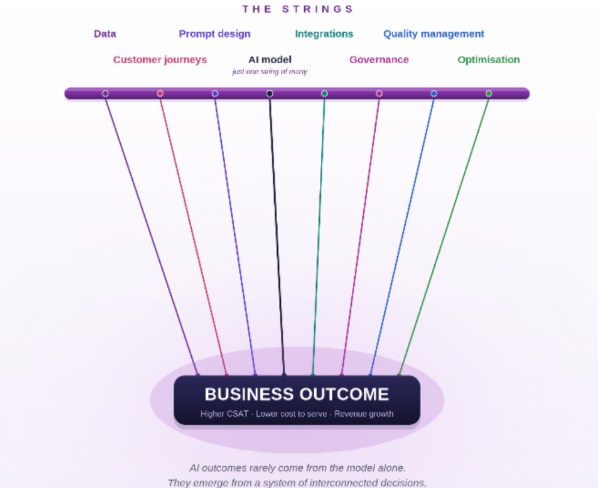
To achieve a business outcome, an organization must manage a complex web of interconnected "strings." Each string represents a critical decision point that dictates success:
- Data Quality: Garbage in, garbage out remains the golden rule of AI.
- System Integration: How the AI talks to the CRM, case management, and inventory systems.
- Customer Journey Design: The architectural blueprint of how a user interacts with the system.
- Workflow Orchestration: Managing the hand-offs between automated agents and human agents.
- Governance & Compliance: Ensuring the system acts within legal and ethical guardrails.
- Continuous Optimization: The feedback loop that turns yesterday’s failed conversation into tomorrow’s successful resolution.
When a contact center fails to hit its resolution targets, it is rarely the fault of the LLM. It is usually a failure in one of these "strings." Consequently, the organization that holds the most strings—the one with the most influence over these variables—is the one that should rightfully be held accountable for the outcome.
The Accountability Spectrum: Aligning Influence with Responsibility
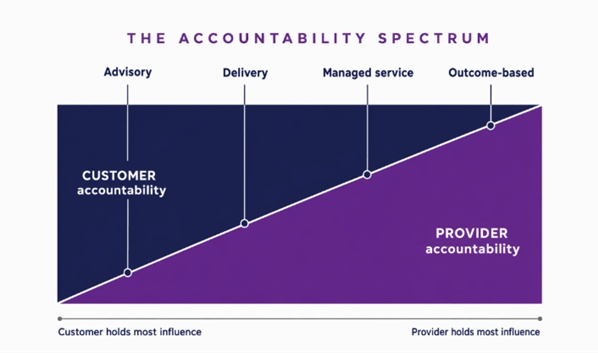
As AI initiatives scale, the "Accountability Spectrum" becomes a defining document for project management. A typical AI deployment involves a matrix of stakeholders: the internal business units, technology vendors, implementation partners, and managed service providers.
Defining Roles in the Ecosystem
- The Advisory Partner: Influences the strategic direction and risk assessment.
- The Delivery Partner: Holds the responsibility for the initial architecture and technical implementation.
- The Managed Service Provider (MSP): Influences ongoing performance, tuning, and daily maintenance.
- The Customer: Maintains control over operational change, user adoption, and internal culture.
The fundamental principle here is that accountability should follow influence. If a provider is merely providing a license to a model, they cannot be held accountable for the final outcome. However, if a provider is managing the integration, the data pipelines, and the ongoing prompt tuning, they possess the agency to influence the result. Therefore, they should be prepared to stand behind that result with commercial commitments.
The Operational Bottleneck: Execution vs. Innovation
While much of the industry remains fixated on the "Model Wars"—GPT-4 versus Gemini, open-source versus proprietary—the real competitive advantage lies in execution. The most successful organizations are those that treat AI as a long-term operational discipline rather than a "set-and-forget" software installation.
An AI agent is, by nature, a living system. It requires constant tuning: refining prompts based on real-world edge cases, adjusting journeys based on customer sentiment, and closing the feedback loop with human agents.
This creates a new tension in commercial relationships. Traditional service models rely on rigid, pre-defined scopes of work (SOWs) that require lengthy sign-off processes for every change. However, AI optimization requires agility. If a system must wait three weeks for a change request to be approved, the model’s performance will degrade, and the business outcome will remain elusive.
The Honest Test for Outcome-Based Models
Butcher suggests that organizations should ask themselves two honest questions before signing a contract:
- The Freedom Factor: How much autonomy are we willing to give our partner to tune and improve the agent in real-time?
- The Velocity Factor: Are we prepared to collaborate at the speed that continuous improvement demands?
If the answer to these questions is "low," then a traditional advisory or managed service model is the appropriate fit. If the answer is "high," the organization is a candidate for an outcome-based model. In these arrangements, the partner holds the strings, and the client pays for the successful realization of business goals rather than hourly labor.
Implications for the Future of Business Consultancy
The shift toward outcome-based AI models signifies a maturation of the market. It marks the end of the "wild west" phase of AI implementation, where vendors could sell potential and hope. We are entering an era of "Accountable AI."
For businesses, this represents a major opportunity. By mapping out which entity holds which "string"—data, integration, design, or optimization—leaders can identify the gaps in their strategy. If they find that no one is accountable for the "optimization" string, they have identified the primary reason for their failure to scale.
Sabio Group, for its part, is leaning into this shift. By offering models that allow clients to pay specifically for outcomes in the contact center, they are betting that when influence and accountability are aligned, the technology will finally deliver on its long-promised value.
Looking Ahead
The path forward is clear. Organizations must stop chasing the "latest model" and start refining the "operating system" around their AI. Whether through internal teams or external partners, the goal remains the same: identify who holds the strings, empower them to act, and hold them responsible for the result.
For those looking to navigate this transition, Sabio Group is hosting an AI Business Consultancy day in Manchester on Tuesday, September 15th. The event promises to move beyond the technical jargon and focus on the practical, commercial realities of building AI systems that actually deliver.
In the race for AI-driven competitive advantage, the winners will not necessarily be those with the most powerful models, but those with the most disciplined approach to accountability. In the world of enterprise AI, if you control the outcome, you can stand behind it. If you cannot control the outcome, you are simply watching the technology evolve from the sidelines.
 Iffa Jayyana
  Raul Delapena Setiawan
  Laily UPN