
 By Sagoh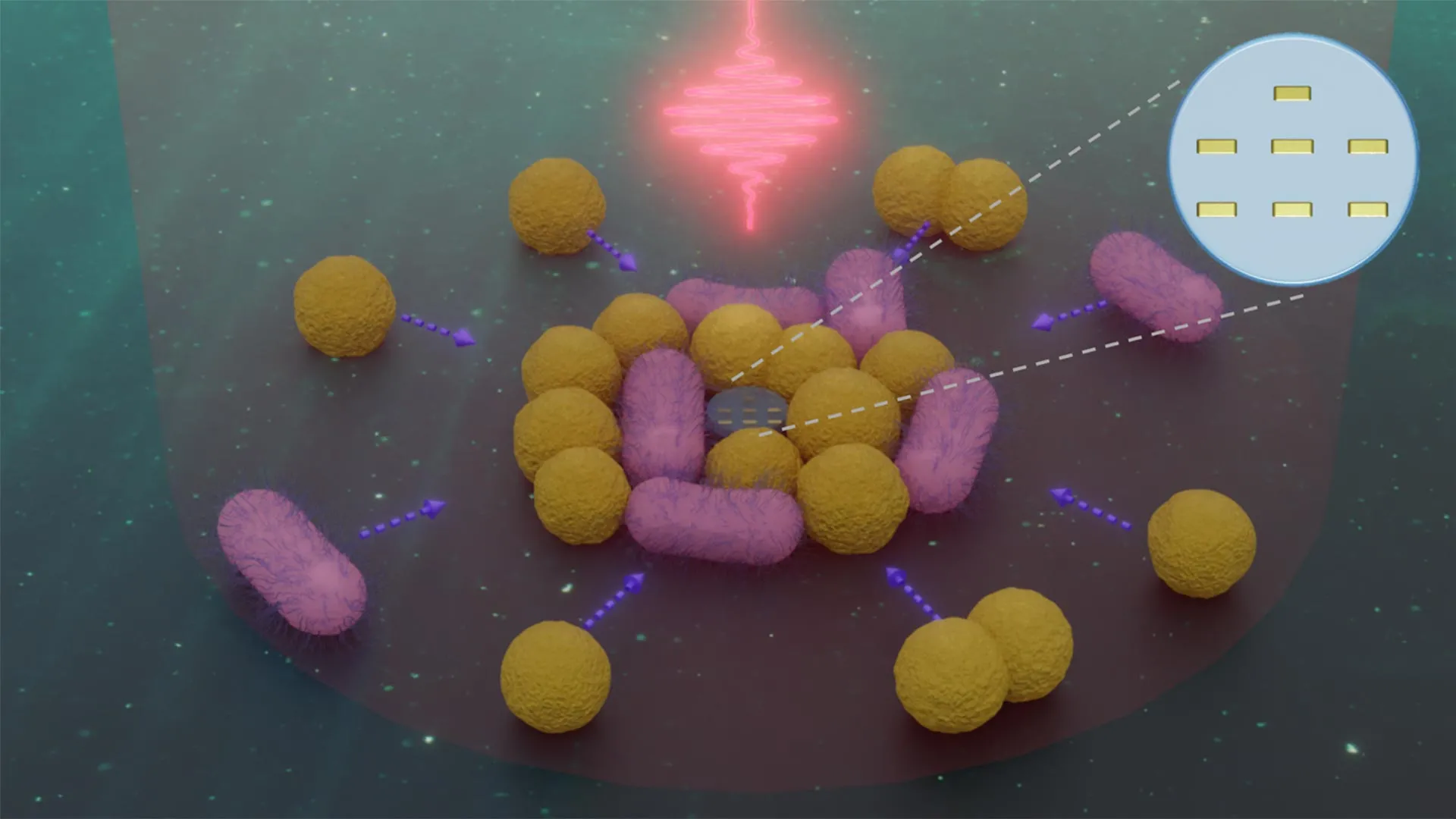
In the quiet, bustling landscape of the microbial world, a revolution is brewing on a scale almost invisible to the human eye. Scientists have long been captivated by the potential to manipulate the building blocks of life, yet the sheer physics of the microscopic realm—where viscosity dominates and friction acts like thick syrup—has remained a formidable barrier. Now, researchers at Julius-Maximilians-Universität (JMU) Würzburg have unveiled a breakthrough that brings us closer to the science-fiction dream of interacting directly with cells and bacteria: light-powered nanorobots smaller than a single micrometer.
These devices, measuring roughly 50 times smaller than the diameter of a human hair, represent a monumental leap in nanorobotics. By harnessing the fundamental momentum of light, these "microdrones" can navigate, collect, transport, and deposit biological cargo with unprecedented precision.
The Genesis of Light-Driven Propulsion
Overcoming the Physics of the Small
The primary challenge in creating autonomous machines at the sub-micrometer scale is propulsion. In our macro-world, we rely on gears, motors, and chemical fuels, but at the scale of a single bacterium, those mechanisms become impractical or inefficient. The JMU team, led by Professor Bert Hecht, sought a more elegant solution: photonics.
The researchers developed a method that utilizes the recoil produced by individual photons to drive these tiny machines. This concept, while conceptually similar to the recoil felt when a firearm is discharged, operates on the scale of quantum momentum. By integrating plasmonic nanoantennas into the robots, the team enabled the devices to absorb light of a specific color and helicity, subsequently re-emitting that light in a calculated direction. This redirection of light particles creates a propulsion force capable of accelerating the microdrones, which possess negligible mass, to impressive speeds.
The Evolution of the Design
The trajectory of this research has been defined by a relentless drive toward miniaturization. Earlier prototypes, while groundbreaking, were limited by their complexity. To achieve the current milestone—a device smaller than one micrometer—the team had to fundamentally rethink the steering apparatus.
By simplifying the internal architecture, the researchers replaced cumbersome control mechanisms with nanoscale antenna wires. These wires function as an integrated compass; they naturally align themselves with the polarization of incoming light. Consequently, the operator can influence the robot’s orientation simply by modulating the light’s polarization. This "steering by light" provides a seamless, tetherless control system that allows the robots to move with agility that rivals biological entities.
Chronology of Discovery: From Concept to Reality
The development of these nanorobots did not occur in a vacuum; it is the culmination of years of rigorous physical inquiry into plasmonics and optomechanics.
- Initial Theoretical Frameworks: The team began by exploring how light-matter interactions at the nanoscale could exert mechanical forces. They focused on "plasmonic nanoantennas," structures capable of concentrating light into extremely small volumes.
- The First Proof-of-Concept: Early experiments demonstrated that light could push small particles. The challenge was transitioning from simple "pushing" to active, maneuverable "steering."
- Refining the Propulsion System: By the mid-development phase, the team successfully utilized photon recoil as a viable engine, moving away from chemical or magnetic drives that could potentially contaminate sensitive biological samples.
- Miniaturization and Control Integration: The most recent phase focused on the integration of antenna wires, allowing for the precise directional control that characterizes the current iteration of the nanorobots.
- Biological Validation: The researchers moved into the lab to test the robots against real-world biological targets, successfully demonstrating the capture and transport of bacteria.
Supporting Data: Efficiency and Maneuverability
The performance metrics of these nanorobots are nothing short of remarkable. Despite their diminutive size, they demonstrate high-level maneuverability that allows them to perform complex tasks in crowded microscopic environments.
Precision Performance Metrics
- Rapid Maneuverability: The robots are capable of executing sharp 90-degree turns, a feat essential for navigating the complex, often chaotic environment of a cell culture or a sample slide.
- Load-Bearing Capability: The robots do not merely move themselves; they are designed for heavy lifting. They can selectively capture and transport multiple bacteria at once. While researchers noted a slight decrease in velocity under heavy loads, the propulsion system remains stable and effective, proving that the robots are robust enough for practical application.
- Scalability: Because the power source is external (the light source), the robots do not require on-board batteries or fuel, allowing for a virtually infinite operational lifespan as long as the light source is active.
The "Microscopic Cleaner" Model
The utility of these machines is best illustrated by their ability to act as "microscopic cleaners." In controlled laboratory tests, the robots were tasked with sweeping areas of a sample, gathering dispersed bacteria, and depositing them into designated zones. This efficiency suggests that we are moving toward a future where "lab-on-a-chip" devices can perform autonomous sorting and cleaning of biological samples without human intervention.
Official Perspectives: Shaping the Microscopic World
The implications of this research have drawn significant attention from the scientific community, as the JMU team emphasizes the shift from mere observation to active manipulation.
"In essence, we have built a light-driven nanorobot that can track down and collect bacteria," says Jin Qin, the lead experimental scientist for the study. Qin highlights that the simplification of the design was the key to achieving a scale where the robots can operate comfortably within the microbial world.
Professor Bert Hecht, who spearheaded the project, underscores the philosophical and practical shift this research represents. "This is a striking example of how light can be used not only to observe the microscopic world but also to actively shape it," Hecht states. He acknowledges that while the concept of robotic cleaners might sound like science fiction, the physical principles are now firmly established, providing a roadmap for future development.
Implications: The Future of Nanotechnology
The success of the JMU nanorobots opens doors to a multitude of fields, ranging from fundamental biology to high-stakes medicine.
Biomedical Research
In the realm of medicine, the ability to transport specific bacteria or cells to precise locations could revolutionize drug delivery. Imagine a nanorobot tasked with delivering a therapeutic agent directly to a specific diseased cell while ignoring healthy tissue. By using light to steer these devices, doctors could potentially perform "micro-surgery" at the cellular level with extreme accuracy.
Environmental Monitoring
Beyond the laboratory, the concept of a "microscopic cleaner" could be scaled up for environmental remediation. If researchers can develop more durable versions of these robots, they could be deployed in water supplies to detect and sequester pollutants or pathogens, effectively cleaning water at the molecular level.
Understanding Biological Dynamics
For biologists, the ability to manipulate individual bacteria provides a powerful new tool to study microbial behavior. By forcing bacteria into specific configurations, scientists can observe how these organisms interact, communicate, and form colonies. This could lead to a deeper understanding of how antibiotic resistance develops or how biofilms—which are notorious for causing infections on medical implants—are formed.
Challenges Ahead
Despite the excitement, the path toward widespread adoption is not without hurdles. The researchers must still address the challenge of scaling up the production of these nanorobots. Furthermore, operating these devices in complex, non-laboratory environments—such as the human bloodstream or highly turbulent liquid samples—will require significant advancements in control systems and material resilience.
The current robots rely on specific light polarization and intensity; in a natural environment, light scattering and absorption could interfere with these signals. The team is now looking toward overcoming these environmental constraints, ensuring that the "micro-drones" can maintain their agility in even the most unpredictable settings.
Conclusion: A New Era of Micro-Manipulation
The work conducted at Julius-Maximilians-Universität Würzburg stands as a testament to the power of human ingenuity when applied to the fundamental laws of physics. By harnessing the recoil of photons—the very particles that allow us to see the microscopic world—scientists have found a way to bridge the gap between our hands and the microbial frontier.
As we move forward, the integration of these light-driven nanorobots into research and industry seems increasingly inevitable. What was once considered the realm of speculation—tiny, autonomous machines cleaning and organizing the world of the invisible—is rapidly becoming a practical, repeatable, and highly effective reality. The microscopic world is no longer just a place to be observed; it is now, thanks to the brilliance of light, a place to be managed.
 Asro
Asro  Siti Muinah