
 By Laily UPN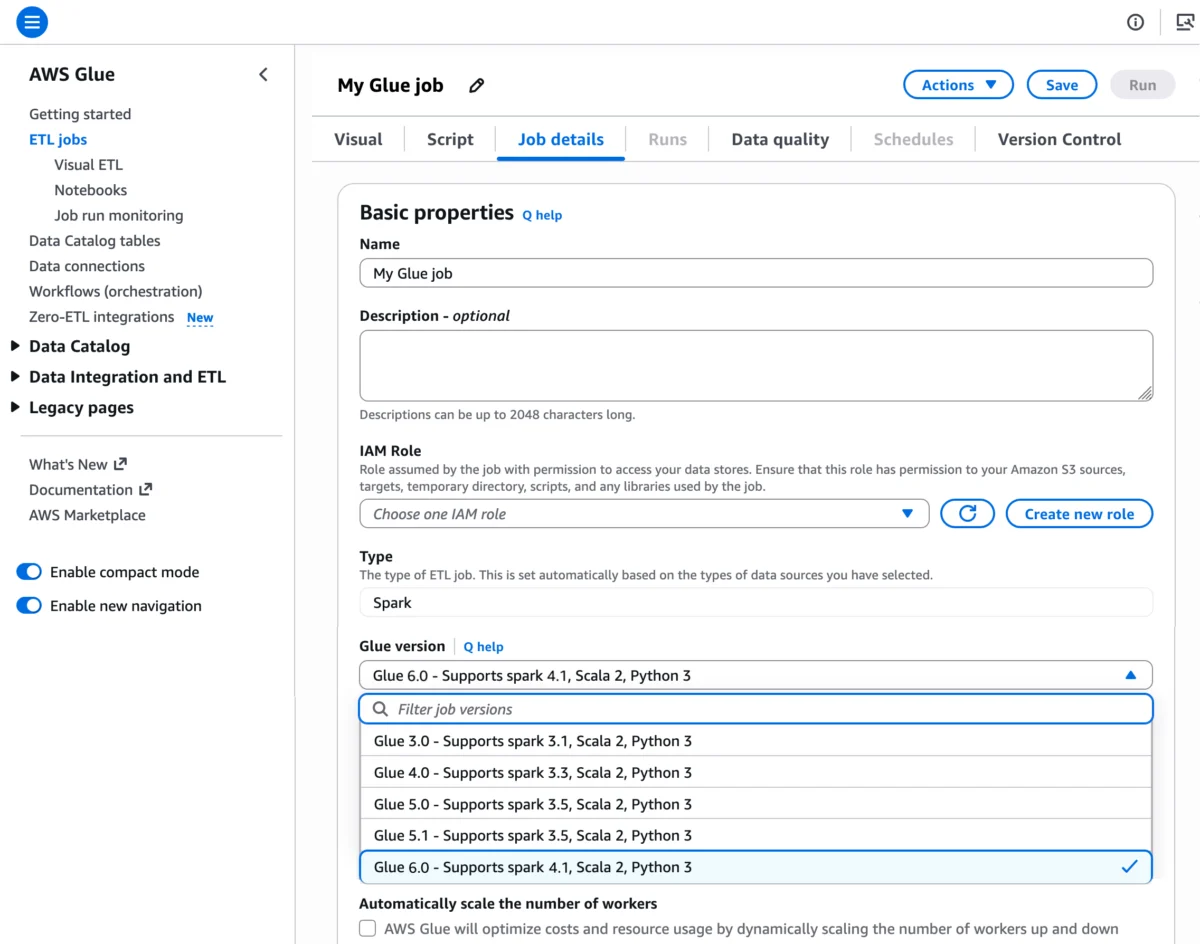
SEATTLE — In a move set to reshape enterprise data architectures and cost models, Amazon Web Services (AWS) has announced the general availability of AWS Glue 6.0. This latest evolution of the fully serverless data integration and extract, transform, and load (ETL) service introduces a modernized runtime stack centered on Apache Spark 4.1, Python 3.13, and Scala 2.13.
Alongside dramatic performance enhancements and deep integration with Apache Iceberg v3 (built on Iceberg 1.11.0), AWS has implemented a 30% price reduction across the board compared to previous iterations. The announcement signals a concerted effort by AWS to make large-scale, open-table format analytics both significantly faster and remarkably more cost-effective for organizations grappling with exponential data growth.
Main Facts: What is AWS Glue 6.0?
AWS Glue 6.0 represents a foundational modernization of the underlying compute engine and ecosystem connectors that power modern data lakes and data lakehouses.
At its core, Glue 6.0 is designed to address the complex friction points data engineers face daily: managing semi-structured JSON and event logs, optimizing compute costs, and keeping pace with rapidly evolving open-source standards.
- 30% Lower Pricing: Users can immediately benefit from a substantial cost reduction compared to older versions of AWS Glue, lowering the barrier to entry for resource-intensive data processing pipelines.
- Modernized Runtime Stack: The platform now executes on Apache Spark 4.1, Python 3.13, and Scala 2.13, offering out-of-the-box performance gains and access to the latest language and framework features.
- Complete Apache Iceberg v3 Implementation: Glue 6.0 delivers the most comprehensive Iceberg v3 support available on any fully serverless managed Spark service.
- The
VARIANTData Type with Shredding: The crown jewel of the Iceberg v3 implementation, theVARIANTtype allows organizations to store and query semi-structured data (such as JSON, system logs, and clickstream events) without schema flattening, manual custom parsing, or brittle pipelines that break when data structures mutate. - Real-Time Capabilities: The service introduces support for real-time streaming workflows capable of achieving single-digit millisecond latency.
Chronology: The Road to Modern Serverless Analytics
To understand the significance of AWS Glue 6.0, it helps to examine the trajectory of cloud-based data management over the past decade.
- The Early Days of AWS Glue (2017–2020): When AWS initially launched Glue, it aimed to eliminate the heavy lifting of provisioning and managing Spark clusters. However, early versions were frequently critiqued for cold-start latencies and rigid version lock-in, prompting data teams to manage custom EMR clusters for high-performance tuning.
- The Rise of Open Table Formats (2021–2023): As the industry shifted away from monolithic data warehouses toward open data lakehouse architectures, formats like Apache Iceberg and Delta Lake gained massive traction. AWS responded by incrementally adding Iceberg support, allowing Glue catalogs to serve as dependable metadata stores.
- The Push Toward Cost Optimization (2023–2025): Driven by macroeconomic pressures, enterprise customers increasingly demanded better price-to-performance ratios from cloud providers. AWS began optimizing its internal runtime infrastructure to drive down operational overhead.
- The Arrival of Glue 6.0 (August 2026): Culminating years of runtime refinement and deep collaboration with the open-source community, AWS released Glue 6.0. By bundling Spark 4.1, Python 3.13, and native Iceberg v3 support with a 30% price drop, AWS has positioned Glue as a unified platform for both batch ETL and real-time streaming analytics.
Supporting Data and Technical Architecture
The technical underpinnings of AWS Glue 6.0 are engineered to maximize throughput while minimizing computational waste.
The Power of VARIANT Shredding
Traditionally, querying semi-structured data like nested JSON objects required data engineers to either flatten schemas—which explodes storage requirements and introduces data redundancy—or parse fields dynamically using complex string manipulation functions, which severely degrades query performance.

The VARIANT data type in Apache Iceberg v3, fully operationalized in Glue 6.0, solves this dilemma through column shredding. Instead of treating semi-structured payloads as opaque strings, the engine intelligently decomposes and indexes components of the JSON payload. This enables columnar-like read speeds on unstructured and semi-structured datasets without sacrificing flexibility.
Pricing Structure and Billing Mechanics
AWS Glue 6.0 maintains the flexible, predictable pricing model that enterprise customers expect, layered on top of the new 30% discount:
- ETL Jobs and Crawlers: Billed by the second with an hourly rate, ensuring organizations only pay for the precise compute time consumed during data discovery, transformation, and loading.
- Data Catalog: A simplified monthly subscription model for storing and accessing metadata. To encourage adoption and experimentation, AWS includes the first 1 million objects stored and the first 1 million accesses completely free of charge.
Official Responses and Ecosystem Reactions
Industry analysts and cloud architects have responded enthusiastically to the release, noting that the combination of lower prices and advanced Iceberg features addresses top enterprise pain points.
"Organizations are no longer willing to choose between performance, open standards, and budget constraints," notes enterprise cloud telemetry. "By undercutting previous pricing models by 30% while simultaneously delivering a state-of-the-art runtime like Spark 4.1 and Iceberg v3, AWS is signaling that serverless data processing can—and should—be both bleeding-edge and economically accessible."
AWS community leaders and developers have also praised the frictionless migration path provided by the engineering team. Because AWS designed Glue 6.0 to operate without forcing breaking API changes, teams can transition their workloads seamlessly.
Implications for Data Engineers and Enterprise Architecture
The launch of AWS Glue 6.0 carries profound implications for how organizations design, maintain, and scale their data operations.
1. Simplified Pipeline Maintenance
Data pipelines frequently break because upstream application developers alter JSON schemas without notifying data engineering teams. With Glue 6.0’s native handling of the VARIANT type and Iceberg v3 specifications, schema evolution is handled gracefully. Pipelines no longer shatter when a new key is introduced or an existing field changes data types.

2. Accelerated Migration to Open Lakehouses
Many enterprises have hesitated to fully commit to Apache Iceberg due to performance overhead or implementation complexities across disparate toolsets. By providing the most complete Iceberg v3 implementation on a fully serverless managed Spark service, AWS removes the operational burden of maintaining catalog syncs, compaction routines, and snapshot management.
3. Favorable Financial Models for Big Data
Data volume growth routinely outpaces IT budgets. The 30% price reduction on Glue 6.0 directly impacts bottom-line cloud expenditures, allowing data leaders to reallocate capital toward advanced machine learning initiatives, real-time analytics, or expanding their data lake footprints.
4. Getting Started and Migration Pathways
Adopting AWS Glue 6.0 requires minimal effort. Engineers can leverage existing automation scripts by specifying the –glue-version parameter set to 6.0 within create-job or update-job APIs via the AWS CLI, AWS SDKs, or AWS Glue Studio.
For existing projects, teams can utilize the built-in Spark upgrade agent within AWS Glue Studio to audit and refactor legacy codebases automatically, or enable auto-upgrade features to transition workloads smoothly. Furthermore, developers can harness the AWS MCP Server and associated AI plugins to query documentation, verify regional availability, and troubleshoot migration issues using their preferred AI-assisted development environments.
As data ecosystems grow increasingly complex, AWS Glue 6.0 establishes a new benchmark for serverless data engineering—proving that high performance, modern open-source standards, and cost-efficiency can coexist at enterprise scale.
 Neng Nana
  Suro Senen
  Lina Hope