
 By Nana Wu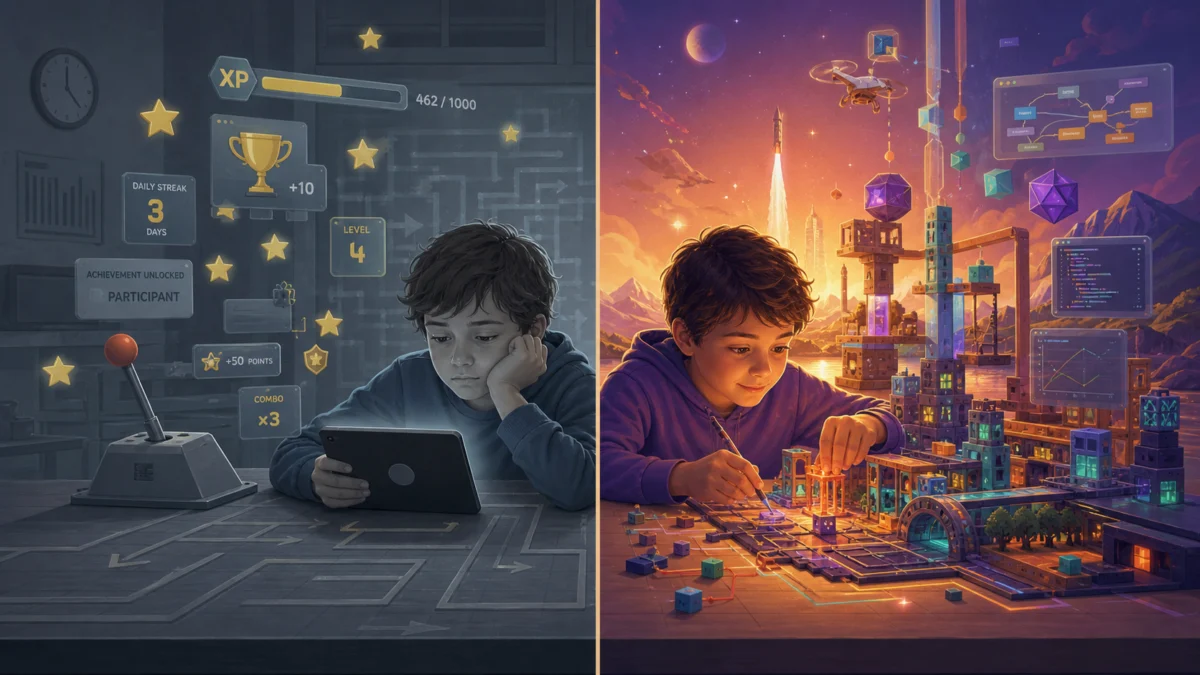
By [Author Name]
Published: May 2026
Main Facts: The Digital Divide Between Real Games and Fake Learning
Modern educational technology faces an unprecedented credibility crisis. For years, software developers and instructional designers have attempted to engage younger demographics—specifically Generation Z and Generation Alpha—by coating traditional academic drills in the veneer of video games. XP bars, digital stickers, streak counters, and cartoon mascots have become ubiquitous in classrooms and homework platforms globally.
However, this superficial gamification is hitting a brick wall of user rejection. Today’s children, who grow up navigating complex virtual sandboxes like Minecraft, collaborative servers in Roblox, and the tactical mechanics of Fortnite, are uniquely media-literate. When handed digital worksheets masquerading as games, they do not see innovative learning tools; they see digitized busywork.
The core conflict lies in a profound misunderstanding of game design. While educational platforms often equate "gamification" with points and extrinsic rewards, actual video games rely on internal agency, systemic mastery, and intrinsic motivation. As a result, the EdTech industry is learning a hard truth: when your target audience has spent thousands of hours experiencing world-class game architecture, you are no longer just competing with other educational apps—you are competing with the best interactive entertainment ever created.
Chronology: The Evolution of "Edutainment" and How It Lost Its Way
To understand how the educational software market reached this impasse, it is necessary to examine the trajectory of digital learning tools over the past four decades.
- The 1980s–1990s (The CD-ROM Era): Early attempts at educational software, such as The Oregon Trail or Math Blaster, integrated gameplay loops directly into educational content. While rudimentary by today’s standards, these titles treated the game environment as the primary vehicle for problem-solving.
- The Early 2010s (The Gamification Boom): As smartphones proliferated and consumer app development matured, tech evangelists popularized the term "gamification." Inspired by behavioral psychology and corporate loyalty programs, developers began extracting surface-level metrics from games—badges, leaderboards, and scoring systems—and applying them to non-game contexts, including education.
- The Mid-to-Late 2010s (The Tablet Generation): Generation Alpha entered the digital ecosystem earlier than any preceding cohort. Armed with tablets, children bypassed traditional PC-based learning games in favor of open-world platforms like Minecraft and Roblox, raising their baseline expectations for digital interaction.
- The 2020s (The Credibility Collapse): Post-pandemic shifts toward hybrid and remote learning flooded the market with rushed educational applications. The widespread deployment of "points-based homework" led to widespread student disillusionment, exposing the friction between corporate metric-driven design and authentic player engagement.
Supporting Data: The Behavioral Reality of Digital Natives
The disconnect between educational app developers and young users is supported by shifting engagement metrics and generational shifts in media consumption.
Market research indicates that the average child in Gen Alpha interacts with interactive media daily by age three. By age eight, most have mastered complex mechanics involving resource management, spatial reasoning, and real-time social coordination. In contrast, typical educational apps rely on Skinner-box psychology—offering variable-ratio reinforcement schedules through meaningless digital tokens.
Educational researchers note three primary points of failure in contemporary EdTech design:
- Asymmetric Design Expertise: The architects of traditional learning software are frequently academics or software engineers with limited fluency in interactive media theory. They view games as reward delivery systems rather than immersive cognitive environments.
- Extrinsic vs. Intrinsic Motivation: Behavioral studies consistently show that while points and badges can drive short-term compliance, they actively erode long-term intrinsic interest. When an XP bar is the only incentive to solve an algebraic equation, the student’s primary goal becomes gaming the system rather than mastering the concept.
- The Illusion of Choice: True game design grants players the agency to experiment, fail productively, and discover solutions organically. Most educational gamification, however, remains strictly linear, offering zero deviation from prescribed curricular paths.
Official Responses and Industry Perspectives
Reactions to the failure of superficial gamification are forcing a wedge between traditional instructional designers and modern product developers.
EdTech Manufacturers and Publishers defend their current methodologies by pointing to institutional constraints. "We operate within strict curriculum frameworks, standardized testing requirements, and tight district budgets," explains a product lead at a major primary education software firm, speaking on condition of anonymity. "True open-world sandbox learning environments are extraordinarily expensive to build, maintain, and align with state educational standards. Points and badges are scalable solutions for mass assessment."
Conversely, Game Designers and UX Specialists argue that these excuses ignore the reality of user behavior.
"You cannot scale your way out of bad design," asserts a senior UX researcher specializing in youth digital behavior. "If a twelve-year-old can spend four hours configuring automated logic gates in Minecraft’s redstone system, but complains that a ten-minute math app is boring, the problem isn’t the child’s attention span. The problem is that the app treats them like a compliance engine rather than an active thinker."
Independent educators and cognitive scientists are increasingly advocating for platforms like Minecraft Education Edition, which bridges the gap by embedding academic subjects—such as history, chemistry, and coding—directly into a genuine sandbox framework where students exercise real creativity.
Implications: The Future of Product Development for Gen Z and Gen Alpha
The implications of this reckoning extend far beyond the classroom, touching corporate training, productivity software, and consumer app design. Developers targeting younger generations must fundamentally alter their approach or face high churn rates and user contempt.
1. Moving Beyond the "Skin" Approach
Slapping an aesthetic skin of gamification over a static digital worksheet is no longer viable. Developers must abandon the assumption that users will be placated by cosmetic rewards. If an application’s core loop—the fundamental action the user repeats—is unengaging, no amount of digital gold or character customization will save it.
2. Adopting Genre-Specific Frameworks
A more effective development paradigm requires asking structural questions rather than cosmetic ones:
- Instead of asking, "How do we gamify this lesson?"
- Developers must ask, "What genre of interactive experience does this content naturally mirror?"
For example, language acquisition shares deep architectural parallels with Role-Playing Games (RPGs), where users build capability over time and unlock new conversational abilities. Mathematics frequently mirrors puzzle or strategy games, where players utilize specialized toolsets to solve increasingly elegant challenges. Fitness and productivity tools align closely with management simulations or action-feedback loops.
3. Respecting User Intelligence
Ultimately, the primary lesson for the software industry is one of respect. Gen Z and Gen Alpha possess a sophisticated, intuitive understanding of digital design that outpaces many of the adults building their tools. They recognize manipulative engagement loops instantly, having discarded predatory mobile games that rely on the exact same psychological hooks.
For app developers, the path forward requires a stark choice: either invest in genuine interactive design that respects user agency, or drop the pretense of "gamification" entirely and build clean, honest, highly efficient digital tools. The middle ground—patronizing worksheets wrapped in digital gold stars—is officially a dead end.
 Neng Nana
  Sagoh
Sagoh  Azzam Bilal Chamdy