
 By Siti Muinah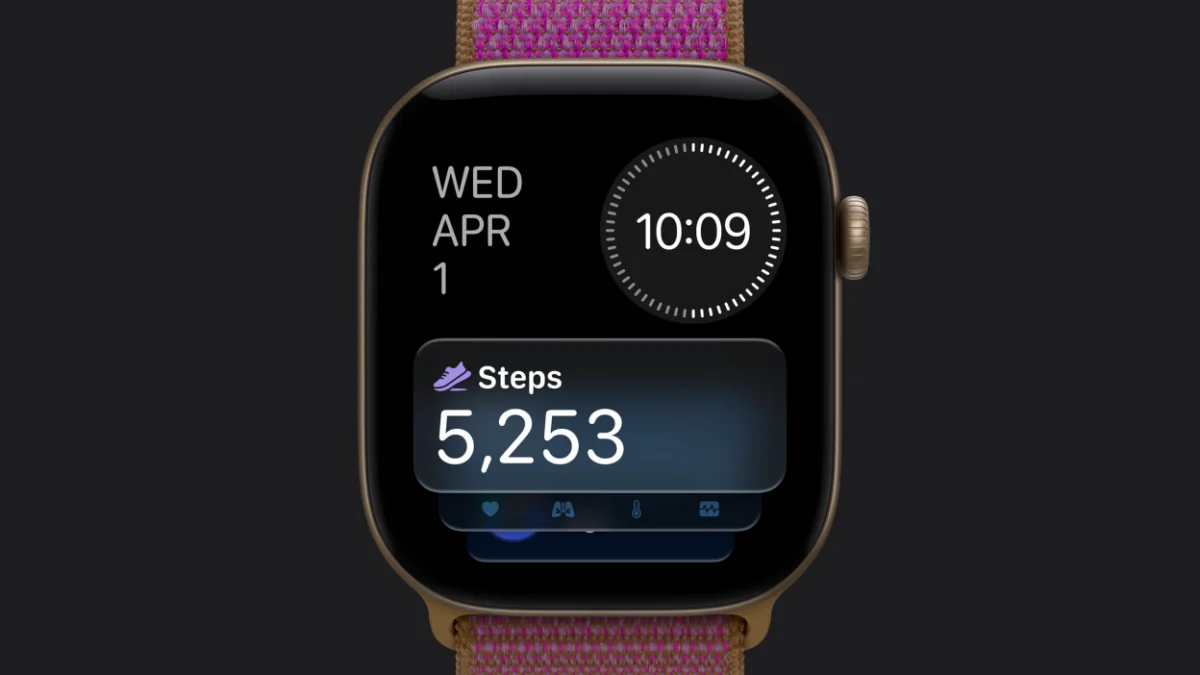
By Beth Skwarecki
Senior Health Editor
September 11, 2026
For over a decade, the fitness wearable market has relied on a universal metric to measure daily movement: the step count. Pioneered decades ago by simple mechanical pedometers and later popularized by digital ecosystems like Fitbit, tracking steps has become a baseline expectation for anyone strapping a computer to their wrist. Over the years, even high-end, performance-focused recovery and tracking rings like Oura and Whoop have yielded to consumer demand, integrating step metrics into their apps and dashboards.
Yet, one major player stubbornly resisted.
Despite tracking steps silently in the background for health analytics, the Apple Watch has never made it simple or straightforward for users to view their real-time step count on a watch face. Apple’s omission was intentional—a philosophical stance designed to shift user focus away from raw numbers and toward its proprietary "Activity Rings," which measure movement, exercise, and standing hours holistically.
However, consumer habits die hard, and public demand has finally won out. Apple is officially changing course. With the debut of the newest hardware generation and forthcoming software updates, the tech giant is finally baking native step counts directly into the Apple Watch interface, ending years of reliance on clunky third-party workarounds.
Main Facts: What Apple is Changing
The landscape of Apple’s wearable fitness tracking is undergoing its most significant philosophical shift in years.
- Hardware Integration: On official product pages for the newly announced Apple Watch Series 12 and the rugged Apple Watch Ultra, Apple highlights enhanced sensor algorithms that deliver a more accurate daily step count. More importantly, the company explicitly confirms a new user-facing capability: checking step counts natively, right from the watch face.
- Software Rollout: While Apple highlights the feature alongside its newest flagship hardware, industry analysts and beta testers anticipate that the capability will expand via operating system updates. Specifically, software patches and forthcoming versions like watchOS 27 are expected to democratize the feature across a broader array of existing devices, such as the Series 9 and newer, Ultra 2 and newer, and the SE 3.
- The Health App Overhaul: Beyond the wrist, Apple’s upcoming redesign of the iPhone Health app incorporates step counts more prominently. Screenshots from the upcoming rollout display a dedicated data tile featuring Apple Watch activity rings paired directly with a persistent daily step tally.
Chronology: A History of Resistance and Workarounds
To understand why this update is making waves in the tech community, it helps to look at how Apple handled physical movement tracking historically.
The Era of the "Rings" (2015–2025)
When the original Apple Watch launched, Apple made a deliberate choice to de-emphasize the traditional 10,000-step goal popularized by the fitness industry. Instead, executives and designers championed the Activity Rings framework. The philosophy was simple: counting steps could encourage sedentary behavior if a user simply paced around their living room, whereas closing rings required sustained periods of elevated heart rate, movement, and postural changes (stand hours).
Internal Apple design philosophy essentially treated raw step counts as outdated or "dumb" metrics. Consequently, if a user wanted to glance at their wrist and see how many physical steps they had taken during a morning run or workday, they were left out in the cold. While the data existed inside the Health app on a paired iPhone, surfacing it on the watch required third-party software interventions.
The Third-Party Solution Era
Frustrated by Apple’s native omission, third-party developers filled the void. Popular applications like Duffy and other specialized step-counter utilities surged in popularity on the App Store. These apps relied on custom watch face complications—miniature data fields—to feed raw step data from Apple’s background sensors onto the user’s preferred watch face. While functional, these solutions often suffered from latency, battery drain, or required microtransactions and subscriptions for advanced customization.
The Tipping Point (2026)
By late 2025 and into 2026, consumer fatigue over Apple’s exclusion of such a basic metric reached an inflection point. Wearable competitors routinely marketed step tracking as an essential baseline feature, leaving Apple isolated in its dogmatic adherence to rings alone. Recognizing that user retention and satisfaction hinged on giving customers the metrics they actually wanted, Apple engineers began re-architecting the user interface to bring steps to the forefront.

Supporting Data and Current Workarounds
For users eager to track their steps prior to the widespread rollout of native watch-face complications, the underlying data has always been accessible—if you know where to look.
How to Access Steps Right Now
Even without upgrading your hardware today, your Apple Watch is already logging your steps. You can manually surface this data by following these steps:
- Open the Health app on your paired iPhone.
- Search for Steps using the search bar.
- Scroll to the bottom of the Steps analytics screen and tap Add to Pinned.
- This action pins the metric to the top of your Health app homepage for instant access.
Deploying Third-Party Complications
To see steps directly on your wrist today, you can download an independent app from the App Store, such as Duffy. Once installed, you can configure your watch face to include that app’s complication, effectively bridging the gap until Apple’s native software update rolls out broadly.
Furthermore, early software previews of Apple’s upcoming Health app redesign—slated for devices supporting Apple Intelligence (such as the iPhone 15 Pro and newer)—reveal a much cleaner integration of daily metrics. Swiping up from the main watch face to view smart stacks will soon incorporate step-oriented cards, expanding upon the existing distance-traveled metrics.
Official Responses and Industry Perspectives
Apple’s official stance on fitness metrics has historically prioritized ecosystem-wide behavioral changes over isolated numbers. However, the marketing language surrounding the Series 12 and Apple Watch Ultra reveals a pragmatic pivot.
Fitness industry analysts note that Apple’s walled-garden approach to health metrics occasionally alienates casual fitness enthusiasts who switch from Garmin or Fitbit ecosystems. By conceding on step counts, Apple is acknowledging that user familiarity matters more than ideological purity in fitness design.
Tech critics and accessibility advocates have similarly praised the move, noting that for individuals managing specific physical therapy regimens, rehabilitation programs, or low-impact daily movement goals, a straightforward step count is far more actionable than a generalized calorie burn or exercise ring percentage.
Implications: What This Means for Consumers and Competitors
The addition of native step counts to the Apple Watch carries broad implications for both consumers and the broader wearable technology market.
For Apple Watch Users
The most immediate impact is convenience. Users no longer need to rely on battery-hungry third-party utilities or dig through menus to evaluate a basic day-to-day metric. By blending the classic step-counter model with its existing Activity Rings, Apple is offering a hybrid approach that satisfies both data-driven stat-trackers and holistic wellness enthusiasts.
For Competitors (Fitbit, Garmin, Oura, and Whoop)
For years, the presence of native step counters was a primary differentiator for competing fitness trackers. Consumers who prioritized raw step tracking often bypassed the Apple Watch entirely, citing its poor battery life and lack of basic step complications. By closing this feature gap, Apple removes one of the last major functional advantages held by dedicated fitness bands, putting additional competitive pressure on companies like Fitbit and Garmin in the mainstream consumer market.
Ultimately, Apple’s decision to embrace the step count proves that even the most stubborn design philosophies must eventually bend to consumer reality. As the updated watchOS and hardware roll out globally, the humble step is finally taking its rightful place on the most popular smartwatch in the world.
 Asro
Asro  Reynand Wu
  Ammar Sabilarrohman