
 By Asep Darmawan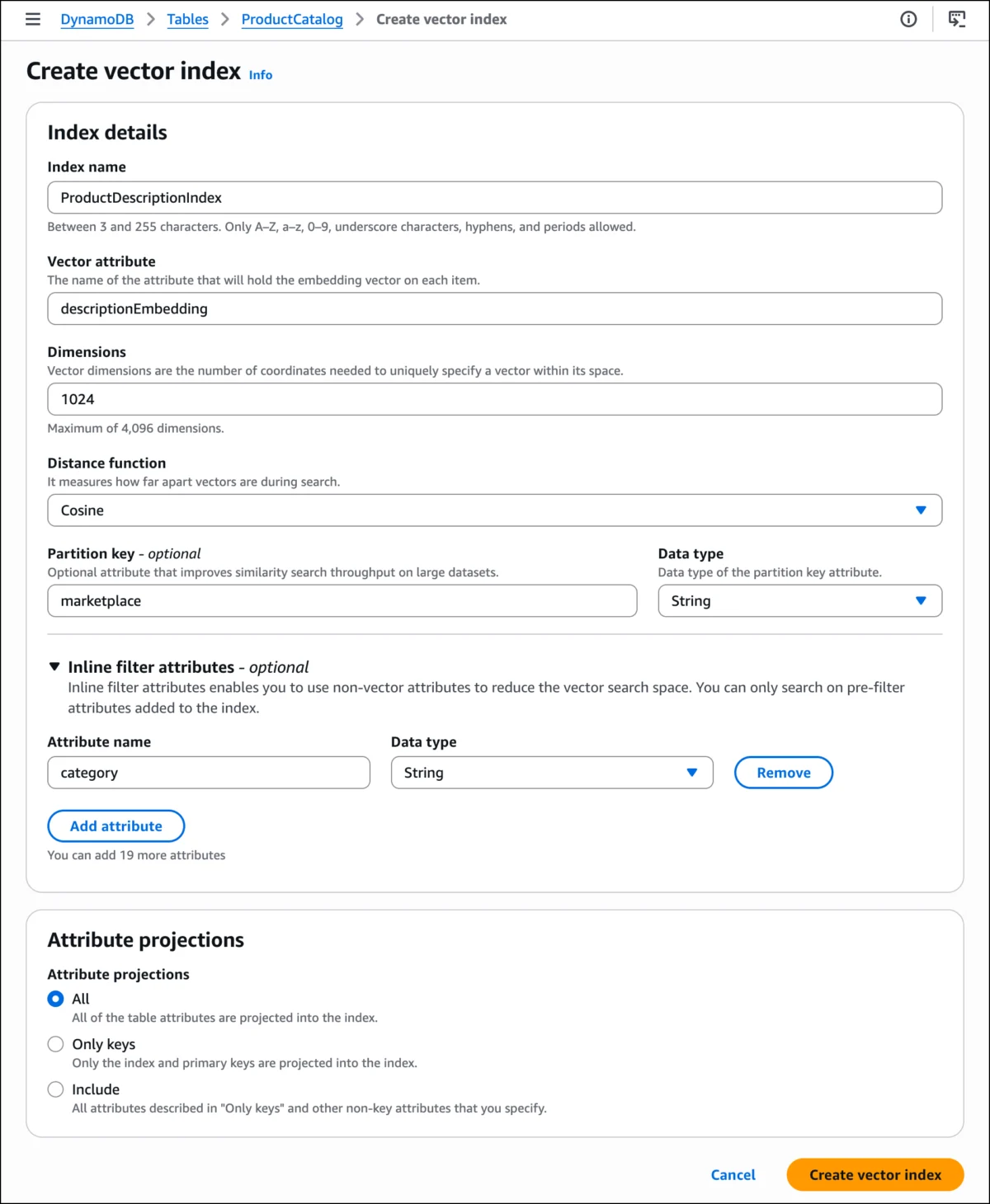
SEATTLE — In a major architectural leap for cloud-native applications, Amazon Web Services (AWS) has announced the general availability of native vector search capabilities in Amazon DynamoDB. The release bridges the long-standing divide between traditional operational data stores and high-performance vector databases.
Developers can now store vector embeddings directly alongside their standard operational data within DynamoDB tables. By eliminating the requirement to replicate, sync, and manage data across disparate specialized vector stores, AWS is dramatically simplifying the technical stack required for modern artificial intelligence workloads.
The service is engineered to scale seamlessly across trillions of vectors, delivering single-digit millisecond latencies with a recall accuracy of 99% or higher. Operating on DynamoDB’s fully serverless foundation, the feature inherits the platform’s zero-maintenance design, requiring no infrastructure provisioning, software installation, version management, or downtime maintenance windows.
Main Facts: What Native Vector Search Means for Developers
The integration of vector search into DynamoDB introduces architectural efficiencies that redefine how teams build semantic retrieval engines, recommendation systems, retrieval-augmented generation (RAG) pipelines, and agentic memory architectures.

- Unified Infrastructure: Vectors and operational data share the same serverless infrastructure and familiar pay-per-request pricing model.
- Scale and Performance: The service supports vector dimensions up to 4096 and scales horizontally without arbitrary storage limitations.
- Supported Distance Functions: Developers can choose between Cosine, Euclidean, and Dot Product distance metrics depending on their specific machine learning use cases.
- Inline Filtering: Queries can apply exact-match filters on non-vector attributes simultaneously during similarity execution, narrowing search spaces at runtime.
- Broad Regional Availability: The feature is generally available today across all commercial AWS Regions, including AWS GovCloud (US).
Previously, incorporating vector search into a DynamoDB-backed application demanded a complex, multi-system design. Engineering teams had to provision a dedicated vector database, write and maintain custom data synchronization pipelines, incur data movement and dual-licensing costs, and continuously tune the architecture to prevent latency degradation at scale.
By contrast, the new native index type integrates smoothly into existing workflows. Developers generate embeddings using models such as Amazon Bedrock Titan Text Embeddings, Cohere Embed, or OpenAI variants, and save them as standard lists of floating-point numbers via a typical PutItem or UpdateItem API call.
Chronology: The Evolution Toward Native Database Convergence
The rollout of vector search within DynamoDB represents the culmination of a broader industry trend toward multimodal database architectures, moving away from fragmented, single-purpose data silos.
- The Siloed Era: As generative AI gained momentum, organizations rushed to adopt vector databases to power semantic search and LLM context windows. This created administrative overhead, forcing engineers to manage dual pipelines where operational records lived in DynamoDB while corresponding vector representations lived elsewhere.
- The Hybrid Demand: Enterprise feedback highlighted the friction of maintaining consistency between operational databases and vector stores. Developers demanded transactional consistency and simpler synchronization mechanisms.
- The AWS Integration Phase: AWS began infusing native vector capabilities across its database portfolio—most notably in Amazon Aurora and Amazon OpenSearch—before turning its attention to its flagship serverless key-value database, DynamoDB.
- General Availability: Today’s announcement brings high-speed vector indexing directly into DynamoDB tables, enabling direct similarity execution inside the database engine.
Supporting Data: Technical Specifications and Performance Metrics
Under the hood, DynamoDB’s vector search is built to handle mission-critical, high-throughput enterprise demands without sacrificing speed or accuracy.

Index Architecture and Configuration
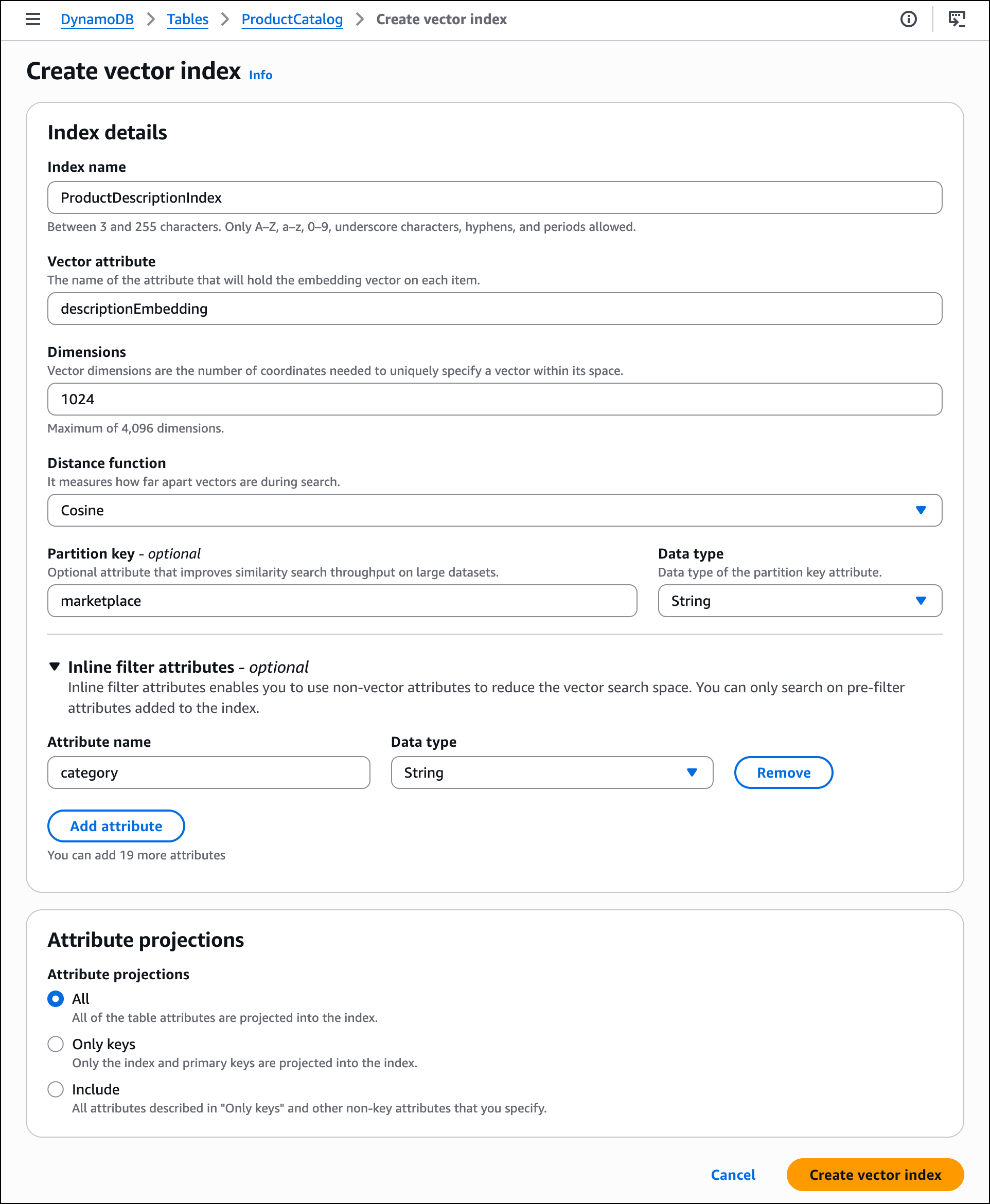
When creating a vector index via the AWS Management Console, CLI, or Infrastructure-as-Code (IaC) tools like AWS CloudFormation, administrators configure several critical parameters:
- Index Name and Attribute: Target the specific attribute holding the vector embeddings (stored as DynamoDB
Listdata types containingNumberelements). - Dimensions: Match the precise output dimension count of the chosen embedding generation model (supporting up to 4096 dimensions).
- Distance Function: Select Cosine (ideal for semantic text similarity by measuring angular differences), Euclidean (measuring straight-line distance), or Dot Product.
- Partition Key: Optionally configure a partition key (such as a
marketplaceorregionidentifier) to distribute vectors across partitions, ensuring predictable latencies and scoping queries to specific subsets of data without full-index scans. - Inline Filters: Specify non-vector attributes (such as
categoryorstatus) for exact-match filtering during query execution.
Query Execution and Scoring
Queries are executed using the new SearchVectors API, which accepts a query vector, a Top K parameter (returning up to 100 results), and optional filter criteria.
The resulting similarity scores correspond directly to the chosen distance function:
- Cosine & Euclidean: Lower scores indicate higher similarity, where a score of
0denotes an identical match. - Dot Product: Higher scores indicate higher similarity.
Official Responses and Architectural Guidance
AWS engineering leads emphasize that the feature was engineered specifically to alleviate operational toil.
"If your application already relies on DynamoDB for operational data, adding similarity search shouldn’t mean doubling your operational footprint," notes architectural guidance from the AWS DynamoDB team. "By keeping vectors and operational data on the same serverless foundation, developers eliminate data movement costs and complex synchronization logic while preserving the single-digit millisecond latency our customers expect."
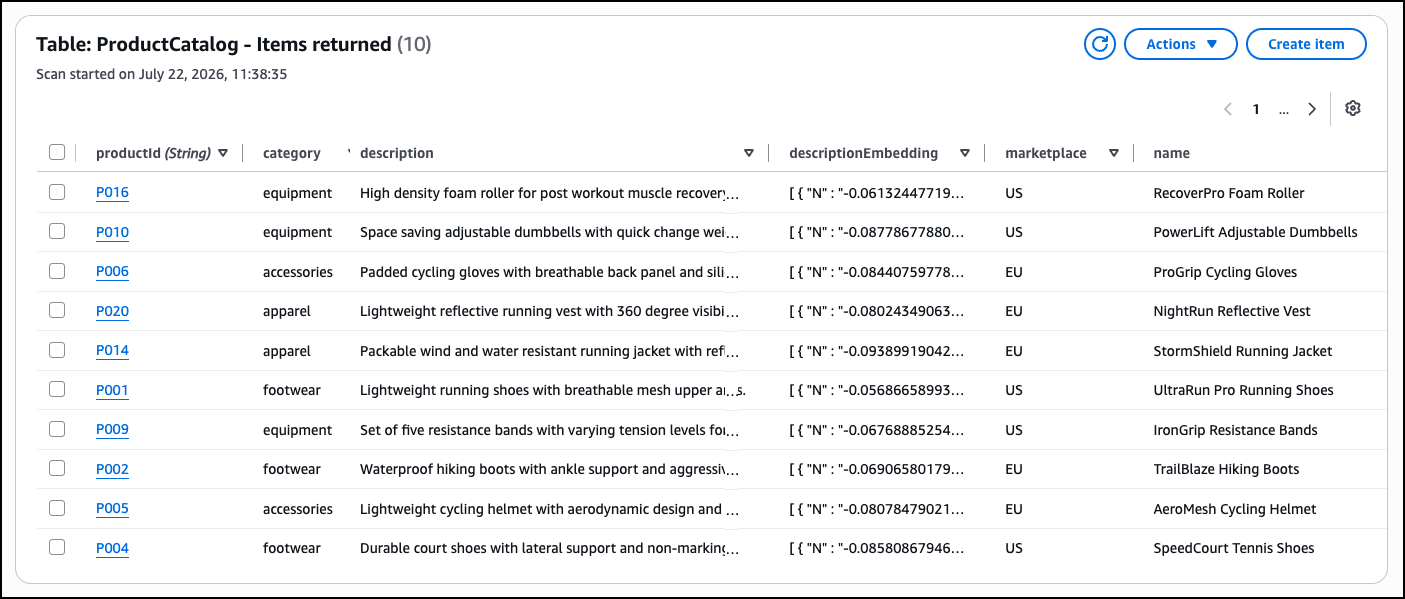
For developers eager to test the feature, AWS has released comprehensive walkthroughs utilizing an online sporting goods store scenario. In this model, an existing ProductCatalog table containing attributes like productId, category, and price is seamlessly augmented with a descriptionEmbedding attribute. By configuring a vector index named ProductDescriptionIndex, shoppers can instantly transition from rigid keyword matching to natural language processing queries—such as searching for "lightweight running shoes for summer"—and receive ranked, context-aware results alongside standard operational attributes in a single response.
Furthermore, teams leveraging AI-assisted coding tools can utilize the AWS MCP Server and associated plugins to interact with vector search APIs and documentation programmatically.
Implications: What This Means for the Cloud Ecosystem
The introduction of native vector search in DynamoDB carries profound implications for software architects, database administrators, and enterprise budgets.
1. Reduced Architectural Complexity
By collapsing two distinct infrastructure components—an operational NoSQL database and a specialized vector store—into a single managed service, AWS significantly reduces the system’s attack surface and points of failure. Teams no longer need to write custom change data capture (CDC) pipelines using tools like AWS Lambda or Apache Kafka to keep vector indices synchronized with master operational tables.
2. Cost Optimization
Dual-database architectures impose compounding expenses: licensing fees for specialized vector databases, persistent infrastructure provisioning costs for idle capacity, and network data-transfer fees incurred during synchronization. DynamoDB’s serverless, pay-per-request pricing model ensures that organizations only pay for the storage and compute consumed by vector indexes when queries or writes occur.
3. Accelerated Time-to-Market for Generative AI
Building intelligent applications—such as personalized e-commerce recommendations, real-time fraud and anomaly detection, and sophisticated Retrieval-Augmented Generation (RAG) agents—frequently bogs down in data engineering bottlenecks. By lowering the barrier to entry for semantic search, AWS empowers developers to ship generative AI features using the familiar DynamoDB APIs and data types they already use in production today.
As enterprises continue to embed machine learning deeply into their core operational workflows, the boundary between traditional databases and AI data stores continues to dissolve. With this release, Amazon DynamoDB firmly positions itself as a unified engine capable of handling both high-velocity operational workloads and complex cognitive search at planetary scale.
 Suro Senen
  Lina Hope
  Nila Kartika Wati