
 By Dwi Wanna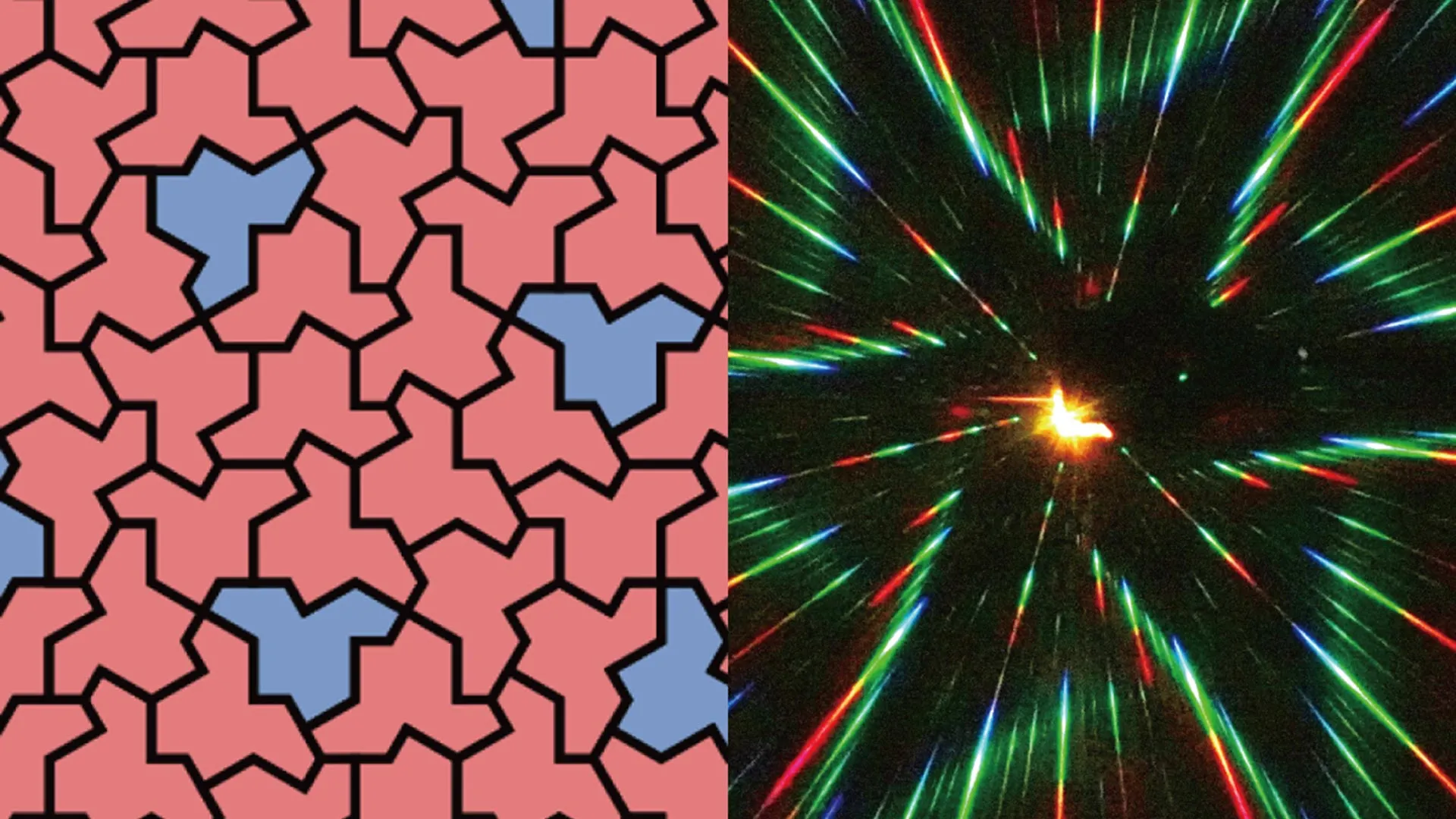
In the quiet corridors of theoretical mathematics, some problems remain unsolved for decades, acting as intellectual monoliths that challenge the boundaries of human logic. One such enigma was the "Einstein problem"—a search for a single, solitary shape capable of tiling a two-dimensional plane without ever repeating its pattern. When the "Smith hat" emerged in 2023 as the definitive solution to this puzzle, it made global headlines. Now, a year later, that same mathematical curiosity is making waves in an entirely different domain: physics.
Researchers at the Institute of Industrial Science at the University of Tokyo have successfully bridged the gap between pure geometry and optical science. By transposing the Smith hat’s complex, aperiodic tiling into the realm of nanophotonics, the team has demonstrated that this "monotile" can force light to behave in ways previously thought impossible. The discovery not only showcases the profound influence of geometry on optical behavior but also hints at a new generation of light-manipulation technologies.
The Einstein Problem: A Mathematical Odyssey
To understand the magnitude of this breakthrough, one must first appreciate the history of the Einstein problem. The term "Einstein" is not a tribute to the physicist Albert Einstein, but rather a playful linguistic nod to the German phrase ein Stein, meaning "one stone." The objective was deceptively simple: find a single "monotile" that could cover an infinite plane in an aperiodic fashion.
For decades, mathematicians believed such a shape might be a mathematical unicorn. While periodic tilings—like the humble checkerboard or the hexagonal honeycomb—are easily understood, aperiodic tilings are far more elusive. They exhibit "quasi-periodic" order; they are ordered in a way that suggests a pattern, yet they never repeat.
The search for the monotile involved a labyrinthine journey through geometry. Early attempts, such as the famous Penrose tiles discovered in the 1970s, required at least two distinct shapes to create an aperiodic pattern. It wasn’t until 2023 that a team of mathematicians—David Smith, Joseph Samuel Kaplan, Craig S. Kaplan, and Chaim Goodman-Strauss—unveiled the "hat" tile. This 13-sided polygon, through its unique geometric constraints, successfully tiled the plane aperiodically, finally solving the Einstein problem and capturing the imagination of the global scientific community.
Chronology of a Discovery: From Paper to Nanoscale
The transition from a theoretical tiling pattern to a physical optical device was a meticulous process of engineering. Lead author Yuto Moritake and his colleagues at the University of Tokyo were not content to leave the hat in the pages of a math journal. They were interested in how this specific geometry would interact with the fundamental building block of the universe: light.
Phase 1: Conceptualization (Early 2023)
Immediately following the discovery of the Smith hat, the team hypothesized that the shape’s lack of mirror symmetry might offer unique properties for controlling light. Unlike standard crystalline structures, which have repeating, symmetrical unit cells, the Smith hat’s aperiodic nature promised a "broken" symmetry that could manipulate electromagnetic waves in novel ways.
Phase 2: Fabrication (Late 2023)
Moving from theory to practice, the researchers utilized electron beam lithography, a high-precision manufacturing process capable of etching patterns at the nanometer scale. They fabricated the Smith hat pattern onto silicon nitride films. These films act as a playground for light, where the physical dimensions of the etched structures are comparable to the wavelength of the light being studied.
Phase 3: The Optical Reveal (2024)
In the experimental phase, the team illuminated these nanostructures with laser light. The results were immediate and striking. The light did not scatter in the diffuse, predictable manner one might expect from standard random surfaces, nor did it form the standard diffraction patterns associated with classic quasicrystals. Instead, the light formed distinctive, pinwheel-like diffraction patterns that rotated and shifted depending on the orientation of the incident beam.
The Physics of Chirality: Understanding the Light-Matter Interaction
The core of the researchers’ discovery lies in the concept of "chirality." In geometry and chemistry, an object is chiral if it cannot be superimposed onto its mirror image. Your hands are the classic example: your left hand is a mirror image of your right, but no amount of rotation will make them identical.
The Smith hat, by its very construction, possesses a handedness. When the researchers projected light through their silicon nitride patterns, they found that the diffraction patterns themselves exhibited this same chirality. This is a departure from conventional optics.
"We found that the diffraction patterns themselves become chiral because the structure lacks mirror symmetry," explains senior author Masaya Notomi. "This kind of optical response is fundamentally different from that observed in conventional quasicrystalline materials."
The light was effectively "reading" the handedness of the geometry. When the physical structure was flipped, the optical behavior mirrored the inversion, proving that the light-matter interaction was being dictated entirely by the underlying geometric symmetry—or lack thereof.
Supporting Data: Symmetry, Polarization, and Directionality
The study published in Nature Communications provides a wealth of data regarding the sensitivity of the Smith hat structures. The researchers observed that the diffraction output is not static; it is highly dynamic, responding to two primary variables:
- Directionality: By rotating the angle of the incident laser, the diffraction patterns shifted in real-time. This suggests that the structure acts as an anisotropic medium, where the flow of light is guided by the orientation of the tiles.
- Polarization: The most significant finding was the structure’s response to the polarization of the incoming light. Because the pattern lacks mirror symmetry, it interacts differently with light waves that oscillate in different directions. This "polarization-dependent chirality" is a highly sought-after trait in the development of optical filters and sensors.
These data points confirm that the Smith hat acts as a geometric filter. It forces light to sort itself according to its own symmetry, effectively acting as a bridge between the abstract rules of aperiodic geometry and the tangible laws of electrodynamics.
Official Responses and Expert Commentary
The broader scientific community has reacted with cautious optimism, noting that this research validates the utility of "recreational" mathematics in serious physical applications.
"What is especially fascinating about the hat tile is that, although the resulting pattern appears irregular at first glance, it is actually constructed from the honeycomb lattice," says Yuto Moritake. This observation is critical; it suggests that there is a hidden, underlying order to the Smith hat that we are only beginning to tap into.
Senior author Masaya Notomi emphasizes that this is not just a one-off experiment, but a proof-of-concept for a new field of study. "These results open a new direction of research on the fusion of quasiperiodic order and chirality," Notomi remarked. "Monotile patterns provide a platform for exploring optical phenomena that emerge from the interplay of symmetry, chirality, and aperiodicity."
External experts in the field of photonics have lauded the study for its clarity. By using a well-defined mathematical object like the Smith hat, the researchers have eliminated the "noise" usually found in naturally occurring amorphous materials, allowing for a cleaner study of how aperiodicity influences wave propagation.
Implications: The Future of Light Manipulation
The implications of this research extend far beyond the laboratory. If we can control how light behaves using specific geometric patterns, we can revolutionize the devices that facilitate our digital world.
Advanced Optical Computing
The ability to manipulate light based on its polarization and direction, dictated by the pattern it travels through, is a cornerstone of optical computing. Unlike current silicon-based electronics, which rely on the flow of electrons, optical computing promises speeds limited only by the speed of light, with significantly less heat dissipation.
Next-Generation Polarization Filters
Current polarization technology often requires bulky, multi-layered materials. The Smith hat structures, being thin films, could lead to ultra-thin, high-efficiency polarizers for high-resolution displays, cameras, and even quantum communication systems.
Sensing and Metrology
Because the diffraction pattern is so sensitive to the orientation and symmetry of the tiles, these structures could serve as highly sensitive detectors. By analyzing the "pinwheel" diffraction, scientists could detect minute changes in light properties, leading to new types of sensors for chemical or biological analysis.
Conclusion: A New Era of Geometric Physics
The story of the Smith hat is a testament to the unpredictable nature of scientific progress. What began as an abstract puzzle—a search for a shape that could fill a floor without repeating its pattern—has blossomed into a vital tool for the future of light manipulation.
By turning the "Einstein" tile into a physical lattice for photons, the University of Tokyo researchers have shown that geometry is not merely a description of the world around us, but a powerful lever with which we can influence physical reality. As we continue to refine these nanostructures, we may find that the secrets to the next generation of optical technology were hidden in the geometry of a simple, hat-shaped tile all along.
The Smith hat has moved from the pages of history into the light of the future, proving that in the quest for scientific understanding, no puzzle is truly solved—it is merely transformed into the next great question.
 Nana Wu
  Siti Muinah
  Sagoh
Sagoh 