
 By Ali Ikhwan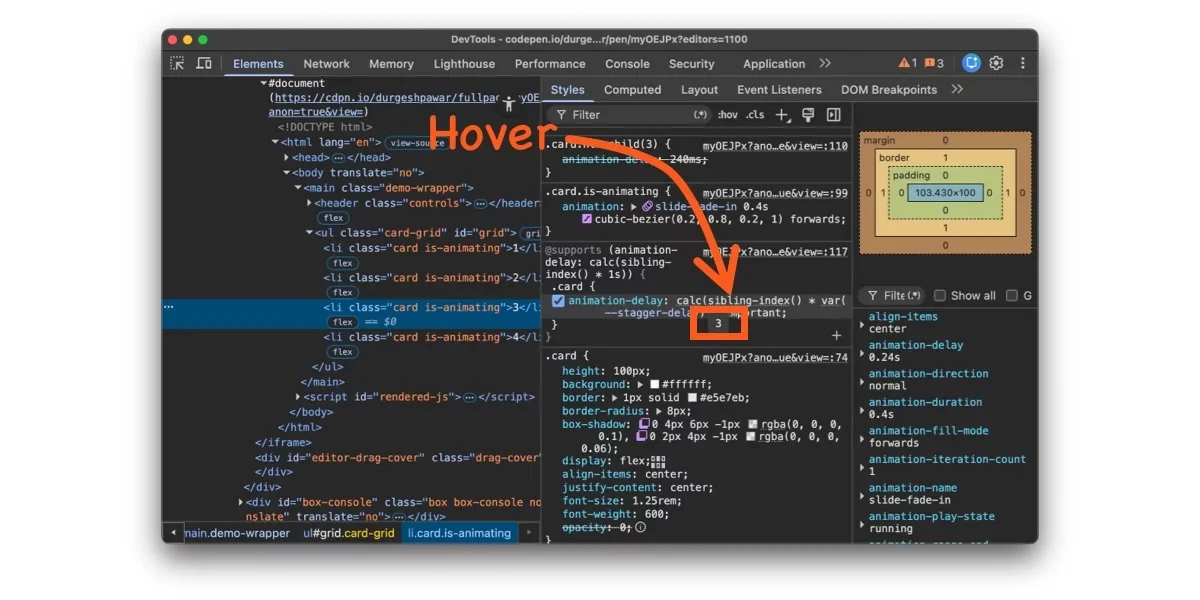
For as long as modern web layouts have relied on responsive grids and cascading style sheets, frontend developers have shared a quiet, collective frustration. Whenever a task required dynamic layout coordination—such as generating a staggered fade-in sequence for a grid of cards, distributing widths equally across an unpredictable number of navigational tabs, or spinning elements evenly across a color wheel—the process felt needlessly convoluted.
Historically, engineers were forced to choose between two imperfect solutions: writing bloated Sass loops that output dozens of hardcoded :nth-child() rules, or injecting inline JavaScript styles directly into the DOM tree. Both approaches violated a fundamental architectural truth: the browser already possessed all the structural data needed to calculate these layouts natively, yet CSS remained locked out of accessing it.
That paradigm has officially shifted. The arrival of sibling-index() and sibling-count() introduces native tree-counting capabilities to the web platform, bringing powerful mathematical tools directly into style sheets. Part of the CSS Values and Units Module Level 5 specification, these native functions eliminate the need for build-time preprocessors, complex JavaScript workarounds, and maintenance-heavy DOM injections, paving the way for elegant, highly responsive interfaces that scale effortlessly from five items to five thousand.
Main Facts: What Are sibling-index() and sibling-count()?
At their core, sibling-index() and sibling-count() are native CSS functions designed to expose structural DOM relationships directly to style rules.
sibling-index(): Returns the integer value representing an element’s 1-based index position among its direct siblings.sibling-count(): Returns the total number of element siblings sharing the same parent container.
Unlike the legacy counter() function, which evaluates strictly to strings and is restricted to pseudo-element content properties, these new functions evaluate directly to raw integers (<integer>). This technical distinction is monumental. Because they return true numerical values, they can be seamlessly integrated into a wide array of mathematical CSS features:
- Arithmetic and Logic:
calc(),min(),max(),round(), andmod(). - Trigonometry: Native trigonometric functions such as
sin()andcos(). - Color Functions: Dynamic manipulation within
hsl(),hwb(), and other color spaces.
When a developer writes calc(sibling-index() * 100ms), the browser automatically handles type coercion, translating the raw integer into a valid <time> value without requiring manual variable declarations or preprocessor loops.
Crucially, it is vital to distinguish between selectors and values. Selectors like :nth-child() are designed exclusively to target and select elements; they cannot be utilized inside mathematical expressions. Conversely, sibling-index() acts entirely within declarations, providing the numerical operands required to execute complex layout calculations.
Chronology: From W3C Drafts to Stable Browser Implementations
The journey toward native CSS tree counting represents years of collaborative debate, specification drafting, and progressive browser implementation within the World Wide Web Consortium (W3C).
- Late 2019 (W3C Issue #4559): The foundational concepts for structural tree-counting and dynamic variable access were formally proposed via CSS Working Group (CSSWG) issue #4559. Spearheaded by community discussions and architectural feedback, the proposal aimed to bridge the gap between structural DOM awareness and styling capabilities.
- Specification Finalization: The functions were formally codified within Section 9 of the CSS Values and Units Module Level 5 specification draft, sparking a wave of creative pattern exploration across the front-end community.
- Mid-2025 (Stable Releases): Modern browser vendors accelerated their implementation timelines. Chrome and Edge version 138 officially shipped support for
sibling-index()andsibling-count()in their stable releases in June 2025. Safari quickly followed suit with its Safari 26.2 release, establishing baseline availability across two of the major engine ecosystems and covering roughly 75% to 80% of global web traffic. - Current Status: While stable implementations roll out across Chromium and WebKit browsers, Mozilla’s development team has registered a positive standards position, with tracking underway via Bugzilla issue #1953973 to bring stable support to Firefox.
Supporting Data & Practical Design Patterns
Once the realization sets in that these functions supply raw integers to the CSS cascade, the practical design applications multiply rapidly. Developers are rapidly adopting several core patterns to streamline their codebases.
1. Reverse Staggered Animations
Creating a staggered fade-in where the final item animates immediately and earlier items follow a delay no longer requires manual index mapping. By subtracting the current index from the total count:
.card
  animation: fade-in 0.4s ease both;
  animation-delay: calc((sibling-count() - sibling-index()) * 80ms);
The last child evaluates to (N - N) * 80ms = 0ms, firing instantly on load, while the first child scales proportionally, eliminating awkward loading pauses.
2. Automatic Equal Widths
Designing navigation bars or tabs that automatically divide container space evenly is accomplished without media queries or resize observers:
.tab
  width: calc(100% / sibling-count());
Whether a component holds four tabs or ten, the percentages adjust dynamically on the fly.
3. Dynamic Hue Distribution & Radial Layouts
Color systems and geometric layouts benefit immensely from native math integration. Developers can distribute items evenly across the color wheel or plot them in circular formations without relying on external JavaScript math libraries:
.radial-item
  --angle: calc((360deg / sibling-count()) * sibling-index());
  --radius: 120px;

  position: absolute;
  left: calc(50% + var(--radius) * cos(var(--angle)));
  top: calc(50% + var(--radius) * sin(var(--angle)));
  transform: rotate(calc(var(--angle) * -1));
Modifying the number of items in the container instantly shifts the geometric shape from a hexagon to an octagon without recalculating coordinates in script files.
Official Responses and Technical Gotchas
Despite the immense power unlocked by these functions, the CSS Working Group and early adopters have outlined several nuanced technical caveats that developers must navigate when implementing them in production environments.

Shadow DOM Scoping and Security
When working with Web Components, sibling-index() and sibling-count() operate strictly on the immediate DOM tree rather than the flattened visual tree. If a custom element wraps internal styling around structural slots, the function evaluates the internal shadow nodes rather than the projected light DOM children. Furthermore, to prevent external style sheets from probing the internal architecture of third-party components via ::part(), browsers deliberately return a flat zero (0), maintaining strict encapsulation boundaries.
The display: none Pitfall
A critical performance and logic nuance involves hidden elements. Because these functions read the DOM tree rather than the visual layout tree, elements styled with display: none are still counted.
<ul>
  <li>Apple</li>                 <!-- sibling-index() = 1 -->
  <li style="display:none">Banana</li> <!-- sibling-index() = 2 (Hidden) -->
  <li>Cherry</li>                <!-- sibling-index() = 3 (NOT 2) -->
</ul>
For applications utilizing dynamic search filters that hide non-matching list items via display: none, gaps will appear in staggered animations and proportional layouts unless filtered nodes are physically removed from the DOM tree or managed via alternative state approaches.
Performance at Scale
While these native functions execute swiftly during the cascade phase—outperforming legacy JavaScript DOM-stamping techniques—extreme edge cases warrant caution. Inserting a new node at the very beginning of a container holding 10,000 children forces the rendering engine to recalculate index values for every subsequent sibling. For standard user interface components like navigation bars, card grids, and tab bars, the performance impact is negligible; however, for high-frequency data streams or infinite-scroll feeds with thousands of churning nodes, virtualization windows managed via script remain necessary.
Implications for the Future of Web Development
The introduction of sibling-index() and sibling-count() represents a philosophical maturation of CSS. For years, the industry leaned toward an era where layout intelligence was heavily offloaded to JavaScript runtime environments. Native tree counting signals a return to declarative styling, empowering stylesheets to react autonomously to structural changes within the DOM.
As standards bodies look toward the horizon, additional proposals are already under discussion. Planned extensions such as the of <selector> argument (akin to :nth-child(of .active)) promise to filter and count specific subset elements dynamically. Furthermore, speculative explorations regarding children-count() and descendant-count() point toward a future where developers possess comprehensive horizontal and vertical views of the document tree entirely within native CSS.
Bridging the Transition Today
Because full browser parity—specifically regarding Firefox implementation—is still actively progressing, developers must rely on progressive enhancement strategies. Leveraging @supports rules ensures that modern browsers receive mathematical layouts while baseline environments fall back safely:
/* Baseline layout for non-supporting browsers */
.item
  width: 25%;
  animation-delay: 0ms;


/* Progressive enhancement for supporting engines */
@supports (z-index: sibling-index())
  .item
    width: calc(100% / sibling-count());
    animation-delay: calc(sibling-index() * 80ms);
Ultimately, the feeling of writing repetitive loops or hacking workaround selectors just to animate a grid of cards is becoming a relic of the past. The obvious solution to structural coordination on the web is finally here, transforming how developers build dynamic, resilient user interfaces.
 Iffa Jayyana
  Nila Kartika Wati