
 By Nana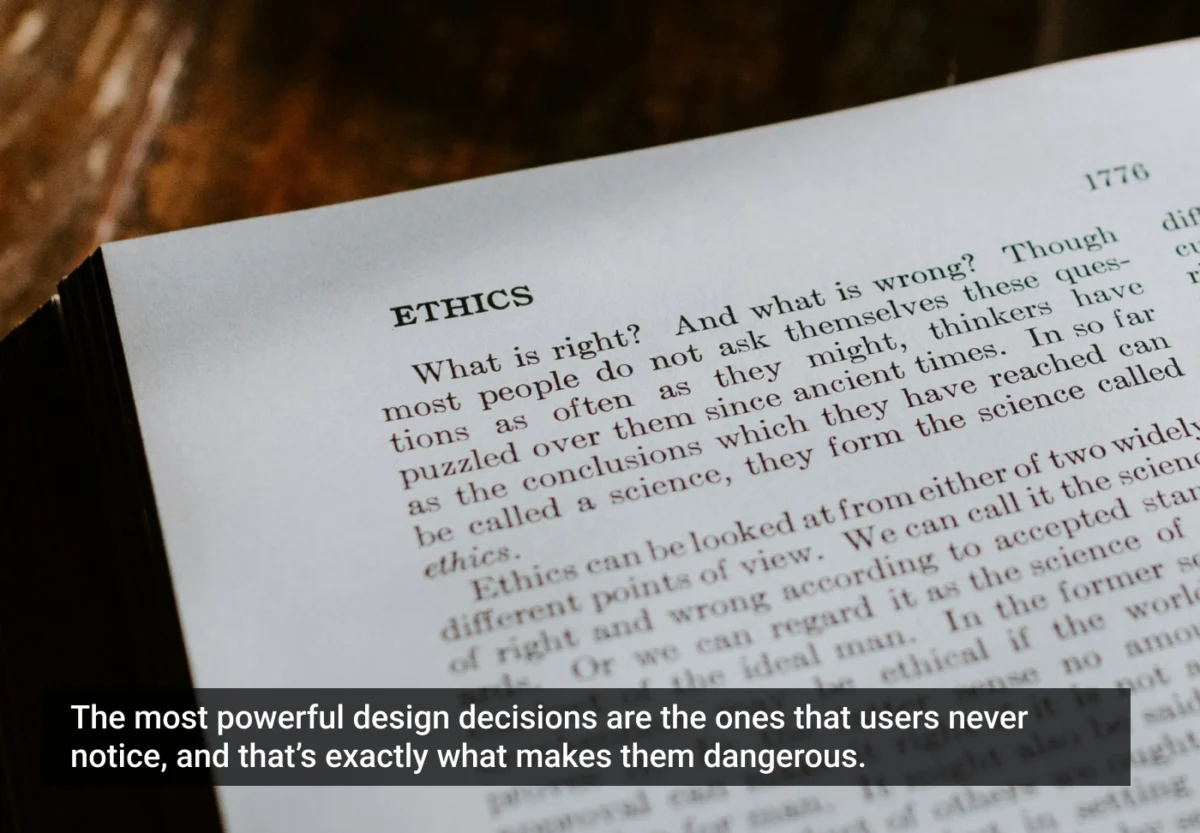
By the WorldUXForum Editorial Board
In the digital realm, every pixel is a deliberate choice, and every pathway is paved with intent. At the heart of the WorldUXForum, we hold a foundational belief: design is not merely about functionality or aesthetics—it is a profound act of responsibility. Every interface we construct, every micro-interaction we deploy, and every user journey we map shapes human behavior.
The “Ethical UX Series” is our ongoing commitment to examining how design decisions—whether implemented consciously or unconsciously—affect real people in the real world. We explore these impacts through the lenses of cognitive psychology, behavioral economics, deep user empathy, and transparent methodologies.
This feature marks the 9th entry in the “Ethical UX Series.” Each installment reflects our maturing understanding of the critical intersection between ethics and user experience. We view this intersection not as an afterthought, but as the bedrock of every decision made by modern designers, researchers, strategists, and technologists.
In this edition, we turn our lens toward the silent yet commanding world of nudges—the micro-signals that quietly direct decisions and the psychological tools that dictate user flow across the digital landscape.
Main Facts: The Power and Prevalence of Choice Architecture
At its core, a nudge is any aspect of choice architecture that alters people’s behavior in a predictable way without forbidding any options or significantly changing their economic incentives. Originally popularized by Nobel laureate Richard H. Thaler and legal scholar Cass R. Sunstein, the concept of the nudge has migrated from behavioral economics into the digital design suites of Silicon Valley and beyond.
Whether manifested as a strategically placed tooltip, a pre-checked subscription box, or a subtly suggestive UI icon, digital nudges are micro-signals designed to influence macro-behaviors.
To the untrained eye, these elements appear trivial. Yet, their psychological impact can be monumental. A well-designed nudge can guide a user toward a beneficial choice—such as completing a secure password setup or opting into organ donation. Conversely, a poorly or maliciously designed nudge can manipulate users into harmful patterns, unwanted subscriptions, or data privacy concessions. This duality is precisely why ethical UX has evolved from a theoretical discussion into an urgent, non-negotiable professional standard.
For UX researchers and practitioners, understanding nudges is no longer a matter of academic curiosity; it is a fundamental survival skill. Every friction point observed in a user journey map, every hesitation caught on video during usability testing, serves as a signal. It highlights where ethical nudges can be deployed to support better outcomes or, conversely, where unchecked design patterns risk causing real-world harm. The razor-thin line separating assistance from exploitation is often defined by a single layer of intent.
Chronology: The Evolution of Behavioral Design in Digital Spaces
To understand where ethical UX stands today, it is vital to trace how behavioral psychology transitioned from the halls of academia into the software development lifecycle.
- The Mid-2000s (The Theoretical Foundation): Behavioral economists like Richard Thaler and Cass Sunstein formalize the concept of "libertarian paternalism," arguing that environments can be structured to encourage better decisions without restricting freedom of choice.
- The Early 2010s (The Growth of Gamification): As mobile applications explode in popularity, tech companies begin borrowing heavily from behavioral psychology. Terms like "user engagement" and "retention loops" enter product design vocabulary. While initially focused on delighting users, these techniques lay the groundwork for more aggressive behavioral tracking.
- The Mid-2010s (The Rise of Dark Patterns): UX designer Harry Brignull coins the term "dark patterns" to describe user interfaces meticulously crafted to trick users into doing things they might not otherwise do. The industry witnesses a proliferation of hidden unsubscribe buttons, forced continuity traps, and disguised advertisements.
- The Late 2010s to 2020s (Regulatory Pushback and the Ethical Turn): Governments and regulatory bodies worldwide—most notably the European Union through GDPR and the Digital Services Act—begin cracking down on manipulative design. Concurrently, professional communities like the WorldUXForum launch dedicated initiatives, such as the Ethical UX Series, to establish industry-wide accountability standards and audit frameworks.
Supporting Data and Mechanics: Dissecting the Nudge
To evaluate whether a design element is operating ethically, we must first break down its mechanics. Here are five common nudge mechanisms frequently found in modern digital experiences:
- Defaults (Pre-selected Options): Leveraging human inertia, defaults rely on the fact that users rarely change pre-set configurations. While an ethical default simplifies setup (e.g., automatically enabling two-factor authentication), an exploitative default opts users into recurring financial charges or data-sharing agreements without explicit consent.
- Visual Hierarchy and Salience: Using color, size, and positioning to draw the eye toward a specific action. A bright, high-contrast "Accept All" button paired with a muted, text-link "Manage Preferences" exploits visual biases to secure total data access.
- Social Proof: Displaying real-time or aggregated data about what others are doing (e.g., "14 people are currently looking at this hotel room"). When accurate, it aids decision-making; when fabricated, it manufactures artificial scarcity and panic.
- Friction and Slippery Slopes: Adding strategic friction to discourage unwanted behaviors (such as deleting an account) while removing friction to encourage impulsive actions (such as one-click purchasing).
- Framing and Language: Presenting identical information in ways that trigger specific emotional responses. As demonstrated by UK government initiatives, changing the phrasing of a question regarding organ donation from a loss frame to a gain frame drastically shifted public participation rates.
The Behavioral Psychology Behind the Nudge
Human beings operate under what Nobel laureate Herbert Simon termed bounded rationality. We simply do not possess the time, cognitive energy, or computational capacity to evaluate every single digital choice from scratch. Consequently, our brains rely on mental shortcuts—heuristics—to navigate the world. Nudges tap directly into these cognitive shortcuts:
- Loss Aversion: The psychological pain of losing something outweighs the pleasure of gaining its equivalent. Designers frequently exploit this by warning users that they are about to "lose their progress" or "forfeit their discount."
- Status Quo Bias: An emotional preference for the current state of affairs, making users reluctant to alter default settings even when better alternatives exist.
- The Decoy Effect: Introducing a deliberately unattractive third option to make a target option appear vastly more appealing by comparison.
Real-World Empirical Evidence: The efficacy of language framing is well-documented. When a UK government website updated its organ donor signup flow by rephrasing prompts to invoke reciprocity ("If you needed an organ, would you take one?"), signups skyrocketed by 96%. This proves that a mere shift in narrative architecture can produce massive, positive societal outcomes without coercion.
Official Responses and Industry Standards
As public scrutiny over digital manipulation intensifies, technology companies, regulatory bodies, and professional design organizations are formulating formal responses to govern how behavioral nudges are deployed.
Regulatory bodies are increasingly classifying deceptive micro-signals as unfair or deceptive trade practices. The Federal Trade Commission (FTC) in the United States and data protection authorities across Europe have ramped up enforcement against companies utilizing dark patterns—particularly those affecting subscription cancellations, hidden fees, and privacy consents.
Simultaneously, enterprise design teams are establishing internal ethics boards and review checklists. Rather than viewing ethical design as a compliance burden or a legal check-the-box exercise, progressive organizations are positioning ethical UX as a core competitive advantage. Companies that respect user autonomy and transparency are finding higher long-term customer loyalty and brand trust, contrasting sharply with those that rely on short-term trickery.
Furthermore, UX research associations are integrating ethical auditing frameworks directly into qualitative testing protocols. Designers are no longer just asking, "Can the user complete this task efficiently?" They are now asking, "Does the user understand the long-term implications of completing this task?"
Implications: The Ethical Threshold and the Road Ahead
The distinction between a benign nudge and a manipulative dark pattern often hinges on intent and transparency. The ethical line is crossed when a design element:
- Deceives or misleads the user regarding the true consequences of an action.
- Imposes unreasonable cognitive load or friction to prevent users from exercising their rights (such as opting out or canceling a service).
- Prioritizes short-term business metrics (conversion rates, data harvesting) over the long-term well-being of the user.
For UX professionals, this requires a fundamental shift in mindset. We must move away from metrics that solely measure engagement at all costs and embrace metrics that measure user clarity, autonomy, and satisfaction.
A Research-Driven Auditing Framework for Nudges
To ensure accountability, designers and researchers can implement a simple auditing framework for any live or proposed nudge within an interface:
- Visibility: Is the nudge transparent, or is it hidden behind misleading UI elements?
- Reversibility: How easy is it for the user to undo or change the action prompted by the nudge?
- Alignment: Does the outcome of the nudge primarily benefit the user, or does it disproportionately serve the platform’s commercial interests?
- Informed Consent: Does the user possess all necessary information to make a truly autonomous choice?
Conclusion: Building Trust, Not Traps
Nudges are powerful tools, but power demands ethical restraint. As Marshall McLuhan famously observed, "We shape our tools, and thereafter our tools shape us."
Ethical nudging is not about forcing neutrality; it is about committing to intentional fairness. By pairing rigorous user research with deep moral accountability, UX professionals can transform digital interfaces from mechanisms of extraction into spaces of genuine empowerment. Technology must remain a useful servant rather than a dangerous master.
As we continue our journey through the “Ethical UX Series,” we invite designers, researchers, and technologists to reflect on their own practices. When we build products with empathy and transparency, we do more than optimize conversion rates—we build trust.
Up next in the “Ethical UX Series”: “Consent Fatigue: Are We Designing People into Compliance?”
Suggested Reading & References:
- Thaler, R. H., & Sunstein, C. R. (2008). Nudge: Improving Decisions About Health, Wealth, and Happiness. Yale University Press.
- Brignull, H. (2010). Dark Patterns: Deceptive Designable Interfaces.
- Kahneman, D. (2011). Thinking, Fast and Slow. Farrar, Straus and Giroux.
- WorldUXForum Archives: The Ethical UX Series, Entries 1–8.
This article originally appeared in an abbreviated format on LinkedIn.
 Azzam Bilal Chamdy
  Lina Irawan