
 By Asro
For the modern founder, the email marketing dashboard can feel like a digital casino—a flurry of flashing percentages, red and green arrows, and shifting data points. Every morning, thousands of entrepreneurs log in, scan their open rates, feel a momentary spike of dopamine or a pang of anxiety, and then move on to the "real work."
But here is the hard truth: most of what you are staring at is noise. In an era of aggressive privacy filters and automated bot activity, the metrics we have relied on for a decade are often lying to us. If you want to scale your business, you must stop "watching" your metrics and start interrogating them.
The State of Email Analytics: A Reality Check
The landscape of digital communication has shifted beneath our feet. Since the introduction of Apple’s Mail Privacy Protection (MPP) in 2021, the industry standard for measuring success—the "Open Rate"—has become fundamentally broken. When Apple’s servers began pre-loading emails to protect user privacy, they inadvertently triggered tracking pixels, logging "opens" for emails that were never actually seen by a human eye.
This created an "inflationary bubble" in marketing data. Today, if your dashboard reports a 45% open rate, you are likely looking at a mix of genuine human interest and automated machine activity. The result? A metric that was once the primary indicator of subject line performance has been relegated to a "broken speedometer."
However, this doesn’t mean you should abandon your analytics. It means you must shift your perspective from precision to direction. If your open rates are trending downward for three consecutive months, the data is still telling you a story: your subject lines are losing their edge, your list is cooling off, or your sender reputation is taking a hit.
The Honest Metrics: Where the Truth Resides
While some metrics have lost their reliability, others have become more critical than ever. To truly understand your email program, you must prioritize the data points that cannot be faked by bots or privacy software.
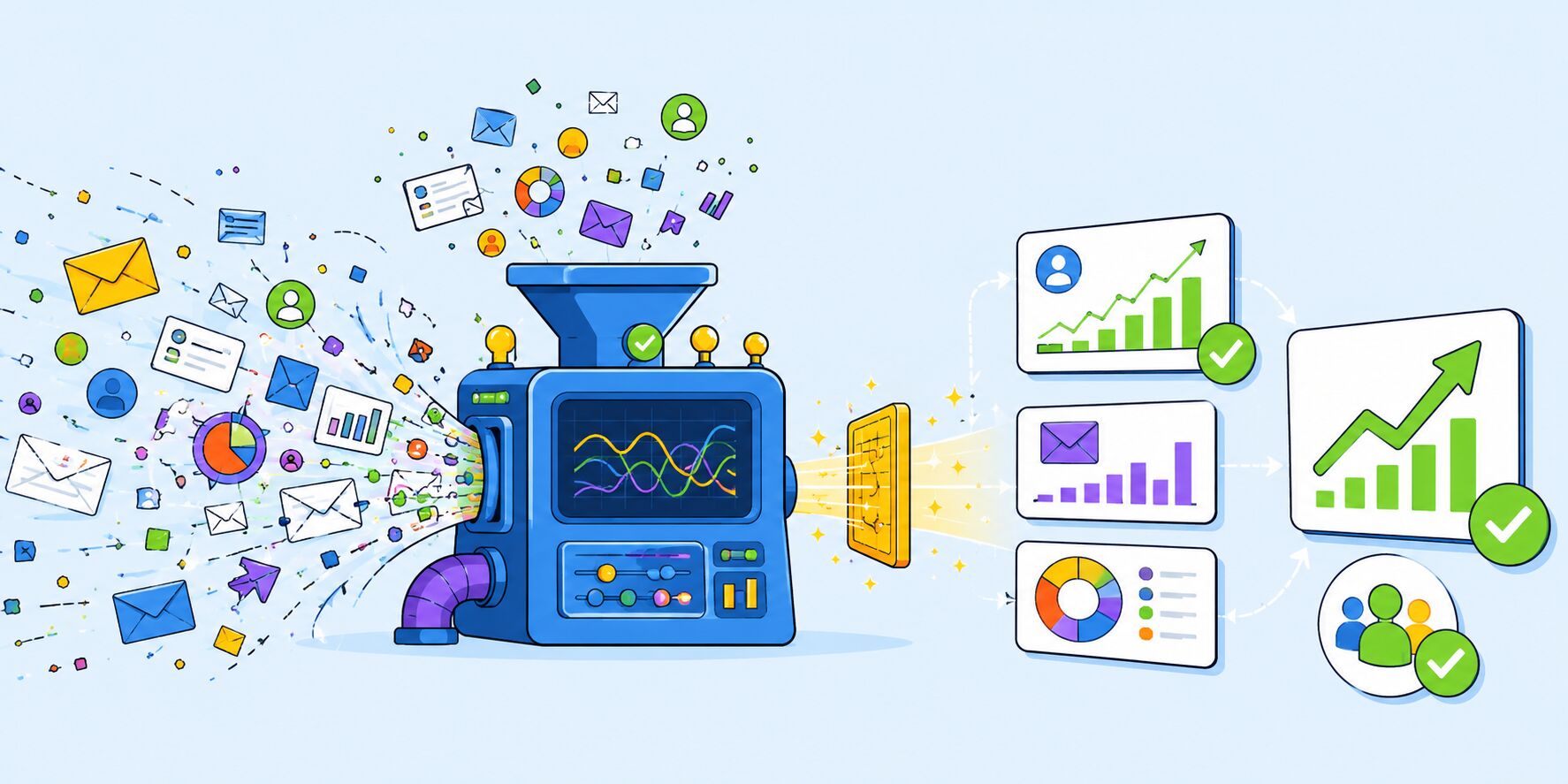
1. The Click-Rate Integrity
Nobody clicks a link by accident, and no privacy filter is going to browse your product page for you. This makes the Click-Through Rate (CTR) the most honest metric in your arsenal.
By analyzing your Click-to-Open Rate (CTOR) alongside your standard CTR, you gain a diagnostic tool that functions like a free consultant.
- High CTR, Low CTOR: Your subject lines are working perfectly, but your internal content isn’t delivering on the promise.
- Low CTR, High CTOR: Your content is strong, but your subject lines are failing to capture interest or are misaligned with the value proposition inside.
By reading these two numbers in tandem, you can isolate exactly which part of your funnel requires intervention, saving you hours of A/B testing guesswork.
2. Revenue Per Email (RPE): The Business Baseline
Engagement metrics are vanity; revenue is sanity. Revenue Per Email (RPE) is the ultimate equalizer. It allows you to compare a high-volume, low-margin promotional campaign against a low-volume, high-converting automated flow.
When you track RPE, you often find that the "clever" campaigns you spent weeks perfecting are outperformed by simple, boring, high-utility transactional emails. For a healthy e-commerce brand, email should account for 20% to 30% of total store revenue. If you are falling short of this benchmark, your email program is currently a secondary channel rather than a primary growth engine.
The Smoke Detectors: Managing List Health
Just as a pilot monitors cabin pressure, a founder must keep a watchful eye on the "smoke detectors" of email marketing: bounce rates, unsubscribe rates, and spam complaints.

- Bounce Rates: A hard bounce signifies an invalid address. If this climbs above 1%, it is a red flag to email service providers that your list acquisition methods are poor.
- Unsubscribe Rates: Contrary to popular belief, a 0% unsubscribe rate is often a warning sign—it usually means your link is hidden, leading frustrated users to mark your emails as "spam" instead of simply opting out. A steady 0.2% to 0.5% is healthy; it represents a natural churn of uninterested leads, leaving you with a higher-quality audience.
- Spam Complaints: This is the metric with teeth. Even a marginal rise in complaints (anything above 0.1%) can trigger filters that send your future emails straight to the junk folder. This is almost always a symptom of frequency fatigue or a lack of relevance.
The Fifteen-Minute Monthly Ritual: A Framework for Decision Making
Data analysis is useless without a corresponding action. To move from passive observation to active strategy, adopt the "Fifteen-Minute Monthly Ritual." Once a month, evaluate your performance through four targeted questions:
- Revenue Attribution: Which campaigns earned the most RPE, and what were the common denominators in their design or copy?
- Engagement Patterns: Which emails had the highest CTOR, and what did they teach us about our audience’s preferences?
- The Trendline: Are our open, click, and unsubscribe rates trending up or down over the quarter?
- Automation Audits: Are our automated flows (welcome, abandoned cart, post-purchase) pulling their weight, or are they stale and ineffective?
The Golden Rule: Change only one thing at a time. Whether it’s rewriting your welcome series copy or adjusting your send frequency for a specific segment, isolation of variables is the only way to know what is actually driving your growth.
Implications for Future Growth
The shift toward data-driven email marketing is not just about cleaning up a spreadsheet; it is about building a scalable asset. Modern platforms, such as Omnisend, have moved beyond simple reporting to provide integrated, real-time revenue attribution. By placing campaign performance and automated flow metrics side-by-side, these tools transform "spreadsheet archaeology" into an actionable roadmap.
As the digital landscape grows more crowded, the ability to nurture a direct relationship with your customers—without relying on the volatile algorithms of social media—will be the defining factor for successful brands.
Final Recommendations for Founders
Your dashboard is not a scoreboard; it is a conversation. It is there to be argued with, tested, and optimized. If you are not using your email data to refine your messaging, you are essentially flying blind.
- Audit your automation: If your automated flows aren’t providing the bulk of your email revenue, prioritize rebuilding them immediately. They are the "always-on" revenue generators that allow your business to grow while you sleep.
- Prioritize list hygiene: Don’t fear the unsubscribe. Fear the inactive, disengaged subscriber who drags down your deliverability and ruins your reputation with inbox providers.
- Leverage technology: Use platforms that offer segment-level insights. Understanding who is responding to your emails is just as important as knowing what they are responding to.
By focusing on high-integrity metrics like RPE and CTOR, and by maintaining a disciplined, iterative approach to your monthly analysis, you stop treating email as a chore. You turn it into a high-leverage growth engine that provides predictable, repeatable, and scalable revenue for your business. Remember: it’s not about how many people open your email—it’s about how many of them move your business forward.
 Laily UPN
  Nana Wu
  Ammar Sabilarrohman