
 By Lina Irawan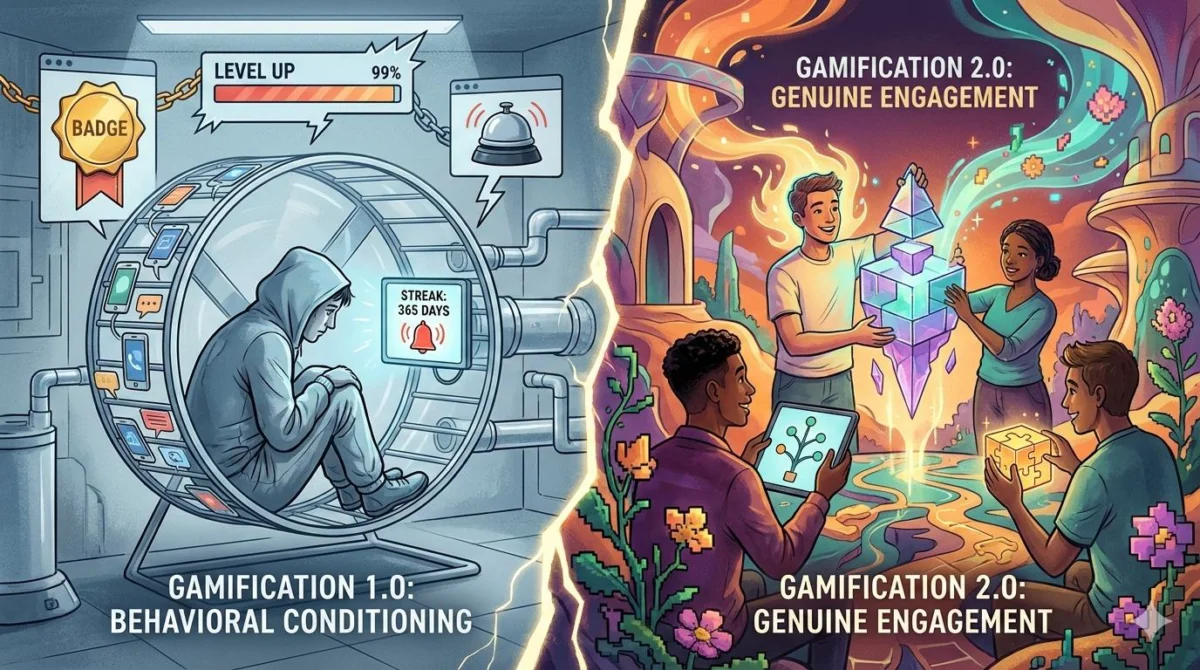
By UX & Interactive Media Desk
Published: May 2026
Main Facts
The modern software landscape suffers from a pervasive epidemic known as the "gamification cargo cult"—a superficial application of game mechanics to non-game products that actual gamers would reject within minutes. From Duolingo’s streak-shaming notifications and LinkedIn’s hollow "All-Star Profile" badges to fitness trackers abandoned in desk drawers after a month of enthusiastic step-counting, the digital ecosystem is littered with platforms that mistake extrinsic psychological triggers for genuine engagement.
Industry veterans argue that this failure stems from a fundamental misunderstanding of what drives human behavior. Rather than being designed by seasoned game developers who understand player psychology, today’s gamification features are typically built by growth teams, product managers, and UX designers blindly following superficial blog posts and checklist-driven design trends.
The core issue lies in the over-reliance on extrinsic rewards—points, badges, leaderboards, and streak counters—which treat users like laboratory rats rather than autonomous agents. True gamification, experts argue, must pivot toward intrinsic motivation, mirroring the deep, enduring engagement found in critically acclaimed video games rather than relying on short-lived behavioral tricks designed strictly to boost short-term metrics.
Chronology: The Evolution and Stagnation of Digital Play
To understand how the software industry arrived at this junction, it is necessary to trace the trajectory of gamification from its academic roots to its current corporate incarnation:
- The Early 2000s (The Academic Awakening): Long before "gamification" became a corporate buzzword, cognitive psychologists and early human-computer interaction (HCI) researchers began studying how video game design principles could encourage positive real-world behaviors, such as learning or physical rehabilitation.
- 2010–2014 (The Rise of the Buzzword): Coined formally around 2010 by consultants and tech evangelists, gamification rapidly transitioned from a design philosophy into a marketing mandate. Startups and legacy enterprises alike scrambled to bolt leaderboards and point systems onto enterprise software, educational apps, and productivity tools.
- 2015–2020 (The Metrics Trap): As growth hacking dominated Silicon Valley culture, product metrics (Daily Active Users, session lengths, retention curves) superseded user experience. Gamification was co-opted entirely by growth teams. Mechanics were no longer designed to make tasks enjoyable; they were weaponized to maximize data collection and ad impressions.
- 2021–2025 (The Fatigue Era): Users began experiencing severe pushback against digital manipulation. Notification fatigue, anxiety-inducing streak maintenance, and meaningless virtual rewards led to widespread consumer skepticism. Apps that relied solely on superficial hooks saw massive initial spikes followed by rapid abandonment curves.
- 2026 and Beyond (The Reckoning and Gamification 2.0): Industry veterans begin publicly challenging the "cargo cult" mentality. A growing movement calls for a total structural overhaul—moving away from the shallow "Fiverr-gig" model of points and badges and returning to the foundational psychology of true play.
Supporting Data & Industry Analysis
The superficial implementation of game mechanics is not just an aesthetic annoyance; it is a measurable failure of product design. Data compiled across consumer apps, enterprise software, and edtech platforms reveal stark patterns regarding user retention and psychological burnout.
The Retention Mirage
- The 30-Day Cliff: Consumer apps utilizing aggressive streak mechanics frequently report high initial spikes in 7-day retention. However, historical data across fitness and language-learning apps shows that over 60% of users abandon these platforms entirely within 30 to 45 days once the novelty of extrinsic rewards wears off.
- System Gaming: When products rely solely on compliance-driven rewards (e.g., points for logging in or clicking through screens), users predictably optimize for the reward rather than the underlying value. Analytics consistently show "phantom engagement"—users clicking through lessons or articles without consuming the content simply to preserve a streak or earn a badge.
The Contrast: Extrinsic vs. Intrinsic Value
Market comparisons between superficial app mechanics and complex interactive media highlight the vast gulf between compliance and true engagement:
| Metric / Dimension | "Cargo Cult" Gamification Apps | Deep Interactive Media (True Games) |
| : മറ്റൊരു (Metric) | :— | :— |
| Primary Driver | Extrinsic (Points, streaks, guilt, badges) | Intrinsic (Mastery, autonomy, social connection, curiosity) |
| User State | Compliant laboratory rat | Autonomous player |
| Long-Term Engagement | Steep drop-off once novelty fades | Hundreds of hours of voluntary immersion (e.g., Elden Ring, Wordle) |
| Design Origin | Growth hacking checklists, product management templates | Decades of iterative play-testing and psychological research |
Official Responses and Expert Perspectives
The critique of modern gamification has galvanized veteran game developers who have spent decades analyzing why human beings voluntarily spend thousands of hours mastering complex virtual environments.
Industry pioneers point out the absurdity of current corporate approaches. As one veteran designer who programmed John Madden Football in 1991 and produced Street Fighter at Capcom notes:
"Here’s the uncomfortable truth these apps share: They were ‘gamified’ by people who have never shipped a game. Growth teams. Product managers. UX designers, following best practices from a blog post. Well-meaning professionals who think gamification is a checklist of mechanics you copy from successful apps."
The benchmark for true gamification is starkly simple, according to veteran developers:
"The tell is simple: if your ‘gamification’ could be spec’d out in a single Fiverr gig—’Add points, badges, and a leaderboard to my app’—it’s not gamification. It’s a cargo cult. You’ve built the bamboo control tower and the coconut headphones, but no planes are landing."
UX researchers and behavioral psychologists have increasingly echoed these sentiments, warning product teams that fear-based retention tactics—such as threatening users with the destruction of a virtual streak—create chronic stress rather than positive habit formation. Users ultimately develop an adversarial relationship with software that attempts to manipulate their emotions via artificial guilt trips.
Implications for the Future of Product Design
The collapse of the "cargo cult" approach to gamification carries profound implications for software architects, product designers, and enterprise leaders heading into the latter half of the decade.
1. The Death of the Checklist UX
Product teams can no longer rely on cookie-cutter templates to manufacture engagement. Simply injecting a leveling system or a progress bar into a boring workflow will no longer suffice to trick users into staying. Consumers have become sophisticated enough to recognize manipulative design patterns and will migrate toward tools that respect their time and intelligence.
2. The Rise of Gamification 2.0
The next generation of interactive product design requires a fundamental shift in philosophy. Designers must stop asking, "How do we trick the user into clicking this button again tomorrow?" and start asking, "How do we make the core experience intrinsically satisfying?"
- Focus on Mastery: Providing clear paths for skill development rather than arbitrary status symbols.
- Fostering Autonomy: Allowing users to shape their own journey rather than forcing them down linear, reward-conditioned funnels.
- Meaningful Challenge: Offering genuine problems to solve rather than hollow tasks designed solely to pad daily active user (DAU) reports.
3. Ethical Re-evaluation of Behavioral Design
As regulatory scrutiny increases regarding dark patterns and manipulative digital design, companies that rely on psychological coercion—such as artificial streak guilt and predatory notification loops—will face mounting public backlash. Designing for intrinsic satisfaction is not only a superior retention strategy; it is a necessary step toward building a sustainable, ethical digital ecosystem.
Up next in the "Gamification" series: Gamification 2.0. Beyond Points and Badges: Designing for Players, Not Metrics. Chapter 2: The Solution. Stay tuned for deep dives into how product teams can reconstruct their interfaces around genuine human motivation.
 Nana Wu
  Basiran
  Nana
Nana 