
 By Basiran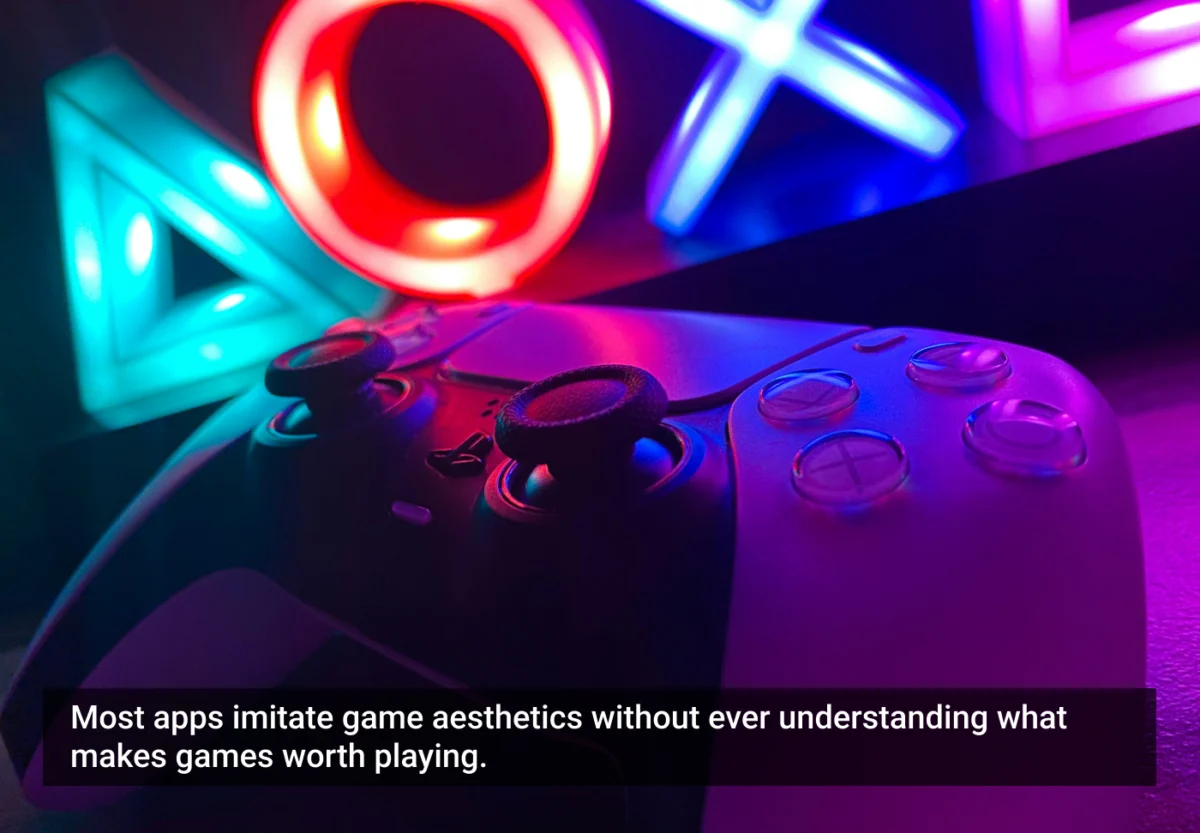
By: Industry Analysis Desk
Published: October 2023
Featured Image Courtesy: Cash Macanaya (Unsplash)
Main Facts: The Crisis of Meaningless Metrics
For over a decade, the digital product landscape has suffered from a collective delusion. Companies across every conceivable sector—from financial technology and health tracking to corporate productivity and online education—have slapped superficial game mechanics onto software and called it "gamification."
The playbook has been remarkably uniform: award a digital badge for completing a profile, hand out arbitrary points for basic interactions, construct superficial leaderboards comparing strangers, and deploy a progress bar that ticks upward whenever a user performs a routine task.
Yet, industry veterans and veteran game designers are pushing back. The consensus is clear: traditional gamification is broken. Users see through the illusion immediately. When an application tells a user, "You completed five tasks! You are now Level 3!" it triggers an immediate psychological disconnect. The critical questions consumers ask are simple yet devastating: What skill did I develop? What can I do now that I couldn’t do before?
If the progression is merely a number going up without any parallel development in human capability, it is not progression. It is a progress bar.
Enter Gamification 2.0—a paradigm shift that moves away from psychological manipulation and behavioral Skinner-boxes, replacing them with the actual foundational design principles drawn from four decades of successful video game development.
Chronology: The Evolution from Reward Mechanics to True Engagement
To understand where digital design is heading, it is vital to trace how the industry arrived at the current impasse:
- The Early 2010s (The Rise of Gamification 1.0): Spurred by the early commercial success of location-based check-in apps and behavioral psychology theories, tech companies rushed to adopt extrinsic reward systems. Points, badges, and leaderboards (often dubbed "PBLs") became the default prescription for user retention.
- The Mid-2010s (The Engagement Plateau): Initial novelty wore off. While metrics spiked temporarily during onboarding, long-term retention failed to improve meaningfully. Users quickly grew cynical about digital trophies that held no real-world value or functional utility.
- The Late 2010s (The Reckoning in EdTech and Productivity): Consumer fatigue set in. Applications that relied heavily on superficial streaks faced intense scrutiny as users realized that maintaining a digital streak did not necessarily equate to mastering a subject or completing meaningful work.
- The Present Day (The Birth of Gamification 2.0): Drawing on lessons from legendary franchises—ranging from Guitar Hero and Civilization to Dark Souls and World of Warcraft—product designers are realizing that true engagement cannot be grafted onto a flawed core product. It must be baked into the architectural foundation of the user experience.
Supporting Data: Why Real Game Mechanics Drive Retention
While traditional gamification treats engagement as an extrinsic transaction (do X, get Y reward), actual video games treat engagement as an intrinsic journey of competence and autonomy. Consider the comparative metrics of design philosophy:
- Extrinsic Motivation Decay: Studies in behavioral psychology consistently show that external rewards (such as points and digital badges) experience severe diminishing returns. Once the novelty fades, or if the reward is removed, user engagement plummets.
- Intrinsic Motivation Sustainability: Games that rely on mastery, agency, and social interdependence maintain active user bases for years, sometimes decades. World of Warcraft and Civilization, for instance, command thousands of hours of voluntary user engagement without relying on superficial push notifications or transactional points.
- The Cost of Bad UX: Data across consumer apps indicates that front-loaded tutorials and forced onboarding drop-off rates exceed 60% when they substitute instruction for discovery. Conversely, open-world design philosophies that encourage exploration boast significantly higher initial retention.
Core Principles of Real Game Engagement
To successfully transition to Gamification 2.0, designers must look past the superficial veneer of video games and examine the psychological and mechanical engines that make them work.
1. Mastery and Progression (Real, Not Fake)
In Guitar Hero, players are not awarded points simply for pressing buttons. The game demonstrates—visibly and undeniably—that the user is getting better at a genuine skill. In week one, a player may fail miserably on Easy mode. By week four, they are executing complex tracks on Hard. That is not an arbitrary level-up; that is measurable competence development.
Compare this to software apps that throw empty accolades at users. Real progression means users can tangibly execute tasks they previously found impossible. Duolingo succeeds brilliantly when a user suddenly realizes they can independently read a Spanish restaurant menu. It stumbles, however, when it obsessively celebrates a "7-day streak" while the user remains incapable of holding a basic conversational exchange.
2. Agency and Meaningful Choice
In strategic epics like Civilization, every single decision carries profound weight. Should a player research sailing or mathematics first? Do they prioritize a military unit or an economic granary? These choices shape the trajectory of the entire playthrough. Players agonize over them because their decisions matter.
Most "gamified" apps offer the illusion of agency through trivialities: "Pick your avatar color!" or "Choose your notification sound!" These are not meaningful decisions; they are decorative theater. Real agency means user choices create genuinely divergent outcomes. When Spotify offers a choice between "Discover Weekly" and "Release Radar," it provides real agency because distinct choices yield completely different musical journeys.
3. Challenge and Flow
Mihaly Csikszentmihalyi’s psychological concept of "flow"—the state of complete absorption in an optimally challenging activity—is the holy grail of game design. If a task is too easy, users experience boredom. If it is too difficult without adequate support, they experience frustration. The sweet spot lives precisely where challenge meets growing competence.
Dark Souls mastered this balance with legendary precision. The game is notoriously difficult, but it is fundamentally fair. When a player dies—and they will die constantly—they understand it was a result of their own tactical error. They learn, adapt, and try again. Difficulty scales organically as user skill grows.
Conversely, bad software gamification fails to create flow because it introduces artificial friction instead of genuine challenge. Forcing users to click through five redundant screens to complete a routine administrative task is not a challenge; it is poor user experience masked by a progress bar.
4. Curiosity and Discovery
The Legend of Zelda: Breath of the Wild drops players into an immense open world with a simple directive: go explore. Almost everything visible can be reached, and almost every creative physical strategy the player attempts is supported by the game engine. Exploration is its own primary reward.
Contrast this with the standard enterprise software onboarding process, which subjects users to a tedious, ten-minute tutorial explaining every feature upfront—forcing impatient users to frantically click "Skip." This completely eradicates curiosity. There is nothing left to uncover because the developers front-loaded all the information.
Great gamification reveals depth gradually, allowing users to stumble upon advanced features naturally and rewarding genuine exploration.
5. Identity and Self-Expression
In role-playing masterpieces like Mass Effect, players do not merely control Commander Shepard; they define who Shepard is through moral frameworks (Paragon or Renegade), political alliances, and personal relationships. Players feel profound ownership over their unique version of Shepard because their decisions shape a digital identity.
Generic software gamification attempts to mimic this by declaring, "You’re Level 12!"—an achievement shared identically by thousands of other users who signed up around the same time. That is not identity; it is a participation trophy.
Real identity empowers users to see their own unique workflows reflected in the software. Notion and Obsidian succeed because users build personal knowledge bases and systems that mirror their individual cognitive styles. These applications do not assign an identity; they provide a canvas for self-expression.
6. Social Dynamics That Actually Work
Guild mechanics in World of Warcraft sustained active player communities for years through structural interdependence. A 40-person raid required specialized tanks, healers, and damage dealers working in synchronized harmony. Participants logged in not for automated daily login bribes, but because 39 other real human beings were depending on them.
Most app-based "social features," by contrast, are nothing more than isolated leaderboards pitting users against nameless strangers for stakes that hold no real-world value. That is not a community; it is a comparative metric disguised as socialization. True social features foster genuine human accountability—workout buddies who check in, study groups tackling hard problems, and collaborative teams driving toward shared goals.
Official Responses and Industry Reception
As the digital product sector absorbs these critiques, reactions from product leaders and UX designers have been mixed yet increasingly receptive.
Forward-thinking product executives note that the era of cheap engagement tricks is coming to a close. "Users are developing a high tolerance for manipulation," notes a lead UX architect at a major enterprise software firm. "When you hand out badges for logging in, you insult the user’s intelligence. Gamification 2.0 forces us to look past cheap dopamine hits and build software that genuinely helps people grow, create, and connect."
However, traditional marketing departments remain hesitant, citing the immediate, short-term metric spikes that simple points-and-badges systems reliably produce during quarterly reviews. The friction between short-term metric acquisition and long-term product loyalty remains the central battleground of modern product strategy.
Implications: The Future of Digital Product Design
The pivot toward Gamification 2.0 carries profound implications for software development, education, corporate training, and consumer apps alike:
- A Shift in Metrics: Companies will need to move away from vanity metrics—such as daily active logins driven by push notifications—and focus on deep engagement metrics, skill acquisition rates, and long-term retention.
- Redefining Success in EdTech: Educational software will face heightened demands to prove genuine comprehension and conversational fluency rather than rewarding users for maintaining arbitrary multi-week application streaks.
- Elevating UX and Game Design Synergy: Product teams will increasingly recruit seasoned game designers not to "add gamification," but to consult on core architectural systems, flow states, and intrinsic motivation loops from day one of the product lifecycle.
Ultimately, the foundational principles of great games are not optional decoration. They are the structural laws that make interactive experiences compelling, voluntary, and deeply satisfying for thousands of hours.
Gamification without these principles is nothing more than a glorified progress bar. And as decades of digital design history have proven, modern users see straight through progress bars immediately.
The definitive question facing product creators in the era of Gamification 2.0 is stark: Are you willing to design your application like an actual game, or are you going to keep adding badges to a broken experience?
Up next in the "Gamification" series: Gamification 2.0. Beyond Points and Badges: Designing for Players, Not Metrics. Chapter 3: The Framework.
 Nana
Nana  Ali Ikhwan
  Lina Irawan